Ro Khanna, the Indian-American congressman representing California’s Silicon Valley, has built his profile around economic fairness, domestic manufacturing and technology leadership
His proposals include a Data Center Bill of Rights addressing local communities’ concerns and the Illegal War Refund Act, which seeks to compensate taxpayers for costs attributed to the Iran war; neither proposal is an enacted law
His political agenda combines competition with China and stronger US manufacturing with calls for diplomacy, congressional oversight of military action and closer US-India ties
Who Is Ro Khanna? The Indian-American Congressman Shaping US Progressive Politics
The son of Indian immigrants and grandson of a freedom fighter, Ro Khanna has built his congressional profile around manufacturing, economic inequality, technology and diplomacy. As he seeks re-election in November, his record reflects the progressive debate over how America should balance economic growth, corporate power and global influence.

Summary
Ro Khanna enters the final stretch before the November 3 US midterm elections with two prominent roles in the Democratic Party: representing California’s Silicon Valley in Congress and leading Democrats on the House Select Committee on Strategic Competition between the United States and the Chinese Communist Party. He is also a vice chair of the Congressional Progressive Caucus.
His recent proposals range from the Illegal War Refund Act, which would compensate taxpayers for the economic costs of the Iran war, to a Data Center Bill of Rights addressing the impact of artificial intelligence infrastructure on local communities. In August, he also introduced the Epstein Files Transparency Act II with Republican Congressman Thomas Massie, seeking stronger legal means to enforce the disclosure of records related to Jeffrey Epstein. All three are legislative proposals, not enacted laws.
Together, these initiatives illustrate the issues shaping Khanna’s political identity: who benefits from technological growth, how economic costs are distributed and how much authority the executive branch should exercise without congressional scrutiny. His national profile also reflects an effort to connect Silicon Valley’s technological and financial power with the concerns of workers and communities outside America’s wealthiest centres.
How Did His Family History Shape Him?
Khanna was born in Philadelphia in 1976 to parents who emigrated from India to the United States during the 1970s. His father worked as a chemical engineer and his mother was a substitute teacher.
His grandfather, Amarnath Vidyalankar, participated in India’s independence movement. In a 2019 reflection marking Mahatma Gandhi’s 150th birth anniversary, Khanna wrote about his grandfather’s involvement in the freedom struggle, his work with Lala Lajpat Rai and the four years he spent in prison.
Khanna has described conversations with his grandfather as an important influence on his understanding of public service. Gandhi’s emphasis on pluralism, non-violence and respect for different faiths forms part of the legacy Khanna has discussed publicly.
That family history is relevant to how he presents his political identity, but it does not explain his positions on every issue. His views on manufacturing, technology regulation, military intervention and US–India relations are also grounded in his congressional work and stated policy priorities.
Advertisement
Khanna’s Indian heritage has given him a personal connection to debates about the relationship between the United States and India. His political career, however, has largely centred on domestic economic questions and America’s role in a changing international order.
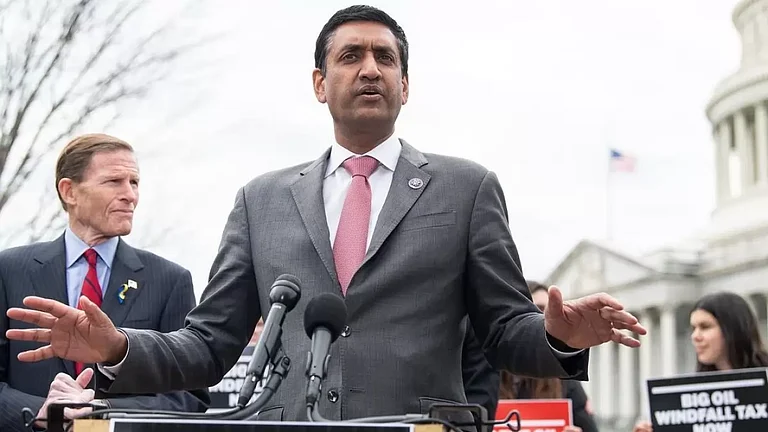
How Did He Move From Academia To Congress?
Khanna studied economics at the University of Chicago and earned a law degree from Yale University. He subsequently taught economics at Stanford University and served as deputy assistant secretary of commerce in the Obama administration.
His move into electoral politics was not immediate. Khanna challenged Democratic Congressman Mike Honda in California’s 17th Congressional District in 2014 but lost. He ran again in 2016 and won, entering the House of Representatives in January 2017.
Representing the 17th district placed him in the heart of Silicon Valley, home to major technology companies and a large concentration of highly paid workers. The constituency gave him direct exposure to the benefits of technological innovation, but also to debates over housing costs, economic inequality, labour conditions and the concentration of corporate power.
Advertisement
Khanna has since served multiple terms in Congress. His appointment as the leading Democrat on the House Select Committee on China in January 2026 expanded his responsibilities beyond domestic economic policy to include technology competition, critical minerals, trade and national security.
The combination of his constituency and committee role helps explain why he frequently links domestic manufacturing to America’s strategic competition with China.
What Does His Progressive Politics Stand For?
Khanna’s economic agenda centres on the argument that growth driven by technology and innovation should translate into broader economic opportunity. He supports higher wages, affordable childcare, paid family leave, expanded access to healthcare and education, and stronger labour protections.
His position is not that technological development should be restrained across the board. Instead, he argues that government should help distribute its gains by investing in workers, training and communities beyond major technology hubs.
His office has advocated expanded access to public college and vocational education, alongside programmes that prepare workers for emerging industries. He has also supported efforts to strengthen the social safety net and reduce barriers to economic participation.
Advertisement
These priorities place him within the Democratic Party’s progressive wing, but his approach also relies on private-sector investment and technological innovation. That creates a central tension in his economic programme: how to encourage industries capable of generating high-value jobs while preventing their gains from remaining concentrated among shareholders, executives and highly paid professionals.
Khanna’s proposals seek to address that tension through public investment, labour protections and a stronger role for government in determining how economic growth benefits society. Their effectiveness, however, depends on legislative support and implementation beyond his own proposals.
Why Does He Want To Bring Manufacturing Back?
Khanna’s economic programme places domestic manufacturing at the centre of American competitiveness. He uses the term “economic patriotism” to describe an approach that combines industrial investment, worker training and technological innovation with an effort to reduce dependence on overseas supply chains.
Advertisement
His work on the Endless Frontier Act helped advance the legislative push that contributed to the CHIPS and Science Act, which provided support for US semiconductor production and scientific research. Khanna has presented such investment as a way to create well-paid manufacturing jobs and revitalise communities that lost employment as production moved overseas.
For him, manufacturing is also a national security issue. Dependence on China for critical minerals, rare-earth materials and other strategic inputs can create vulnerabilities in supply chains essential to technology and defence.
His role on the House Select Committee on China reflects this approach. The committee’s Democratic leadership has advocated stronger US manufacturing, reduced dependence on Chinese supply chains and investment in the processing of critical minerals.
Khanna’s position combines competition with China and support for American technological leadership. He has backed military deterrence and efforts to address the US trade deficit, while also arguing that international cooperation remains necessary in areas such as artificial intelligence safety.
This distinguishes his approach from a simple argument for either free trade or economic protectionism. He wants the United States to remain technologically competitive while ensuring that industrial policy produces jobs and economic benefits across a wider part of the country.
Can Silicon Valley’s Wealth Be Shared More Widely?
Khanna’s technology policy reflects the district he represents. Silicon Valley is central to American innovation, but the expansion of data centres and artificial intelligence has also raised questions about electricity demand, water use, pollution and the impact on nearby communities.
On August 6, 2026, Khanna introduced a Data Center Bill of Rights, a resolution calling for greater local control over the construction and operation of AI data centres. Among its proposals is a prohibition on data centres in residential areas and within 2,500 feet of homes, schools, childcare facilities, hospitals and nursing homes.
The proposal seeks to make communities part of decisions about infrastructure built to support the technology industry. It reflects Khanna’s broader argument that the costs of technological expansion should not be imposed on residents while the financial gains accrue elsewhere. The resolution remains a proposal, not an enacted restriction.
His Creator Bill of Rights, introduced in January, addresses another part of the digital economy: the treatment of online creators and platform workers. It focuses on protecting their economic interests as businesses increasingly rely on digital platforms.
Khanna has also proposed greater international cooperation on AI safety. In a September letter to Secretary of State Marco Rubio, he outlined an alternative approach to US-China cooperation that included a binding agreement and international inspections.
These initiatives illustrate the balancing act in his technology agenda. He supports American leadership in AI and innovation but argues that growth must be accompanied by safeguards for workers, consumers and communities.
What Is His Approach To US Foreign Policy?
Khanna’s foreign policy emphasises diplomacy, congressional oversight and restraint in the use of military force. He opposed the 2003 invasion of Iraq and has criticised broad authorisations of military force that allow presidents to undertake military action without sufficient congressional scrutiny.
His September 2026 Illegal War Refund Act is a recent example. Introduced in the House as H.R. 10498, the bill would require the federal government to calculate the economic costs of the Iran war to American taxpayers and their dependants, then fund payments intended to compensate them. Khanna has described the conflict as an illegal and unauthorised war. The bill was referred to the House committees on Ways and Means and Appropriations; it has not become law.
His emphasis on restraint does not mean he rejects strategic competition. As the senior Democrat on the China committee, he supports military deterrence, domestic industrial investment and reducing American dependence on Chinese materials and manufacturing.
On Israel and Palestine, Khanna led a September 2025 congressional letter calling on the US government to recognise a Palestinian state. The initiative reflected his stated support for diplomacy and Palestinian self-determination.
His positions therefore combine scepticism towards military intervention without sufficient congressional authority with support for a strong US industrial and defence base. He seeks to distinguish strategic competition from the assumption that every international dispute should be addressed through military force.
How Does His Indian Heritage Shape US–India Relations?
Khanna has supported closer US–India relations through his work in Congress. During the 118th Congress, he chaired the bipartisan Congressional Caucus on India and Indian Americans and co-led a congressional delegation to India in August 2023 with Republican Michael Waltz.
In 2022, Khanna also helped advance a bipartisan amendment intended to strengthen the US–India defence partnership. His work on the India caucus and defence cooperation has reflected support for closer strategic ties between the two countries.
His engagement with India sits alongside his stated commitment to pluralism and human rights. In his writing on Gandhi, Khanna has emphasised the importance of respecting different faiths and building a political culture that accommodates religious diversity.
Those positions illustrate why his Indian ancestry should not be treated as a proxy for his views on the Indian government. His approach to the bilateral relationship is better assessed through his legislative record, public statements and diplomatic engagements.
Khanna’s record points to support for greater defence cooperation and a stronger strategic relationship, alongside principles he says should guide public life in both countries. His heritage informs his personal identity, while his positions on India and the United States remain part of a wider political programme.

What Does His Political Trajectory Tell Us?
Khanna’s political profile brings together three priorities that do not always sit comfortably alongside one another: progressive economic policy, the interests of a technology-intensive constituency and a foreign policy that combines strategic competition with diplomacy.
His manufacturing agenda seeks to spread the benefits of technological growth beyond Silicon Valley. His technology proposals address the distribution of costs as AI infrastructure expands, while his foreign policy places greater emphasis on congressional oversight and the limits of military intervention.
His current role on the China committee adds another dimension. He advocates reducing dependence on Chinese supply chains while maintaining that some areas, such as AI safety, require international engagement. His US–India work similarly combines support for closer strategic ties with a public identity shaped by pluralism and the legacy of India’s independence movement.
As Khanna seeks re-election, his record offers a picture of the arguments over the Democratic Party’s economic and foreign policy direction. His significance lies in the attempt to connect American industrial and technological power with economic fairness at home and diplomatic engagement abroad.
Published At: