1,307 Ebola cases, 307 deaths amid conflict in eastern Congo
Nearly 28 million face acute hunger as violence disrupts farming
Defence spending tripled to 3.4% GDP; revenue lost 0.5% GDP
Insecurity blocks aid access; humanitarian appeals remain underfunded
Outlook Explains | How Conflict Is Fueling Hunger, Displacement And Ebola In Congo
Conflict, displacement, hunger and a growing Ebola outbreak are deepening one of the world's largest humanitarian emergencies. As violence persists in the east, aid agencies warn that millions remain beyond the reach of lifesaving assistance

Summary
The Democratic Republic of the Congo is confronting multiple emergencies at once. Years of armed violence in the country's eastern provinces have driven millions from their homes, disrupted livelihoods and overwhelmed already fragile public services.
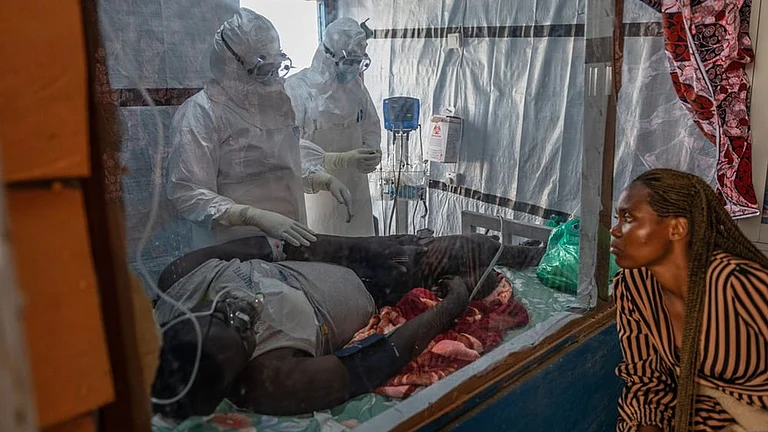
As humanitarian needs continue to rise, the country is also battling a rapidly expanding outbreak of Bundibugyo Ebola virus disease, placing additional pressure on a health system already stretched by conflict and displacement.
According to the latest United Nations (UN) updates, humanitarian conditions have continued to deteriorate across eastern Congo, where fighting, repeated displacement and restricted humanitarian access have left communities increasingly vulnerable. The UN has warned that civilians continue to bear the brunt of attacks while insecurity hampers the delivery of aid.
The Price Paid For Conflict
The humanitarian emergency is rooted in persistent violence across eastern Democratic Republic of the Congo.
According to the Office of the UN High Commissioner for Human Rights, armed groups continue to commit widespread abuses against civilians, including killings, conflict-related sexual violence, forced recruitment and attacks on civilian infrastructure.
The Human Rights Council was told that violations of international humanitarian law and human rights continue to be documented despite ongoing regional peace efforts.
Human Rights Watch in its World Report 2026, said the conflict intensified during 2025, particularly in North Kivu and Ituri provinces, where clashes involving the M23 armed group, the Allied Democratic Forces (ADF), CODECO militia and other armed actors forced communities to flee repeatedly while exposing civilians to violence and insecurity.
The humanitarian consequences have continued to spread well beyond the frontlines.
The Displacement Crisis
The Norwegian Refugee Council (NRC) has once again ranked the Democratic Republic of the Congo among the world's most neglected displacement crises, marking the tenth consecutive year the country has appeared on its annual list.
Repeated waves of violence have displaced families multiple times, often leaving them without shelter, healthcare or reliable access to food. According to the NRC, humanitarian operations remain constrained by insecurity and chronic funding shortfalls, limiting assistance to some of the country's most vulnerable communities.
Advertisement
The United Nations has echoed those concerns, warning that insecurity continues to obstruct humanitarian access in several affected provinces, leaving many communities beyond the reach of aid despite rapidly growing needs.
As Hunger Deepens
Conflict has also become a major driver of food insecurity.
According to the Integrated Food Security Phase Classification (IPC), nearly 28 million people are projected to experience high levels of acute food insecurity during 2026, with conflict, repeated displacement, economic disruption and climate shocks continuing to undermine agricultural production and household incomes.
The World Food Programme (WFP) describes the Democratic Republic of the Congo as one of the world's largest hunger crises, with millions requiring emergency food assistance. The agency warns that continued fighting has disrupted farming, displaced rural communities and made it increasingly difficult for humanitarian organisations to reach populations most in need.
The situation has become particularly severe in the eastern provinces, where families displaced by violence often arrive in overcrowded sites with limited access to food, clean water and healthcare.
Advertisement
The funding gap has compounded the crisis.
According to the UN Office for the Coordination of Humanitarian Affairs' Financial Tracking Service, humanitarian appeals for the Democratic Republic of the Congo remain significantly underfunded, forcing aid agencies to prioritise only the most urgent needs despite rising displacement and worsening food insecurity.
As the humanitarian situation deteriorates, another emergency has unfolded across the same conflict-affected region.

The Ebola Outbreak
The World Health Organization (WHO) says the Congo remains at the centre of the ongoing Bundibugyo Ebola virus disease outbreak, with transmission continuing to expand across eastern provinces.
According to the latest update issued by Congolese health authorities on Monday, the country has recorded 1,307 confirmed cases, including 377 deaths, across Ituri, North Kivu and South Kivu provinces. Ituri alone accounted for more than 91% of confirmed infections. The reported fatality rate is likely to underestimate the true toll because deaths occurring before the outbreak was officially declared remain under investigation.
Advertisement
The outbreak is unfolding in an exceptionally challenging environment, where insecurity around health facilities, population movements and restricted humanitarian access continue to complicate surveillance, testing and response efforts. The organisation added that response efforts increasingly depend on local leaders and community engagement as insecurity limits access for health workers.
Efforts to Control the Outbreak
Health authorities have sought to prevent the outbreak from spreading further through surveillance, contact tracing, laboratory testing and ring vaccination, but the response continues to be shaped by the realities of conflict.
According to WHO, response teams have vaccinated thousands of frontline workers and contacts while strengthening infection prevention and control measures in health facilities. Cross-border surveillance has also been reinforced given the movement of people between affected provinces and neighbouring countries.
Despite these measures, WHO warned that insecurity, population displacement and community mistrust remain among the biggest obstacles to containing transmission. The organisation assessed the national public health risk as high, citing the geographical spread of cases, insecurity affecting response operations and the continued movement of displaced populations. While the regional risk was assessed as moderate and the global risk as low, WHO stressed that sustained surveillance and international support remain essential to preventing further spread.
Advertisement
The United Nations has also warned that the outbreak is unfolding against the backdrop of one of the world's most complex humanitarian emergencies, where conflict continues to disrupt routine healthcare, disease surveillance and emergency response capacity.
Economy and Instability
The conflict has also imposed growing economic costs.
According to the World Bank's Congo Economic Update, persistent insecurity in North and South Kivu disrupted revenue collection, reduced economic activity and contributed to an estimated revenue loss of 0.5% of GDP during 2025. Temporary tax exemptions introduced to cushion households from rising living costs further reduced government revenues by around 0.3% of GDP.
At the same time, government spending shifted sharply towards security. Defence expenditure tripled year-on-year to 3.4% of GDP as authorities responded to escalating violence, while salaries for military and police personnel were increased to strengthen security forces.
The expansion in defence spending coincided with higher expenditure on health and education, even as the government introduced spending cuts elsewhere to maintain fiscal discipline.
The World Bank noted that despite these pressures, the country's debt remains sustainable, although it remains vulnerable to fluctuations in copper and cobalt prices that underpin much of the Congolese economy. It also warned that insecurity continues to weigh on investor confidence and public finances, particularly in the eastern provinces where much of the fighting is concentrated.
A Growing Emergency
The humanitarian outlook continues to worsen.
According to the United Nations Office for the Coordination of Humanitarian Affairs' Financial Tracking Service, the humanitarian response for the Congo remains significantly underfunded despite rising needs across protection, food security, health and emergency shelter.
Addressing the Human Rights Council in June, UN High Commissioner for Human Rights Volker Türk said civilians continued to pay "the highest price" as violence, displacement and grave human rights violations persisted across eastern part of the country.
He called for greater protection of civilians and accountability for violations of international human rights and humanitarian law.
The latest UN humanitarian update also warned that continued fighting has further restricted humanitarian access, disrupted essential services and increased protection risks for women, children and displaced communities. Aid agencies have repeatedly stressed that insecurity remains one of the principal barriers to delivering assistance in affected areas.
An Interconnected Crisis
Congo's humanitarian emergency extends far beyond a single conflict or disease outbreak.
Armed violence has displaced millions, disrupted food production and weakened public services, while humanitarian agencies struggle to reach communities cut off by insecurity.
At the same time, the Ebola outbreak has added fresh pressure to an already overstretched health system, forcing authorities to respond to multiple emergencies simultaneously.
WHO continues to monitor the outbreak as surveillance and vaccination efforts expand in affected provinces. Meanwhile, humanitarian agencies warn that without improved access and sustained funding, conflict, hunger, displacement and disease are likely to remain interconnected challenges for millions of people across the Congo.
Published At: