Reporters Without Borders last month ranked India 157th out of 180 countries in its Press Freedom Index, down from 151st place the previous year. Norway, meanwhile, has held the top position in the rankings for the past decade.
‘Maybe It Was A Tough Question For PM Modi’: Helle Lyng Speaks About The Backlash To Her Modi Question
In an interview to Outlook, Helle Lyng says though she felt she was unfairly targeted by a section of Indian media, she is grateful that the question she posed to the Prime Minister spiralled into a viral debate in India and beyond

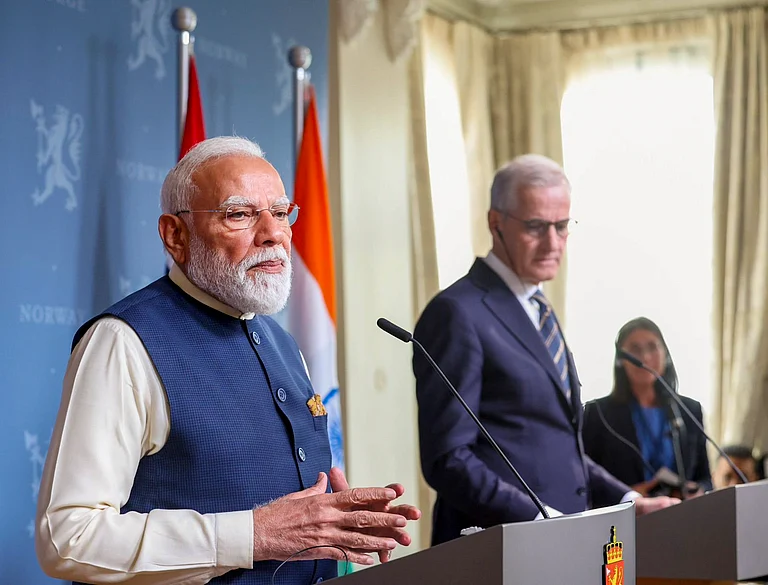
However, the report drew renewed attention when Helle Lyng, a Norwegian journalist with the local-newspaper Dagsavisen, put a question on the issue to India’s Prime Minister Narendra Modi on May 18.
The PM was on a five-nation tour, and while he concluded the joint statements along with Norwegian Prime Minister Jonas Gahr Støre, Lyng’s voice rang in the room.
“Prime Minister Modi, why don't you take some questions from the freest press in the world?”
It was a question that lasted only a few seconds, but it quickly travelled far beyond the press line in Oslo. Modi did not respond and walked away with accompanying dignitaries.
The question brings into perspective the wider debate online about press freedom, journalism and political accountability in India.
In an interview with Outlook, Lyng reflects on the reaction to her question and the controversy that followed.
Edited excerpts:
Did you expect such a reaction after asking the question to Prime Minister Modi?
I don’t think I could have ever imagined it, but at the same time, I think it was worth it because maybe it facilitated and could work as a conversation starter about press freedom. I only think of this as a conversation starter, but somehow, in a weird way, I, here in Norway, was able to spark a debate about press freedom in India.
And that's something I'm grateful for. At least a lot of Indian people are very grateful that I asked that question. That's all I can really do.
You have been giving interviews to Indian media outlets after the incident. Do you feel you were targeted for asking that question?
Yeah, of course. I think a lot of people want to portray me as a dumb Western person, girl even. They target my age and they target my credentials; when I really only raised the question of press freedom in India. To me, that was a little bit surrealistic that someone tries to frame my age and gender in it. There are people making deep fakes and cartoons of me, some of which are a little bit sexist.
But, it's okay. In every interview, I have tried to acknowledge that I am not here to lecture anyone about Indian society, I am not here to lecture anyone about religion, political systems or history. I was only trying to raise the discussion about press freedom and the contrasts in press freedom.
Advertisement
Were you aware that the Indian prime minister has not held any formal press meets so far?
I think it's alarming if any world leader in their years of power doesn't hold press conferences, I think that’s something that any world leader should do. I look to any country that doesn't have a lot of press briefings. India is not alone in not having a lot of press meetings. But I think any country that doesn't have press meets, it's alarming.
You were invited to the press brief by the Ministry of External Affairs where you raised questions around trust and human rights violations. You also asked if the Prime Minister will start taking critical questions from the Indian press at some point in the future? Do you think your questions were answered in that press brief?
No. He [Sibi George, from the Ministry of External Affairs Secretary (West)] tried to answer just half of the question, which was about trust, but he did not look at trust in regards to human rights violations and press freedom. I think that’s important. I wish I had gotten some information on policies. For instance, is the government considering doing anything to improve human rights or improve press freedom? Will Prime Minister Modi start taking questions at press conferences at one point?
Advertisement
What exactly did you mean when you said trust?
To me, it is just about when countries cooperate, it is important to have a level of trust. India and Norway are helping each other grow, the goal is to grow our economies together and therefore, I am interested to see how India uses that power when the Prime Minister becomes an even more important person on the world stage than he already is. Will that also be beneficial to the public of India or will it make things worse?
Are you particularly interested in global press freedom or were you focussing on India’s press freedom because the Prime Minister was visiting.
I am interested in press freedom. I've always been, ever since I started working as a journalist.
You had approached Leader of Opposition Rahul Gandhi on X for an interview. Did you manage to get the interview with him?
Advertisement
Not yet. He hasn't contacted me, which is fine. But I also think that honestly if it came down to it, I would do an interview with him, but I also think it would be more interesting for him to do bigger interviews with the news organisations of India.

Has the incident changed how you are perceived within the journalism industry in Norway?
No, not at all. This is business as usual here. I met my old boss and he said he was proud of me. That is kind of how we do things here.
I just reject the premise that any leader of any powerful country can come to Norway and not be getting tough questions.
Did you feel the question you asked was a tough question?
Advertisement
To me it was a usual question but maybe it was a tough question for PM Modi. There’s differences in opinion, but I think critical questions are the backbone of journalism and that's where journalism should always come from. There's different types of journalism, but at least to the rich and powerful, critical journalism is the most important thing you can do.
You mentioned confrontational journalism in one of your posts on X. Where do you draw the line between persistence and activism?
I think that activism is a completely different field because then you are maybe with an organisation and you continuously work on one subject for a long time. Whereas, with journalism, it's supposed to be challenging. At this point, it might have been seen as confrontational because I was trying to go back and forth, and to many people in India that might not be common to see.
While I understand why it was looking like it's a little bit more heated than what you're used to, at least with regards to people in power, if we view other journalists abroad, even in the United States, it gets a lot more heated than this.
You said your Meta accounts have been suspended. Were you able to recover them?
For now, yes. But I keep getting logged out, especially on Instagram.
Has the incident affected your mental health?
No, I am okay. It is weird that people call me a spy, levelling all undocumented allegations with no truth to it. But I will say that I really wasn't prepared for it. For the first few days, even if I slept for six to seven hours, I still woke up kind of exhausted.
Published At:
Tags