More than 70,000 migrants entered Ceuta in July, with more than 90% later returned to Morocco
Thousands remain under processing for returns, asylum claims, vulnerability assessments and child-protection procedures
Clashes and attacks on migrant accommodation have added a new layer to Spain’s continuing migration crisis in the enclave
Mass Influx, Returns, Violence: How A Migrant Surge Sparked Growing Tensions In Ceuta
A month after more than 70,000 migrants entered Spain’s North African enclave, tensions have erupted in Ceuta as thousands remain under processing and Spain seeks EU help to manage returns, asylum claims and vulnerable migrants

Summary
Violence has erupted in Ceuta a month after more than 70,000 migrants entered the Spanish enclave from Morocco, adding a new dimension to a crisis that has already strained the city's border, reception and asylum systems. The BBC reported clashes involving residents, migrants and police, attacks on migrant accommodation and disruption of humanitarian aid.
Spain has since moved beyond the immediate task of securing the border. It is now trying to identify and process those who remain, return people who have no right to stay, protect asylum seekers and unaccompanied minors, and manage the wider impact on Ceuta. Madrid has formally asked the EU for additional help from Frontex, Europol and the European Union Agency for Asylum.
The result is a crisis that has moved through several stages: a mass border crossing, emergency returns, a prolonged processing operation and now growing social tension.
What Triggered The Mass Crossing?
The July influx followed a Spanish Supreme Court ruling concerning people entering Ceuta by swimming.
Spain's Interior Ministry said migrant-smuggling networks were using the ruling to encourage irregular crossings. It said Spain and Morocco were strengthening coordination to manage the situation and return people who had entered irregularly.
The ruling became relevant because of the legal treatment of people entering the enclave by sea. Spain subsequently introduced additional physical measures around the Tarajal breakwater as part of its response to the crossings.
The scale of what followed was unprecedented.
The Spanish government said more than 70,000 people entered Ceuta on July 30 and 31. More than 90% were subsequently returned to Morocco during the initial phase of the response.
That reduced the immediate pressure at the border, but it did not end the crisis.
Why Are Thousands Still In Ceuta?
The more than 70,000 people who entered the enclave do not represent the number still there.
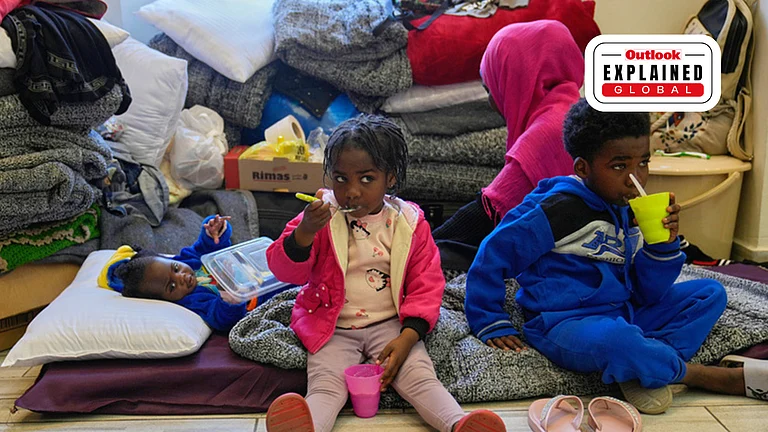
The Spanish government said more than 90% had returned to Morocco, while several thousand remained in Ceuta because their cases could not simply be resolved through a single mass-return procedure.
Advertisement
Those remaining include people whose legal status has to be established through identification, return procedures, asylum applications, vulnerability assessments and child-protection processes.
Spain's Interior Ministry said its expanded triage system includes medical checks, vulnerability screening, biometric identification and the registration of cases involving return, international protection and trafficking.
That is why the remaining migrants cannot simply be treated as one group and sent back.
Each person's circumstances have to be established before authorities determine what procedure applies.
How Is Spain Processing Them?
Spain has expanded the machinery required to process the remaining cases.
On Thursday, the Interior Ministry said it had opened eight additional police processing lines at a temporary reception facility in Ceuta. It also deployed an 11-member team from the Directorate-General for International Protection to accelerate asylum processing.
The process involves more than immigration registration. Authorities are also assessing health and vulnerability, identifying possible victims of trafficking and determining whether individuals qualify for international protection or require other forms of assistance.
Advertisement
Spain has also strengthened coordination between the Interior Ministry, the Ministry of Inclusion and Ceuta's authorities as the crisis has moved into a longer-term phase.
The operation has therefore shifted from emergency border management towards migration processing, asylum procedures and protection of vulnerable people.

Why Has The Situation Turned Violent?
Tensions in Ceuta have escalated into clashes involving residents, migrants and police, while migrant accommodation has been targeted and humanitarian aid disrupted. The report linked the unrest to tensions that had built up over the continued presence of migrants in the city.
Spain's official data provides evidence of a broader deterioration in the social climate.
The Ministry of Inclusion said its FARO monitoring system detected 57,406 cases of hate speech or discriminatory content online in July. It said messages detected on July 30 and 31 alone reached 9,590, with the increase coming after migrants entered Ceuta.
Advertisement
The ministry said people from North Africa were among the principal targets of the hate narratives it identified.
The online figures do not by themselves explain the physical clashes reported by the BBC. They do, however, show how quickly the mass arrival became a source of hostility and discriminatory rhetoric.
What Is Driving The Wider Tension?
Ceuta's geography magnified the impact of the influx. The enclave is a Spanish territory on the North African coast, surrounded by Morocco except for its coastline. A sudden arrival of tens of thousands of people therefore placed extraordinary pressure on reception, processing and public services designed to operate at much smaller scales.
Spain's government has described its response in phases. The initial priority was border control and restoring order. The subsequent focus shifted towards humanitarian assistance and returns, followed by a longer-term process involving asylum, protection of minors and the social and economic consequences for Ceuta.
Advertisement
That creates competing pressures.
People without a legal basis to remain have to be processed for return. Those seeking international protection must have access to the relevant procedures. Unaccompanied minors require separate protection arrangements.
The longer that process takes, the longer the city has to manage the practical consequences of the original influx.

How Has Spain Reinforced The Border?
Madrid has also tightened physical controls around the point where many migrants attempted to enter.
Spain's Interior Ministry installed an inflatable barrier and containment buoys at the Tarajal breakwater separating Ceuta from Morocco. The ministry linked the measure to the Supreme Court ruling concerning people entering the enclave by swimming.
The measure reflects Spain's attempt to reinforce maritime control while the legal and administrative systems deal with those who have already entered.
The border response is therefore occurring on two tracks: preventing further irregular entry while processing those who remain inside Ceuta.
Why Has Spain Asked The EU For Help?
By late August, the crisis had moved beyond simply controlling the border.
On Friday, Interior Minister Fernando Grande-Marlaska formally requested assistance from Frontex, Europol and the European Union Agency for Asylum. Spain wants Frontex support for triage and returns, EUAA assistance with asylum procedures and interpreters, and Europol cooperation against migrant-smuggling networks.
The request followed an offer of assistance from the European Commission after EU officials assessed the situation created by the July influx.
The significance is that the crisis has become an EU-level migration-management issue, not only a Spain-Morocco border problem.
The European Commission has said EU agencies are prepared to provide additional support, particularly as several thousand people remain in Ceuta and a significant number are unaccompanied minors.

Why Has Madrid Created A Single Command?
Spain has also elevated the response beyond the Interior Ministry.
On Tuesday, the government announced a single command structure for managing the crisis and declared a situation of national-security interest in Ceuta. The structure brings together the autonomous city, Government Delegation, National Intelligence Centre, relevant ministries and the Department of National Security.
The government said the arrangement was necessary because the consequences now extend beyond border control into returns, humanitarian assistance, protection of minors, asylum and the social and economic impact on the city.
Madrid has also allocated €25 million for measures relating to minors and other support linked to the crisis.
What Is The Current Situation?
A month after the mass arrival, the immediate border emergency has largely given way to a more difficult administrative and humanitarian problem: what happens to those who remain?
Spain says more than 90% of those who entered have returned to Morocco. For those still in Ceuta, the government has to distinguish between people subject to return, people seeking international protection and vulnerable groups requiring separate procedures.
That is why Madrid is simultaneously expanding processing capacity, reinforcing parts of the border infrastructure, strengthening coordination inside Ceuta and seeking assistance from EU agencies.
The violence adds a new dimension to a crisis that has already moved well beyond the original border crossing..
What began with an extraordinary movement of people across Spain's African frontier has become a much broader test of border control, returns, asylum processing, protection of vulnerable migrants and social stability inside Ceuta.
Published At: