China's Ethnic Unity and Progress Promotion Law took effect 1 July, codifying decades of policy
Article 63 permits legal action against individuals outside China for undermining ethnic unity
Tibet scores 0/100 in Freedom House rating; UN experts warn resettlement may amount to crimes against humanity
Beijing frames law as safeguarding unity; critics call it assimilation and a blow to autonomy
In Tibet, China's Ethnic Unity Law Renews Debate Over Identity, Autonomy
China's new Ethnic Unity Law gives permanent legal force to policies long implemented across Tibet. Beijing calls it a safeguard for national unity; critics see it as the codification of assimilation. Six months on, its impact is already under scrutiny

Summary
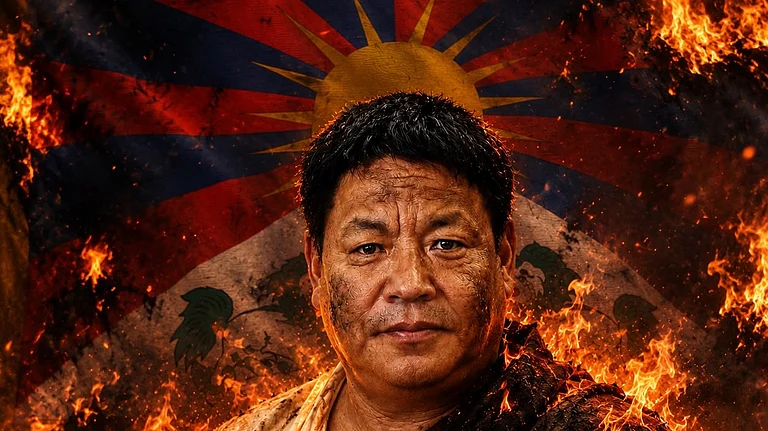
On the evening of July 2, a man carrying a Tibetan flag stopped outside the United Nations headquarters in New York. Moments later, he was engulfed in flames in what authorities and Tibetan activists described as an apparent protest against Chinese rule over Tibet. The 52-year-old, identified by Tibet's government-in-exile as Lobga Rangzen, later died of his injuries.
The self-immolation took place after China's Ethnic Unity and Progress Promotion Law came into force on July 1, folding decades of assimilation policy into permanent statute. For Tibet, a region already carrying the lowest freedom score on earth, the law is being read less as a new chapter than as the legal closing of an old argument and, six months on, as the framework now reaching into monasteries, classrooms and the lives of Tibetans who left the plateau decades ago.
Assessments of the law's implications for Tibet often begin with the region's freedom rating. The Tibet Autonomous Region has received a score of zero from Freedom House for two consecutive years, the lowest of any territory it assesses, while mainland China scored 9 out of 100.
Nine days before the law took effect, Sikyong Penpa Tsering, political head of the Central Tibetan Administration, warned foreign governments from Dharamshala that the law "may constitute a further step towards genocide" and risked becoming "a death blow to the original constitutional promise of meaningful regional autonomy."
Beijing frames the law rather differently: as a legal safeguard for social harmony across the country's 56 officially recognised ethnic groups. Deputy justice minister Hu Weilie called it "legitimate, lawful, necessary and a workable legal provision," dismissing foreign criticism as an attempt to smear a routine exercise of state sovereignty.
Between those two positions sits Tibet: seven million people, a monastic civilisation, and a government-in-exile that has spent the past year documenting arrests, disappearances, monastery closures and forced relocations in a fifty-nine page annual report. What changed on 1 July was not the substance of that record, but that it now has a permanent legal foundation underneath it.
Advertisement
What the Statute Requires
Passed by the National People's Congress on March 12, 90-days before taking effect, the law runs to 65 articles across seven chapters and reads less like a new policy than the consolidation of several that already existed. Article 15 requires schools to use Mandarin as the basic language of instruction from preschool onward.
Article 20 places a duty on parents to raise children with loyalty to the Party and "the Chinese people," barring them from instilling ideas "not conducive to" ethnic unity, reaching, for the first time, past the classroom into the home.
Article 22 calls on local governments to build "mutually embedded community environments", the same demographic logic underwriting resettlement off ancestral land.
Drawing the most international attention, Article 63 allows Chinese authorities to pursue legal responsibility against organisations and individuals outside the country found to have undermined ethnic unity, wherever they happen to live.
Advertisement
None of these provisions name Tibet specifically. All describe measures already operating there for years.
Seven Million People, One Identity
China's 2020 census, compiled by the United Nations, counts roughly 1.41 billion people nationwide, of whom more than 1.28 billion upwards of 91% identify as Han. The remaining 125 million, spread across 55 officially recognised minority groups, make up under 9% of the population.
Tibetans number just over seven million, nearly two-thirds of them still rural precisely the land-based, linguistically distinct life the law's "mutually embedded community environments" language is built to dissolve.
Under Xi Jinping, the framework for managing that diversity has hardened into a single concept, Zhonghua Minzu, the Chinese nation, with Xi urging China's ethnic groups to "hug tightly like pomegranate seeds." The new law gives that concept, for the first time, the force of statute rather than Party doctrine.
Advertisement
The Record Behind the Statute
The clearest evidence of what a legalised version of these policies is likely to produce is the record of what the unlegalised version already did.
The Tibetan Centre for Human Rights and Democracy's Annual Report 2025 documents a year in which revised religious-affairs measures, effective 1 January, required monasteries to uphold Communist Party leadership as a condition of operating.
Roughly 1,000 monks and nuns were expelled from Larung Gar, the world's largest Tibetan Buddhist institute; more than 300 stupas were demolished near a monastery in Drago County, officially for "illegal construction."
Around the Dalai Lama's 90th birthday in July, authorities searched monasteries and homes across Sichuan, Qinghai and Gansu, confiscating photographs and compelling residents to sign pledges renouncing them. Shersang Gyatso, a 52-year-old monastery administrator, died by suicide in August amid that crackdown.
Language policy moved in lockstep.
A national Preschool Education Law took effect in June, formalising Mandarin in early education. Reforms confirmed in August will strip Tibetan of core-subject status in the national college entrance exam from 2026, and in December the National People's Congress removed a longstanding provision permitting minority-language instruction, on the grounds it was "no longer necessary."
Advertisement
That same month, authorities detained Choktrul Dorje Ten, founder of one of the last Tibetan-run vocational schools in Qinghai, and shut it down, a case Amnesty International later cited, alongside Uyghur academic Ilham Tohti and ethnographer Rahile Dawut, as exactly the kind of peaceful cultural work the new law risks criminalising further.
Detention and death in custody run through the same year. Village leader Gonpo Namgyal died three days after release from seven months' detention tied to a Tibetan-language preservation group; lama Tulku Palden Wangyal died in custody after seven to eight years moved between prisons.
Protest against development projects fared no better as in February 2024, hundreds gathered in Derge County to oppose a hydropower project threatening six monasteries; security forces detained more than a thousand people, and the monastery administrator who organised the demonstration was reportedly tortured so severely he lost the ability to speak or swallow.
A similar pattern played out in November 2025 in Kashi Township, where more than 80 Tibetans were detained after opposing illegal gold mining on ancestral land.
Forced Labour, By the Numbers
In January, UN human rights experts added a further dimension, warning that state labour and resettlement programmes affecting Tibetans and Uyghurs were severe enough that the coercion involved "may amount to forcible transfer and/or enslavement as a crime against humanity."
Roughly 3.36 million Tibetans have been affected by resettlement programmes between 2000 and 2025, with close to 930,000 relocated through whole-village or household relocation and an estimated 650,000 drawn into labour-transfer schemes in 2024 alone, a means, the experts said, to "forcibly re-engineer"
The law also incorporates resettlement into its development framework. Article 22 identifies population relocation and resettlement as measures to support regional development and improve living standards.
When the Law Follows You Abroad
It is Article 63 that has drawn the sharpest reaction internationally. In China Law Translate's rendering, it holds that individuals outside China found to have undermined ethnic unity "are to be pursued for legal responsibility in accordance with law."
Amnesty International's deputy regional director, Sarah Brooks, argued the law is not really about harmony between communities: "'Unity' in this context is not harmony between different communities," she said, but political alignment with the Party.
Amnesty noted that at a June 24 State Council press conference, officials confirmed the law's provisions were intended to apply beyond China's borders, a confirmation it said "risks providing a stronger legal basis" for repression already documented among the diaspora.
Beijing's account differs sharply: officials at the same briefing said Western coverage had "distorted and misinterpreted" the provision, framing it as an ordinary state's right to act against separatism abroad.
However, UN High Commissioner for Human Rights Volker Türk has urged China to repeal the law outright and members of the European Parliament have warned member states to weigh suspending extradition treaties with Beijing over the provision.
Two cases, both predating the law, illustrate policies that are now reflected in its provisions.
Tulku Hungkar Dorje, a 56-year-old abbot who had fallen under scrutiny in Qinghai for declining to give the government-appointed Panchen Lama an "appropriately warm reception," fled to Vietnam in 2024 and was detained there in a joint Chinese-Vietnamese operation in March 2025.
Vietnamese authorities announced his death from a heart attack days later, despite no known history of heart disease, and cremated his body without his monastery's consent; his 85-year-old mother died within weeks, her family says from grief.
Four UN experts later wrote to Beijing and Hanoi citing the Minnesota Protocol on unlawful deaths; neither government has substantively responded.
Zhang Yadi, a Chinese student known online as Tara who had supported Tibetan rights while studying in France, was arrested in Yunnan in July 2025 and remains held, by most accounts, in Hunan, evidence, TCHRD argues, that the extraterritorial logic Article 63 now codifies was already being applied to non-Tibetans before the statute existed.
Former Indian diplomat Dilip Sinha argues the mechanism is not new, only newly legalised. "Communist China has perfected the art of regulating the behaviour of its diaspora by controlling their relatives in China," he says, pointing to Chinese police stations run out of diplomatic missions abroad, a practice he calls a violation of "basic principles of natural justice."
Tibet, he adds, has faced repression for seven decades, resulting in the flight of its leadership, the destruction of its culture, and a demographic shift driven by Han in-migration and boarding schools that have taken in nearly a million Tibetan children.
The new law, in his reading, will further that destruction, even as it hardens resolve among Tibetans in exile while making life harder for those who remain.
Two Ways to Read the Same Law
Sinha frames the law as part of a wider project tied to Xi's use of Han nationalism to consolidate power after years of Party and military purges, and warns Beijing is exporting its surveillance model to governments seeking tighter control over dissent.
He expects India to keep treating Tibet as China's internal affair and other governments to keep criticism "calibrated carefully enough not to disturb broader ties with Beijing."
Gautam Bambawale, former Indian ambassador to China and Bhutan, sees continuity rather than escalation, "This law further increases the ability of Beijing to override any views of minorities regarding their different customs or beliefs," he says is not a rupture with past practice but its codification. Beijing continues to reject the assimilation charge outright, insisting its ethnic policies protect equality and raise living standards while safeguarding lawful rights.
Since the law came into force on July 1, discussion around China's policies in Tibet has increasingly centred on its legal provisions. Rights groups, Tibetan organisations and legal scholars have pointed to the legislation while assessing its implications for issues such as religious practice, language, education and cultural preservation, alongside developments on the ground in Tibet.
In its submission, the Central Tibetan Administration has urged governments and international organisations to oppose the law, press for its repeal, seek a United Nations investigation, consider targeted accountability measures, encourage dialogue between Beijing and Tibetan representatives, and support the preservation of Tibetan culture in exile.
How the international community responds remains uncertain. Previous appeals, including a 1993 UN Sub-Commission resolution calling on China to allow access to Tibet for UN special rapporteurs, have had limited practical effect. Whether the new law prompts a different international response remains to be seen.
Published At: