Critics have often dismissed BRICS as a forum that produces declarations more readily than deliverables.
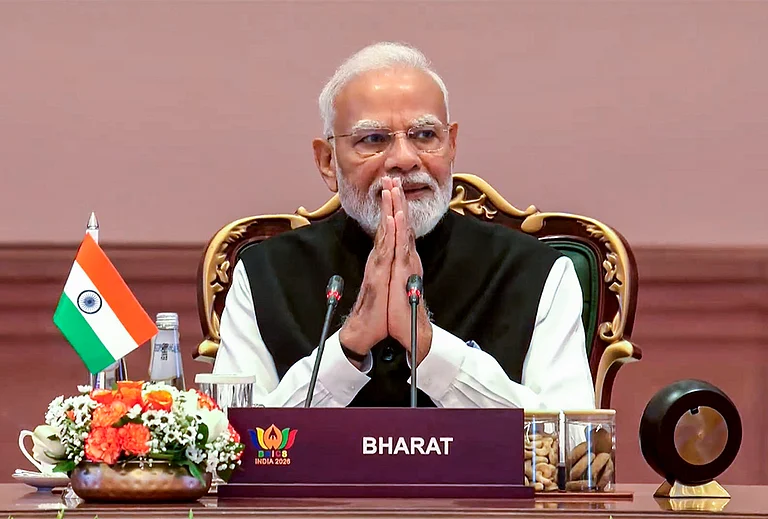
The Delhi Declaration, adopted unanimously at the 18th BRICS Summit on September 12, 2026, offers an intriguing test of that proposition.
The Indian imprint is visible in its efforts to keep BRICS inclusive rather than confrontational, practical rather than ideological and pro-Global South rather than anti-Western.
BRICS Summit 2026: Can The Delhi Meet Move BRICS From Talk To Action?
The real question is whether Delhi has helped convert a sprawling coalition of emerging powers into something capable of doing more than talking

Summary
For nearly two decades, Brazil, Russia, India, China and South Africa (BRICS) has lived with an awkward paradox. Its economic weight has become impossible to ignore, its political vocabulary has grown louder, and lately it has expanded dramatically from five to 21. Yet, its critics have often dismissed it as a forum that produces declarations more readily than deliverables.
The Delhi Declaration, adopted unanimously at the 18th BRICS Summit on September 12, 2026, offers an intriguing test of that proposition. Its 140 paragraphs range from conflicts and terrorism to trade, development, energy, health, technology and global governance. More than its length, however, is the political feat behind it: eleven increasingly diverse members managed to speak with one voice as the Iran war, sanctions, tariffs and great-power rivalry were pulling in different directions.
The real question, therefore, is not whether BRICS has produced another exhaustive declaration. It is whether Delhi has helped convert a sprawling coalition of emerging powers into something capable of doing more than talking.
Miraculous Consensus
The declaration was born in unusually difficult circumstances. BRICS now contains countries with sharply different strategic loyalties and regional interests. Iran and the United Arab Emirates (UAE) sit within the same grouping despite their very different positions on their regional security architecture. Russia remains estranged from the West. China wants alternative to Western dominance. India and Brazil want greater room for manoeuvre without turning BRICS into an anti-Western alliance.
In the run-up to this summit their diversity was painfully up in the face with BRICS foreign ministers meeting in May having failed to build consensus over language concerning West Asia. At the summit level, the challenge was even sharper: how could the organisation condemn violence, defend sovereignty and civilian protection, criticise unilateral sanctions and still avoid being torn apart?
The eventual declaration calls for restraint, dialogue and diplomacy while expressing concern over the wider conflict. This was possible because consensus in BRICS is not the same thing as unanimity among countries that agree on everything. It is consensus among countries that disagree on an extraordinary number of things. The declaration is therefore a diplomatic miracle.
Advertisement
From Talk to Action
Yet, its just just a matter of building consensus. BRICS has been building action-oriented cooperation for years. The New Development Bank has already provided an institutional foundation. Their ministerial and working-level cooperation now covers health, science, education, agriculture, industry, energy and digital technologies.
India’s chairmanship—that saw it hosting 350 meetings in 30 cities in the last eight months—this machinery has produced concrete initiatives including cooperation on Micro, Small and Medium Enterprises (MSMEs), photovoltaics, logistics and start-ups, as well as an India-proposed BRICS Start-up Innovation Fund.
That is where the Delhi summit becomes more interesting than its geopolitical headlines suggest. Its emphasis on supply chains, trade facilitation, food and energy security, digital infrastructure, development finance, health and climate adaptation points towards the less glamorous but potentially more consequential side of BRICS: building habits of active cooperation that can survive political disagreements.
This is why the Delhi Declaration should not be judged by whether BRICS will ever become another European Union or North Atlantic Treaty Organization. It was never designed to be one. BRICS has no common foreign policy, no permanent secretariat and no supranational authority. It is a platform whose strength lies precisely in allowing countries with different political systems and strategic interests to cooperate without first demanding that they agree on everything.
Advertisement
The test is consequently simpler: does this platform allow its members to produce useful cooperation? If BRICS can make payments easier, strengthen supply chains, widen development finance, facilitate technology partnerships, expand health cooperation and create more resilient trade among its members, it becomes an institution of practical consequence—even if its leaders continue to disagree loudly on geopolitics.
The India Imprint
This is where India’s chairmanship becomes particularly noticeable. It was a difficult balancing act as India inherited the BRICS chair in January 2026. It had to manage a raging Iran war and Gulf rivalries, China’s growing weight, Russia’s strategic importance and its own tensions with the United States. But India had no interest in allowing BRICS to become a geopolitical counterweight to Washington.
The Indian imprint is visible in its efforts to keep BRICS inclusive rather than confrontational, practical rather than ideological and pro-Global South rather than anti-Western. That distinction is central to India’s conception of multipolarity: India seeks a world in which power is distributed more widely, not a world in which one hierarchy is simply replaced by another.
Advertisement
The same instinct appears in BRICS’ economic agenda. India has resisted making de-dollarisation the organising principle of BRICS, even while supporting greater use of national currencies and more efficient cross-border payments. India wants to create more choices, not another rigid financial bloc. This showcases the strikingly practical Indian signature in the 2026 BRICS deliberations.
From start-ups and MSMEs to skills, research, education, digital systems and supply-chain resilience, the Delhi Declaration has pushed BRICS towards areas where cooperation can produce visible benefits beyond summit communiqués. India’s proposal for a BRICS Start-up Innovation Fund and its initiatives on skills and academic collaboration illustrate this developmental emphasis. India’s achievement is not that it seeks to make BRICS agree with India on everything. Instead, it lies in India enabling BRICS in keeping disagreement from paralysing the platform itself.

Why BRICS Attracts Many Countries
Advertisement
The most revealing story about BRICS may actually lie outside the Delhi Declaration. Why do many more countries aspire to join it? Because BRICS now represents roughly half the world’s population and around 40 per cent of global GDP in terms of purchasing-power parity, while the BRICS countries account for more than a quarter of world trade. Its economic centre of gravity has become too large to ignore.
For many aspiring nations, the attraction is not ideological. It is brutally practical: access to markets, investment, technology, development finance and a greater voice in international institutions. This is an important corrective to the Western tendency to read BRICS principally through the prism of China, Russia and their assumed opposition to the United States.
Newer members and partner countries see something much simpler: a seat at a table where the rules of the global economy are increasingly contested. That attraction is itself evidence of institutional relevance. Countries do not queue up to join organisations that have no perceived value.
As the West Watches…
Western governments have understandably begun to take BRICS seriously. The bloc’s economic weight, expansion and interest in alternatives to Western-dominated financial and political structures make it consequential. Even sceptics acknowledge the paradox: if BRICS were merely a talking shop, it would be difficult to explain why so many countries want closer association with it.
Western reading often reduces BRICS to an anti-Western project. Delhi has pushed against precisely such narrow interpretations. The emerging BRICS is better understood as a negotiating space of the Global South: a place where countries seek greater autonomy, bargaining power and representation without necessarily seeking confrontation. That distinction defines BRICS.
Thus the Delhi Declaration does not magically resolve the intra-BRICS contradictions. Indeed, BRICS does not need to become a tightly disciplined geopolitical alliance to matter. It needs to become useful. The Delhi Declaration points to that struggling grouping which seeks to turn its extraordinary diversity into a source of bargaining power rather than paralysis; its growing membership into influence rather than incoherence; and its declarations into habits of cooperation. That ultimately is the contribution India has sought to make.
(The author is former professor of diplomacy and disarmament, School of International Studies, Jawaharlal Nehru University, New Delhi)
Published At:
Tags