Owaisi and Azad's emerging political equation could reshape the opposition's electoral calculations ahead of the 2027 UP Assembly elections.
The proposed third front brings Dalit-Muslim political representation into focus, a key constituency in Uttar Pradesh politics.
Its emergence raises questions about the SP's PDA strategy and its efforts to consolidate opposition support.
Owaisi, Azad And Dalit-Muslim Vote: How A Third Front Tests SP's PDA Strategy In UP
The Owaisi-Azad alliance enters the 2027 UP contest with a 403-seat plan, putting Akhilesh Yadav's PDA strategy and opposition unity under scrutiny

Summary
Asaduddin Owaisi and Chandra Shekhar Azad have formed a new alliance for the 2027 Uttar Pradesh Assembly elections, naming Azad as its chief ministerial face. The new front, called the Samajik Parivartan Morcha (SPM), plans to contest all 403 Assembly seats, setting up a fresh contest for opposition votes in the state.
The two leaders announced the alliance on Thursday and said its aim was to prevent the Bharatiya Janata Party (BJP) from securing a third consecutive term in Uttar Pradesh. They also invited INDIA bloc parties, including the Samajwadi Party (SP) and Congress, to join the front.
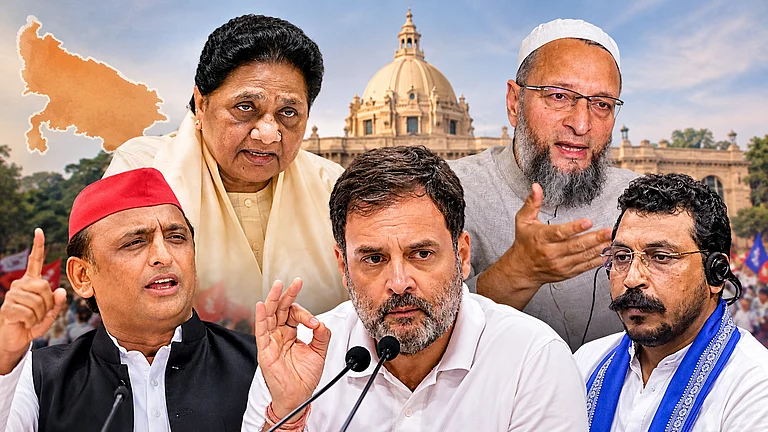
The alliance could open up a fresh contest for Dalit and Muslim votes, which are central to the SP's PDA plank — Pichhda, Dalit, Alpsankhyak. It also raises a larger question for the opposition, whether a third front can expand its support base or split anti-BJP votes in closely contested constituencies.
Vote Bank Arithmetic
The numbers underline the electoral significance of these communities. Dalits account for roughly 21% of Uttar Pradesh's population, while Muslims make up around 19%. Together, they constitute nearly 40% of the state's population.
Their combined electoral presence is significant across several constituencies. Around 41 Assembly seats have a Dalit-Muslim electorate of more than 50%.
Muslim voters are spread across a wider electoral map. At least 143 Assembly constituencies have a significant Muslim presence, including 70 seats where they account for 20-30% of the population and 73 where their share exceeds 30%. These constituencies are concentrated particularly in Rohilkhand (Bareilly, Moradabad, Rampur and Bijnor) and Upper Doab (Meerut, Muzaffarnagar, Saharanpur and adjoining areas)
SP's Vote Base Faces A Challenge
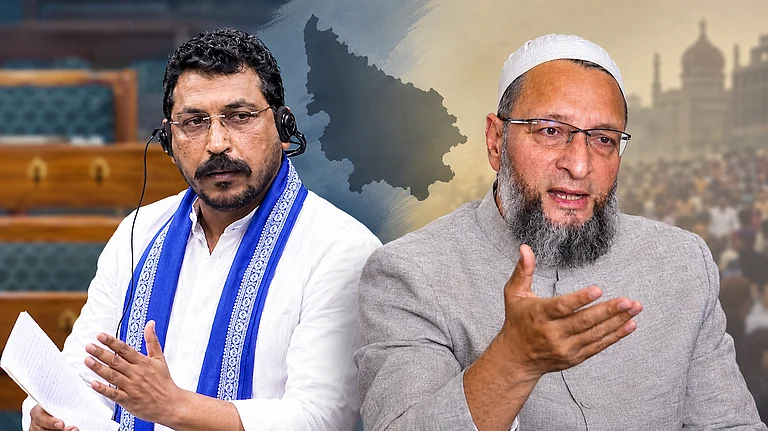
The SP faces a direct electoral challenge from the new alliance. Muslim voters have overwhelmingly backed the party in recent elections, helping it emerge as the principal challenger to the BJP.
Advertisement
Political observers see the emergence of a third front with a Muslim face as a potential challenge to Akhilesh Yadav's support base. Under the proposed arrangement, AIMIM may contest 40-45 seats with substantial Muslim populations, while the Azad Samaj Party could field candidates in most of the remaining constituencies.
The overlap in their electoral support bases could become crucial. Even a limited shift in Muslim or Dalit votes towards the SPM could divide the anti-BJP vote in closely contested seats.
However, the alliance's electoral impact will also depend on whether Owaisi and Azad can build a strong grassroots organisation and mobilise voters beyond their respective support bases.
Could The BJP Benefit From A Split Opposition Vote?
Even a small shift in votes could influence the outcome in closely contested constituencies. A significant part of the SP's electoral strategy depends on retaining consolidated Muslim support.
Advertisement
AIMIM offers Muslim voters an independent political platform. If a section of these voters shifts from the SP-Congress alliance to the SPM, the division could benefit BJP candidates in multi-cornered contests.
Azad's outreach also creates a challenge for the SP's PDA strategy and the Bahujan Samaj Party's (BSP) traditional Dalit support base. If Dalit votes are divided further among the SP, BSP and SPM, opposition parties could find it difficult to consolidate their support against the BJP.
With the SPM planning to contest all 403 seats, even a limited diversion of votes from the principal opposition challenger could influence the outcome in constituencies decided by narrow margins.
Alliance Friction
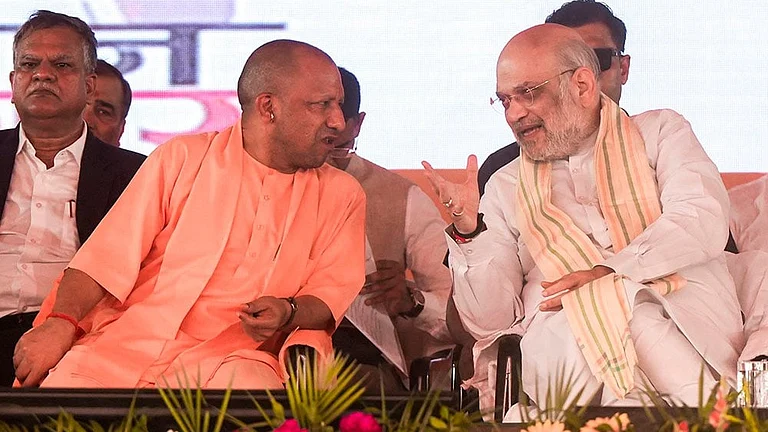
The new front has also raised questions about the possibility of a broader opposition alliance. Owaisi and Azad have invited the SP and Congress to join them, even as their own electoral entry could complicate opposition vote-sharing arrangements.
Advertisement
Differences over leadership and seat-sharing, along with mutual suspicion among non-BJP parties, have already posed challenges to opposition unity. Naming Azad as the alliance's chief ministerial face adds another dimension to the leadership question.
These differences could limit the front's ability to expand into a broader anti-BJP coalition. Rather than bringing opposition parties together, the SPM's entry could deepen existing divisions ahead of the 2027 Assembly elections.
Published At: