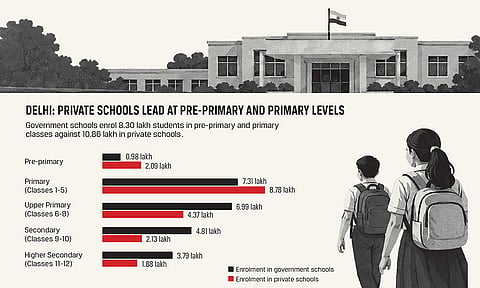
When Priyanka’s son turned five, she wanted to enrol him in a government school. But he was admitted to a private school instead. “I cannot take risks with a school that has a doubtful image,” she says. “His future is more important.” Her decision reflects a pattern in Delhi’s school enrolment figures: private schools enrol more than half of the city’s primary students. In 2025–26, 16.44 lakh students were enrolled at the primary level in Delhi. Of these, 8.78 lakh went to private unaided recognised schools and 7.31 lakh to government schools, according to the Unified District Information System for Education Plus (UDISE+) 2025–26 report released by the Union Ministry of Education.
InDepth | The School Choice Shift: Government Schools Lose Ground to Private Ones
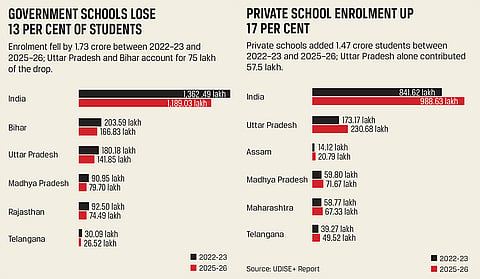
Since 2022–23 government schools in India have lost 1.73 crore students while private schools gained 1.47 crore

Of the 44.46 lakh enrolments across pre-primary to class 12 in the national capital, 23.88 lakh (53.7 per cent) were in government schools and 19.24 lakh (43.3 per cent) in private schools. Even though the government school share has dropped, it is still larger than the private school one. Since 2022–23, total enrolment in Delhi has fallen from 46.29 lakh to 44.46 lakh. Government-school enrolment fell from 27.76 lakh (60 per cent) to 23.88 lakh (54 per cent) while private-school enrolment rose from 17.03 lakh (37 per cent) to 19.24 lakh (43 per cent).
An analysis of data by Outlook shows that beyond pre-primary and primary, in Delhi, government schools still enrol more students (see page 54). The UDISE+ report classifies enrolment under four broad management categories: government, government-aided, private unaided recognised and others. This analysis compares enrolment in government schools, including central and state government schools, with enrolment in private unaided recognised schools.
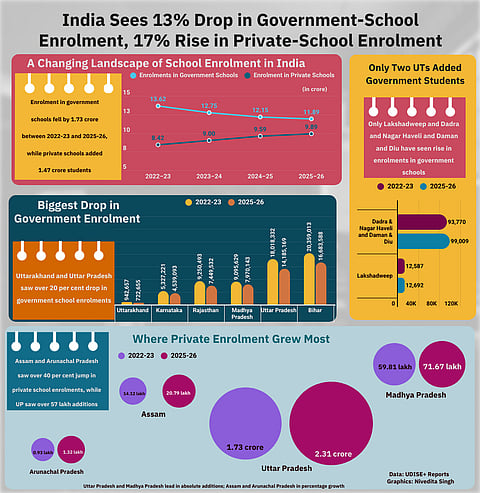
Nationally, India enrolled 24.72 crore students in 2025–26: 11.89 crore (48 per cent) in government schools and 9.89 crore (40 per cent) in private ones. State governments alone accommodated 11.71 crore students, so almost half of India’s students still depend on government schools. By level, however, private schools have higher enrolment at the pre-primary and higher secondary stages, while government schools lead in elementary (1–8) and secondary (9–10).
The balance has shifted sharply since 2022–23, when 13.62 crore (54 per cent) of the 25.18 crore enrolments were in government schools and only 8.42 crore (33 per cent) in private ones.
A few kilometres away from Priyanka’s home in Ghaziabad’s Indirapuram, lives Bindia, the sole earning member of a family of six. Her son is going to a private school because there are no government schools nearby. Unlike Bindia and Priyanka, Mohini, also from Uttar Pradesh (UP), did not opt for a government school despite being a teacher in one. “I teach at a government school and I know the kind of resources provided there,” she says. “Also, I don’t want my daughter to have a complex later in life that I did not send her to a good school.”
Advertisement
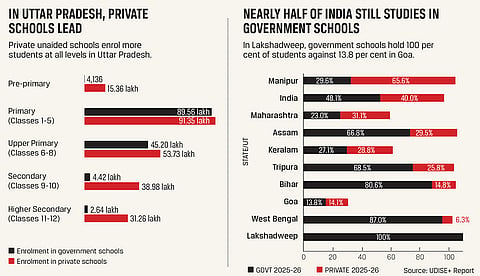
The enrolment picture in UP is different from that of its neighbour Delhi. Of the 4.27 crore enrolments in 2025–26, 2.31 crore (54 per cent) were in private schools against 1.42 crore (33 per cent) in government schools. Private schools lead at all five levels: pre-primary, primary, upper primary, secondary and higher secondary. At the pre-primary level, out of the total 15.56 lakh enrolments, 15.36 lakh were in private schools.
This was not always so. Until 2022–23, the balance favoured government schools: of 4.17 crore enrolments, 1.80 crore (43 per cent) were in government schools and 1.73 crore (42 per cent) in private ones. By 2023–24, that had reversed. Between 2022–23 and 2025-26, UP recorded the biggest fall in government enrolment of any state, almost 40 lakh, from 1.80 crore to 1.42 crore across pre-primary to higher secondary. Private enrolment rose by over 57 lakh, from 1.73 crore to 2.31 crore—also the largest among states.
Advertisement
The Shift in Pattern
When officials from the Directorate of Education, Delhi were asked about the shift in the pattern, they said that government schools are providing free and quality education to all students. “The government schools in Delhi are giving very tough competition to private schools. Our schools are among the best in state government schools across India.”
An official from the Directorate of Education, UP, says that enrolment in government schools increased by over 21 lakh between 2018–19 and 2021–22, driven by migration of the population back to their hometowns in and after 2020. “Post the [Covid-induced] lockdown, many people returned to villages in UP from metro cities, where they had lost employment. So the enrolment increased. After 2022, when the situation became completely normal, they moved back to the cities with their families.”
The UDISE+ tables tell a more complicated story. Between 2022–23 and 2023–24, the total enrolment in the state remained almost the same at 4.16 crore. But the enrolment in private schools witnessed a massive jump from 1.73 crore to 1.97 crore while the enrolment in government schools dropped from 1.80 crore to 1.58 crore.
Advertisement
Earlier this year, a NITI Aayog report said that government schools continue to serve as the primary providers of education, though their share has declined over the decade: from 54.3 per cent in 2014–15 to 49.25 per cent in 2024–25, while private unaided institutions, despite being fewer in number, have expanded their enrolment share considerably, from 31.7 per cent in 2014–15 to 38.8 per cent in 2024–25. “This reflects rising household demand for private schooling. The distribution of enrolment across different management types reflects not only patterns of access but also household choices and broader education provisions. These choices are shaped by perceptions of quality, affordability and trust in governance,” the report said.
Arun C. Mehta, former head of the department of educational management information system at the National University of Educational Planning & Administration, tells Outlook that the contrasting enrolment trends need to be examined in the context of several factors, including household income, distance to school, the availability of particular educational stages, language of instruction, social expectations, local competition and the perceived reliability of teaching. Demographic composition and settlement patterns also matter. “Delhi is a predominantly urban territory with a high concentration of schools.,” he says. “Its government-school system has also received considerable policy attention in areas such as school infrastructure, teacher deployment, classroom facilities and academic support.”
Advertisement
The government schools in Delhi, Mehta says, serve a large and socially diverse population, including many children from lower-income households and migrant families. “Their role is therefore not limited to providing an alternative to private education; they are central to ensuring access to schooling for a substantial proportion of the city’s children,” he adds.
UP, on the other hand, he points out, has a much larger and more geographically dispersed population, extensive rural areas, considerable variation in household incomes and educational infrastructure, and a large network of government and private schools.
71% Enrolment at the pre-primary level in private schools in India
“In many locations, the availability, accessibility and perceived attractiveness of private schools can influence parental choices,” he says. “The state also has a large private-school market in absolute terms, reflecting both its population size and the substantial role of private providers.” He cautions that the differences should not, however, be reduced to a simple conclusion that government schools in Delhi are better or that private schools in UP are necessarily better.
According to Mehta, UP deserves particular attention because of its enormous school-age population and the scale of its school-education system. “The apparent crossover between government- and private-school enrolment in 2022–23 and 2023–24 may reflect a combination of genuine changes in school choice and changes in the way enrolment was recorded,” he adds.
On private schools’ dominance at the pre-primary level at the India-level with over 71 per cent enrolment, Mehta says it is important not to interpret these enrolment patterns as direct measures of educational quality.
“This is largely a structural issue. Early-childhood education in the public system is provided substantially through anganwadi centres, which fall under a different administrative system and are not equivalent to school-based pre-primary sections covered by UDISE+,” he says.
He points out that families may increasingly choose private schools because they perceive them to offer better teaching regularity, English-medium instruction, closer supervision or stronger prospects for their children’s future.
Consolidation of government schools can also affect the pattern, he says. Yet, the closure or merger of a school does not, by itself, mean that all its students have moved into private education. As per the data, the total number of schools remained almost the same at 14.66 lakh, with a marginal increase of 573 between 2022–23 and 2025–26. But the number of government schools dropped by 10,765, while private schools rose by 18,259. In 2025–26, government schools accounted for 68.5 per cent of all schools but 48.1 per cent of enrolment, while private unaided schools made up 23.3 per cent of institutions but 40 per cent of students.
Beyond Delhi and UP
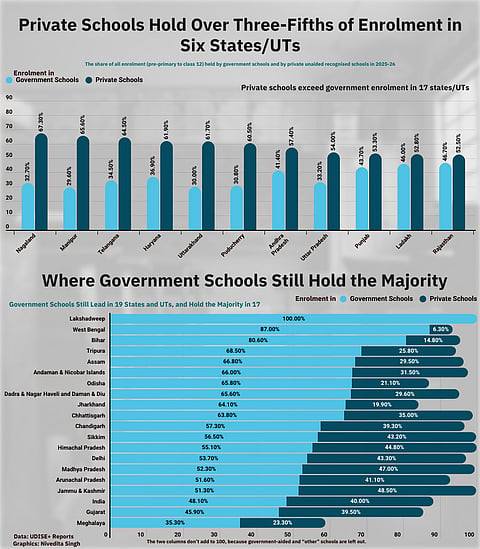
West Bengal and Bihar, the leading states for government enrolment, offer a different picture from India, Delhi and UP. The private schools are nowhere close in these states. Of the 2.07 crore students in Bihar in 2025–26, about 80 per cent (1.67 crore) were in government schools and only 30 lakh (15 per cent) in private schools. In 2022–23, total enrolment in Bihar was 2.45 crore, with 2.04 crore (83 per cent) in government schools and just 27.82 lakh (11 per cent) in private.
In West Bengal, in 2022–23, government schools accounted for 90 per cent of enrolment: 1.59 crore out of 1.78 crore. Private schools had just six per cent, a share that stayed about the same in 2025–26, when the government share dropped to 87 per cent with 1.54 crore students. Lakshadweep has no private enrolment in either year, so government schools accommodate all of its students.
In Nagaland, Manipur, Telangana, Haryana, Uttarakhand and Puducherry, more than six of every 10 students are enrolled in private schools. In 2022–23, 10 states had more enrolments in private schools than in government schools: Telangana, Maharashtra, Tamil Nadu, Karnataka, Haryana, Uttarakhand, Manipur, Nagaland, Puducherry and Ladakh. By 2025–26, the number had increased to 17, with Uttar Pradesh, Rajasthan, Andhra Pradesh, Punjab, Keralam, Goa and Mizoram joining the list.
Between 2022–23 and 2025–26, private enrolment did not fall in any state or Union Territory (UT). But the government enrolments, on the other hand, dropped in every state and UT except Lakshadweep, and Dadra and Nagar Haveli, and Daman and Diu. This was despite 14 states and UTs reporting an increase in total enrolment between 2022–23 and 2025–26, led by UP (10.31 lakh increase) and Telangana (6.49 lakh).
Mehta suggests caution in concluding that the students government schools lost have shifted to private ones. “A reduction in one category and an increase in another do not establish that the same children transferred between them,” he says. “Such a conclusion would require evidence tracking individual students or otherwise identifying actual transfers.”
The central policy challenge, he says, is not simply to reverse the growth of private enrolment. “It is to ensure that every child has access to affordable, equitable and good-quality education, and that government schools remain a credible and preferred option for families across social and economic groups,” Mehta notes. The enrolment patterns, he says, should also not be seen as a direct measure of educational quality.
Government schools are central to implementing the Right of Children to Free and Compulsory Education Act, 2009, which guarantees children aged 6–14 the right to free and compulsory elementary education. On paper, access appears strong, with more than 97 per cent of habitations reportedly covered by primary and upper-primary schools.
In 1976, education was moved from the state list to the concurrent list, making it a shared responsibility of the Centre and state governments. Yet, more than 15 years after the Right to Education Act came into force, the enrolment figures suggest that access does not necessarily translate into confidence. Understanding this gap requires a closer examination of why parents choose particular schools: a question that enrolment data alone, as Mehta cautions, cannot answer.
Nivedita Singh is Senior Correspondent, Outlook
Published At: