Nana Patekar won three National Film Awards across two acting categories.
His acting career began with Gaman in 1978 after years of struggle.
Parinda, Krantiveer, Welcome and Natsamrat remain among his defining performances.
Who Was Nana Patekar? Everything About The Padma Shri Awardee Who Died At 75
The veteran actor built a remarkable career across Hindi and Marathi cinema, earning three National Film Awards and the Padma Shri while delivering some of Indian cinema’s most memorable dramatic and comic performances.

Summary
Nana Patekar had a career that only few Indian actors could match. He could be intimidating in one film, unexpectedly funny in another and deeply vulnerable in the next. His voice, his manner of speaking and the sheer intensity he brought to a role became instantly recognisable, whether he was working in Hindi cinema, Marathi cinema or theatre. But there was much more to Patekar than his most famous performances. He was also a writer, director and theatre actor, and his journey to becoming one of Indian cinema’s most respected performers began with a childhood marked by financial hardship.
The veteran actor died at 75 in Goa on October 8, 2026, after suffering a cardiac arrest. His death marked the end of a career spanning nearly five decades, during which he established himself as one of the most distinctive performers in Indian cinema. From intense dramatic roles to comic turns and acclaimed Marathi performances, Patekar built a body of work that extended well beyond the conventional boundaries of Bollywood.
Who was Nana Patekar and what made him different?
Born Vishwanath Patekar on January 1, 1951, Nana Patekar came from Murud-Janjira in Maharashtra. Unlike many stars who entered the industry through established connections, his route to cinema was shaped by financial struggle, art and theatre.
He made his feature film debut with Gaman in 1978 and spent his early years building himself as a serious performer. His breakthrough came with Parinda in 1989, in which he played the volatile gangster Anna. The role demonstrated what would become his greatest strength: the ability to make even extreme characters feel grounded and frighteningly human.

Patekar went on to appear in films including Prahaar: The Final Attack, Angaar, Tirangaa, Krantiveer, Raju Ban Gaya Gentleman, Khamoshi: The Musical, Agni Sakshi, Ab Tak Chhappan, Apaharan and Raajneeti. He was equally capable of playing morally complicated dramatic characters and larger-than-life commercial roles.
Advertisement
That range was particularly visible in Welcome, where he played Uday Shetty, the hot-headed gangster whose comic timing introduced him to an entirely different generation of viewers. His work in Marathi cinema remained equally important, particularly Natsamrat, where he delivered one of his most celebrated later performances.
Nana Patekar's early life before becoming an actor
Patekar's journey to stardom began with poverty rather than privilege. After his father's business collapsed, the family faced severe financial difficulties. At around 13, Patekar began painting film posters in Mumbai to help support his family.
He later recalled earning ₹35 a month and walking nearly eight kilometres to work after school. The job also provided him with one meal a day. Those experiences remained an important part of how he spoke about money, food and success even after he became a successful actor.
Patekar studied at the Sir J.J. Institute of Applied Art in Mumbai and worked as a commercial artist before turning seriously towards theatre. Acting eventually became his profession, but his background in visual art remained an important part of his creative identity.
Advertisement

Nana Patekar's National Film Awards and biggest achievements
Patekar won three National Film Awards, making him one of the most decorated actors of his generation. He won Best Supporting Actor for Parinda in 1990 and again for Agni Sakshi in 1997. In between, he won Best Actor for Krantiveer in 1995.
The Krantiveer performance became one of the defining achievements of his career. Patekar also won the Filmfare Award for Best Actor for the film, adding to his earlier Filmfare win for Parinda and later recognition for villainous roles.
His achievements extended beyond acting. Patekar made his directorial debut with Prahaar: The Final Attack in 1991, a film centred on soldiers and military training. His association with the armed forces extended beyond cinema. He underwent military training, served in the Territorial Army and spent time with Indian soldiers during the Kargil War.
Advertisement
In 2013, he received the Padma Shri for his contributions to cinema and the arts.
Nana Patekar net worth and life away from cinema
Reports place Nana Patekar's net worth between approximately ₹50 crore and ₹80 crore, though these figures are media estimates rather than officially confirmed financial records. In his later career, he was reportedly paid around ₹2 crore to ₹3 crore for a film.
Yet his lifestyle was notably modest by Bollywood standards. He lived in a 750-square-foot one-bedroom apartment in Andheri, Mumbai, and also owned a home in Goa and a large farmhouse near Khadakwasla in Pune.
His relationship with wealth was closely tied to his philanthropic work. In 2015, Patekar co-founded the NAAM Foundation with actor Makarand Anaspure to support farmers and families affected by Maharashtra's agrarian crisis. The organisation later expanded its work to areas including water conservation, livelihoods, education and healthcar
Nana Patekar's legacy in Indian cinema
Nana Patekar’s legacy lies in the fact that he never needed to behave like a conventional Bollywood hero. He could dominate a scene without relying on glamour, and his strongest performances often came from characters who were flawed, angry, vulnerable or deeply conflicted.
Advertisement
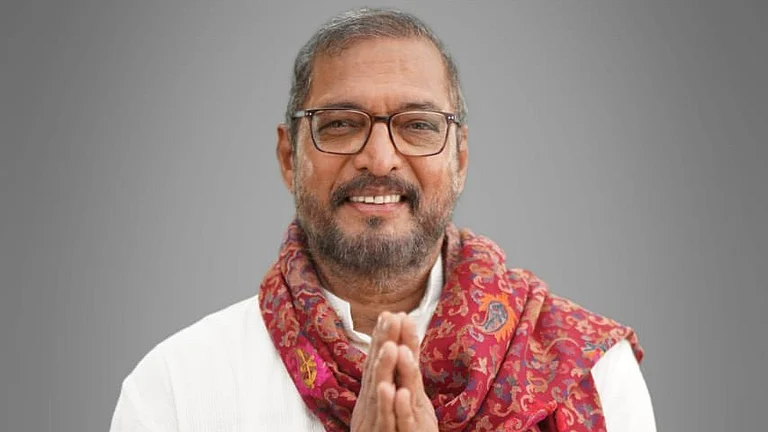
The Indian cinema has lost a distinctive actor, but the characters, performances and voice that made Nana Patekar unforgettable will remain part of its history.
Published At: