Ashish Avikunthak is a filmmaker who is also an accomplished archaeologist and cultural anthropologist.
The Epistemic Archaeology of Ashish Avikunthak: Cinema and the Religiosity of Everyday Life (Bloomsbury Academic, 2025), edited by Erin O’Donnell and Šarūnas Paunksnis, looks at his body of work across three decades.
Despite Avikunthak’s Tantric lifestyle and his extensive engagement with Hindu rituals, his work constitutes a sustained and radical act of dissent.
Tantra, Religiosity, Archaeology: The Cinema Of Ashish Avikunthak
As the first English-language book devoted entirely to filmmaker Ashish Avikunthak, this volume, published by Bloomsbury Academic, offers a comprehensive engagement with his three-decade-long cinematic practice.

Summary
Ashish Avikunthak, a filmmaker working primarily in Bengali, occupies a singular position among the rare practitioners of Indian avant-garde cinema. Beyond his cinematic practice, he is an accomplished archaeologist and cultural anthropologist. His films have been exhibited at major international film festivals as well as in galleries and museums across the world. In 2021, Cambridge University Press published his monograph Bureaucratic Archaeology: State, Science and the Past in Postcolonial India. He currently serves as Professor of Film and Media at the Harrington School of Communication, University of Rhode Island.
As critic Amrit Gangar observes, Avikunthak’s cinematic universe resembles a vast chamber with multiple entrances, or more evocatively, the Chausath Yogini Temple at Mitawali in Morena, whose sixty-four shrines form a circular gallery. One may enter through any portal, guided by one’s own sensibilities. This metaphor structures The Epistemic Archaeology of Ashish Avikunthak: Cinema and the Religiosity of Everyday Life (Bloomsbury Academic, 2025), edited by Erin O’Donnell and Šarūnas Paunksnis. Each contributor enters Avikunthak’s work through a different doorway—sometimes several—to offer close, rigorous readings. Together, the essays traverse Tantric philosophy, experimental form, ritual practice, politics, sound, colour and the profound cinematic meditations on death and time that shape his oeuvre.
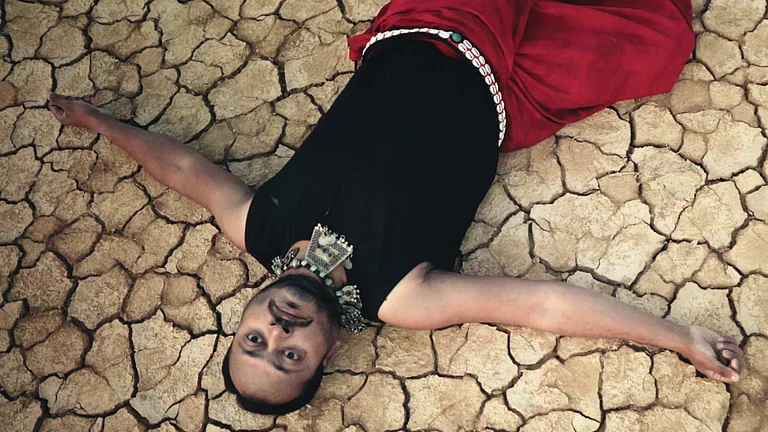
Despite Avikunthak’s Tantric lifestyle and his extensive engagement with Hindu rituals—features that might superficially invite alignment with contemporary religious revivalism or so-called “Sanghi cinema”—his work constitutes a sustained and radical act of dissent. The volume demonstrates how his cinema resists the monolithic narratives of Hindutva and contests the operations of power embedded within them. Through a fiercely independent aesthetic, Avikunthak rejects both political co-option and the homogenising pressures of global capital.
In an era when culture and religion have been reduced to marketable commodities, Avikunthak deploys what he terms ‘infra-realism’ to reconfigure cinematic aesthetics at their foundation. At a time when films are increasingly treated as consumable products, his work remains deliberately resistant, refusing accessibility, speed and international legibility as governing values.
Advertisement
Gangar’s essay offers a comparative study of Ritwik Ghatak and Avikunthak, tracing a lineage of filmmakers who abandoned Western cinematic conventions to reimagine Indian ritual and Tantric traditions as a distinct visual language. Gangar describes Ghatak as a “lensing philosopher,” whose use of wide-angle lenses allowed him to collapse the boundary between inner consciousness and external reality, defying Renaissance principles of perspectival convergence. This radical optical legacy, continued by Mani Kaul and Kumar Shahani, finds renewed expression in Avikunthak’s digital practice, where the lens becomes an instrument for exploring spatial geometry, cosmogony and Tantric vision.
Šarūnas Paunksnis examines Avikunthak’s cinema as a resistance to Western colonial epistemologies. He argues that Tantra functions in Avikunthak’s work as a decolonial praxis, offering an alternative mode of knowing the body, the world and spirituality. By embracing mysticism and ritual—domains long dismissed by Western rationalism—Avikunthak articulates a worldview that confronts what Paunksnis terms the “coloniality” of modern thought, which continues to govern perception and subjectivity in postcolonial societies.
Advertisement
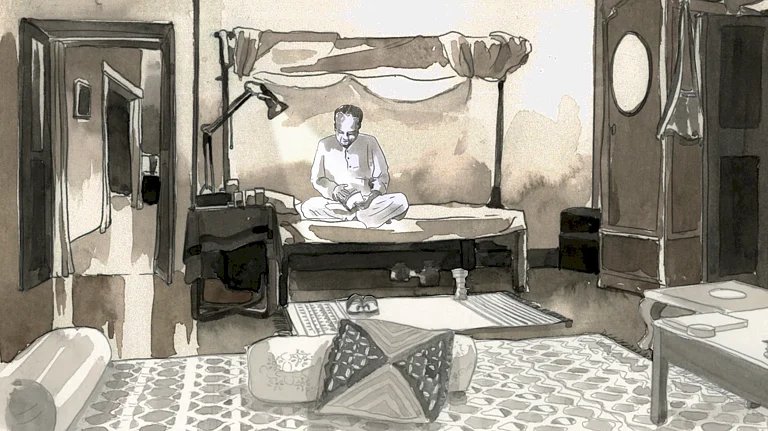
Erin O’Donnell situates Avikunthak’s films from 2013 to 2024 as models of radical art in an age marked by rising global authoritarianism and Hindu ethno-nationalism. She demonstrates how his cinema operates as a form of protest against the anti-democratic concentration of power in contemporary India. Crucially, Avikunthak’s critique does not emerge from a conventional secular-liberal or Leftist position; instead, it interrogates religious culture from within faith itself.
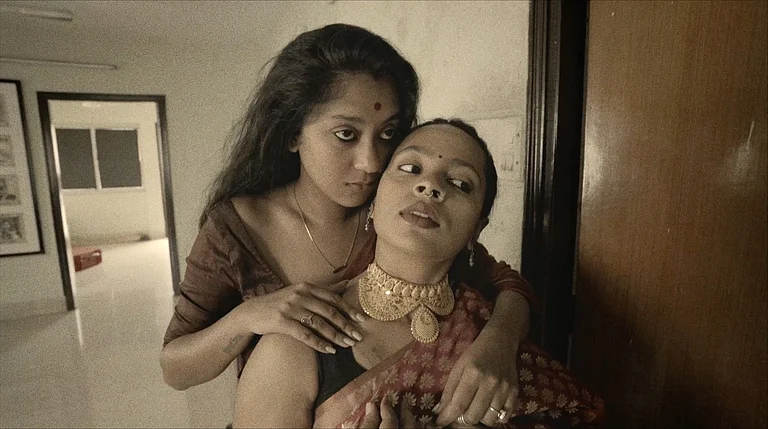
Avikunthak’s cinema frequently stages intimate, corporeal bonds between women, where nudity functions not as spectacle but as a means of elevating the human body to the divine. In films such as Vrindavani Vairagya (2018), these moments unfold alongside thumris devoted to Radha and Krishna, producing a convergence of femininity, music and Tantra. O’Donnell argues that these carefully constructed “sonic-scapes” destabilise the rigid certainties of Hindutva ideology, opening a sensuous and resistant space against both religious nationalism and global authoritarianism.
Advertisement

Aparna Frank draws a compelling parallel between Roland Barthes’s A Lover’s Discourse: Fragments (1977) and Avikunthak’s Nirakar Chhaya (2007), a Bengali adaptation of Sethu’s Malayalam novel Pandavapuram (1979). She demonstrates how the film rejects linear narration in favor of a fragmentary, Barthesian mode of address. Through dense layers of quotation, poetry and recurring motifs, Avikunthak creates a deliberate disjunction between image and text, allowing desire and meaning to remain unresolved.
Arka Chattopadhyay poses fundamental ontological questions about cinema’s capacity to represent death. Can film visualise death as an autonomous state, severed from life? Can it render stillness as an independent existence? Through analyses of Avikunthak’s short and feature films, Chattopadhyay argues that his cinema advances a rare philosophical meditation on mortality. As he writes, cinema, like all art forms, can renew itself only by “killing” its own inherited conventions.
Pratyush Bhattacharya examines the representation of violence in Avikunthak’s cinema, focusing on Vidhvastha (2024). He traces how blind faith transforms violence into sacred obligation, revealing the normalised brutality that undergirds civilisation itself. Avikunthak’s formal strategies, Bhattacharya argues, exceed the limits of both social realism and modernist avant-gardism.
Advertisement

Hrishikesh Ingle explores the relationship between ritual and time, arguing that Avikunthak isolates time from spatial constraints to examine its essence. Through images of ritual-in-action, time emerges as cyclical, layered and transformative rather than merely a medium of recording.
Budhaditya Chattopadhyay offers a nuanced study of Avikunthak’s soundscapes, structuring his analysis through the stages of Dhrupad and Khayal performance—from alap to jhala—while situating these practices within the broader transformations of cinematic sound in the digital era.
The final chapter presents an extended dialogue between the editors and Avikunthak, covering his “Cinema of Prayoga,” infra-realism, dense dialogue, the interplay of old and new technologies, censorship and the inseparability of politics and Tantric philosophy in filmmaking.
As the first English-language book devoted entirely to Avikunthak, this volume offers a comprehensive engagement with his three-decade-long cinematic practice. In an era that often rewards mediocrity in both Indian and global cinema, Avikunthak’s work stands as an indispensable intervention.
Published At: