Filmmaker Ashish Avikunthak's latest film The Killing Of Meghnad premiered at the International Film Festival Rotterdam.
It is based on Michael Madhusudan Dutt's 19th century epic poem of the same name.
Avikunthak’s long-standing cinematic project has been utilising ancient texts to interrogate contemporary Indian identity and the nature of violence.
Ashish Avikunthak Interview | The Killing Of Meghnad As A Subversive Philosophical Inquiry
Filmmaker Ashish Avikunthak's latest film is an interrogation that brings to the surface what has long been subdued—the philosophical, ethical and affective tensions that make the epic of Ramayana what it truly is.

Summary
Ashish Avikunthak is known for his non-linear narratives and a deep preoccupation with violence, ritual, death and the intersection of the ancient with the contemporary. His new film, The Killing of Meghnad, which premiered at the International Film Festival Rotterdam, is based on Michael Madhusudan Dutt’s 19th century epic poem of the same name, which itself was a radical subversion of the Ramayana. Avikunthak takes that subversion several steps further.
The film is structured as a series of long, static takes and ritualistic performances. It draws from the moment in Ramayana where Meghnad (the son of Ravana) is killed by Lakshmana while unarmed in a temple. In Dutt’s poem and Avikunthak’s film, Meghnad is the tragic hero, and his killing is portrayed as a cowardly, dishonourable act.
In a world of fast-paced cinema, Avikunthak subverts the viewer's expectations through forcing the audience to sit with the discomfort of death and mourning. By avoiding the glamour of Bollywood to maintain a sense of raw, ritualistic reality, the film feels more like a staged play or a religious rite than a movie, challenging the definition of cinema itself.
Avikunthak’s films often function as a series of interconnected philosophical inquiries. The Killing of Meghnad serves as a spiritual and thematic sequel to his 2024 work, Vidhwasth (Devastated). While the former reinterprets the Ramayana, the latter presented a revolutionary rethinking of the Bhagavad Gita. Both represent Avikunthak’s long-standing cinematic project of utilising ancient texts to interrogate contemporary Indian identity and the nature of violence.
P.K. Surendran spoke to Ashish Avikunthak for Outlook on the genesis of the film, its visual style and more. Edited excerpts:
Your film is based on Michael Madhusudan Dutt’s Meghnad Badh Kavya. He was a product of the Hindu College’s Westernised curriculum and later lived in England as a barrister—a background that fundamentally reshaped his literary DNA. In Meghnad Badh Kavya, we see the Sanskrit Ramayana collide with the Western tragic tradition of Milton and Homer. As a filmmaker you also operate within a global, academic and Westernised framework while engaging with ancient Indian motifs. Do you see your film as a continuation of Dutt’s hybridity?
Advertisement
As postcolonial subjects, we are inherently hybrid beings, a condition that Homi Bhabha articulated with clarity in the late 1990s when he argued that hybridity is an unavoidable structural reality of postcolonial life. Figures such as Gandhi and Tagore, often viewed as exemplifying an authentic Indian modernity, were also importantly hybrid. Yet, if we are to identify the earliest consciously hybrid figure in Indian literary modernity, Michael Madhusudan Dutt stands out and this is why Meghnad Badh Kavya occupies such a crucial place in the making of Indian modernity. The issue is not whether a person is hybrid, since hybridity is inescapable, but rather the specific nature and direction of that hybridity.
Although Dutt wrote English poems and sonnets that were largely derivative of Western forms, his radical intervention emerged in Meghnad Badh Kavya, where he took a narrative deeply rooted in Indian religious tradition and transformed it into a new aesthetic form, creating a work in which form and content reshaped each other. In my own films, I attempt something similar by engaging with cultural, philosophical, and ritual materials that are genealogically Indian while reconfiguring them through cinematic strategies drawn from multiple aesthetic histories, with the aim of inhabiting hybridity deliberately and exploring the new forms that can emerge from transforming inherited content through a conscious dialogue with cinematic modernity.
Advertisement

The Killing of Meghnad Still Ashish Avikunthak
Your new film is a departure from your earlier film’s visual style, especially the look of the film is very different. There was ‘disturbing quality’ in your earlier films against the traditional art films with 16mm film grain, erratic handheld fast pans, jerky movements, repetition of acts and shots in black and white and in colour. They were designed to be sensory assaults—visceral, jagged, and often physically unsettling to watch.
Meghnad Badh Kavya is the second work in what has gradually taken shape as my trilogy engaging with religious texts through contemporary cinematic language. The first film in this trajectory was Katho Upanishad (2011), a piece that stands apart from the unsettling or disquieting tonality that you associate with some of my later work. That film unfolded in only three shots, and the sensory force of the experience was carried primarily by the sixty‑minute single take that constituted its central movement. My intention there was to foreground the contemplative stillness at the heart of the dialogue between Yama and Nachiketa, allowing the philosophical resonance of their exchange to emerge through temporal duration and minimalistic formal intervention.
In Meghnad Badh Kavya, I continue to pursue this underlying logic, but the emphasis shifts toward illuminating the introspective dimension of the violent event itself. The film attempts to create a space where reflection, interiority and emotional rumination are not simply represented but become the structural principle through which the narrative is experienced, extending the theoretical concerns of Katho Upanishad into a very different mythological and aesthetic terrain. This contemplative strategy is achieved by keeping the camera completely still and filming in natural landscapes such as Ladakh, the Spiti Valley, Kutch and the tropical forests of eastern India.
In this process, space itself, understood through the Indian philosophical concept of ākāśa, slowly permeates each frame. As ākāśa seeps into the visual field, the narrative becomes imbued with a sense of spaciousness, stillness and metaphysical expansiveness that transforms the topographical geography of these locations and makes the film into an experiential meditation on interiority and perception.
Advertisement

The Killing of Meghnad Still Ashish Avikunthak
The poem is divided into nine cantos. Each part exhibits different incidents. Starting from the death of Beerbahu, son of Ravana, etc. With nine cantos to cover, you focused on the dialogue rather than the descriptions. How did you decide which specific philosophical exchanges (like those between Sita and Sarama) were the ‘soul’ of the film? You give lots of importance to the utterance of dialogues. This creates a kind of sonic universe.
In adapting this work, I made a deliberate decision to strip away the narrative scaffolding and descriptive embellishments, focusing instead on the distilled, dialogical core of the poem. It is within these exchanges, which function as verbal duels, intimate revelations and philosophical confrontations, that Michael Madhusudan Dutt embeds his most incisive inquiries into ethics, destiny and human vulnerability. By isolating the dialogue, I aim to foreground the clash of ideas that gives Dutt’s text its distinctly modern sensibility. The film therefore shifts away from the external action of the epic and toward the interior landscapes of its characters, where intellect, doubt and emotional crisis unfold with greater urgency than battle or spectacle.
By centring the cinematic structure on these conversations, I sought to move beyond the epic’s narrative momentum and toward its argumentative soul—the place where its conceptual tensions are most alive. This emphasis allows the audience to encounter the text’s complexity directly, not as passive spectators of mythic events but as participants in a rigorous intellectual engagement with Dutt’s 19th century radicalism, which continues to resonate with remarkable force today.
Advertisement

The Killing of Meghnad Still Ashish Avikunthak
According to Ashish Nandy, nationalism became ‘puritanical’, trying to make Hinduism look like Christianity—monotheistic, rigid and focused on a "muscular" Rama. Dutt’s Meghnad Badh Kavya is messy, emotional and polytheistic. It celebrates the ‘loser’ of history. Nandy views Dutt’s version as more authentic because it doesn't try to ‘clean up’ Indian culture to please a Western audience; it uses Western literary forms (blank verse) to defend an Indian ‘villain’.
As we know, the Ramayana exists in multiple regional, linguistic and interpretive traditions, which makes the notion of a singular or “authentic” Rama essentially untenable; what we have instead are many Ramas shaped by the cultures that retell him. Michael Madhusudan Dutt’s portrayal of Rama draws most directly from the Krittibasi Ramayana, the 15th century Bengali rendering of Valmiki’s epic, yet Dutt radically reimagines the character by stripping away the sheen of idealised heroism that had come to define him. His Rama is a profoundly human figure who worries about his brother’s fate on the battlefield, who is shaken when Lakshmana is gravely wounded and whose vulnerability and emotional restlessness make him deeply relatable within a human imagination.
At the same time, Dutt undertakes a parallel transformation of Ravana. Instead of the traditionally vilified demon‑king, Dutt presents a father tormented by anxiety for his son, a ruler weighed down by emotional turmoil and a complex human being rather than a one‑dimensional antagonist. By rendering both Rama and Ravana in shades of emotional grey rather than in the stark moral binaries typical of earlier tellings, Dutt infuses Meghnad Badh Kavya with a distinctly modern sensibility. It is this humanisation, this insistence on psychological depth and moral ambiguity, which not only reshapes the epic’s central figures but also marks the poem as a pioneering work of modern Indian literature.
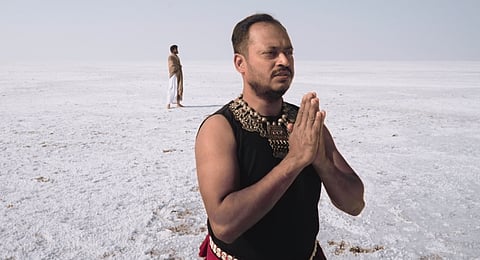
The Killing of Meghnad Still Ashish Avikunthak
As an archaeologist, you often deal with ‘layers’. How does this film act as a ‘layered dialogue’—a 21st century film commenting on a 19th century poem that comments on a 16th century text (Tulsidas) and a 2,000-year-old epic (Valmiki)?
My film functions as a 21st century cinematic commentary on Michael Madhusudan Dutt’s reinterpretation of Krittibas’s Ramayana, which in turn is a commentary of Valmiki’s classical text that had already been shaped by numerous Ramayana traditions circulating across the subcontinent more than two thousand years ago. I understand my own adaptation as participating in this long chain of reinterpretations—each responding to and reshaping the versions that came before it. These multiple layers of commentary form a kind of historical palimpsest in which every retelling both inherits and transforms the epic. My re‑reading is acutely aware of this deep stratification of meaning, in part because my training as both an archaeologist and an anthropologist has taught me to recognise how texts, practices and narratives accumulate, fracture and reform across time. Approaching the Ramayana through this lens allows me to treat the film not as a linear adaptation but as an intervention in an ongoing cultural and intellectual conversation—one that stretches across centuries and continues to evolve in the present.
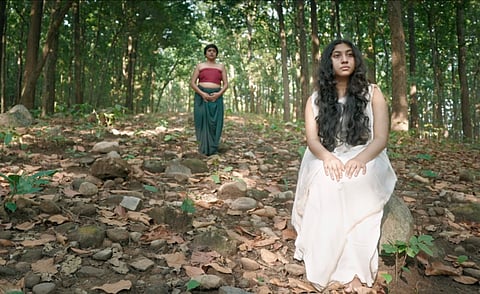
The Killing of Meghnad Still Ashish Avikunthak
Why was it essential to physically place Michael Madhusudan Dutt—in his Victorian attire—within the frame of this ancient landscape?
I think of my film as commentary, where I intentionally unsettle the original text by displacing its setting and disrupting its dialogue, using the source material only as a catalyst. My Meghnad Badh Kavya is not merely a retelling or adaptation or Dutt's original. Instead, I transmute Dutt's text into a new narrative structure. What remains is only a faint echo, absorbed into a world shaped by my own cultural, linguistic and political concerns. This process creates a work that remains in constant tension with its source and the friction of that dissonance becomes visible on screen.
My practice is not one of erasure but of abandonment—the deliberate leaving behind of the textual body so that the cinematic form can take shape within its vacated space. A palimpsest provides the closest analogy since multiple layers of meaning continue to coexist even though only the topmost stratum is fully legible. Within this framework, it became almost inevitable that Dutt himself would appear in the film. The actor Sagnik Mukherjee embodies this multilayered structure by playing both Dutt and Rama and in an early sequence he even appears as Meghnad, allowing the film to collapse author, character and commentary into a single personification. This doubling and redoubling reflect the very logic of the project: my film engages with its source not by reproducing it, but by inhabiting, refracting and ultimately transforming it.
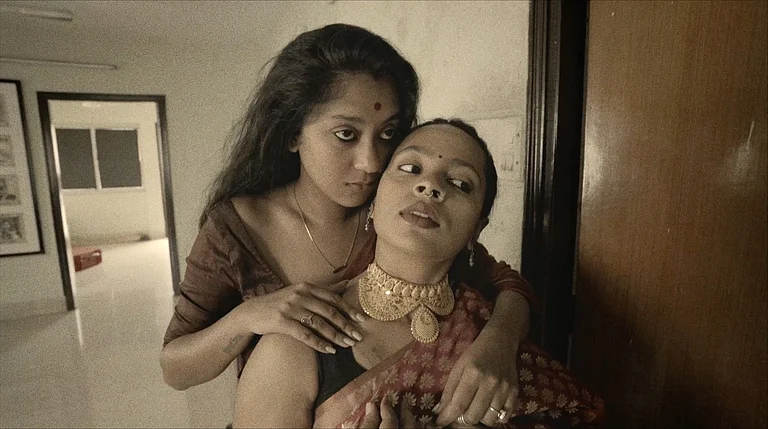
In Meghnad Badh Kavya, the soundscape often feels disconnected from the visual. You use a very rigid, deadpan delivery of the 19th century text. By removing traditional inflection and ‘acting’, you seem to treat the dialogue like an incantation or a ritual.
I do not believe there is anything that can meaningfully be called “traditional acting.” What we often imagine as tradition is really a series of evolving performance conventions shaped by the technological, aesthetic and cultural conditions of each cinematic era. In the silent period, acting relied on heightened mimicry, as exemplified by figures like Charlie Chaplin and Buster Keaton, whose performances used exaggerated gesture and physicality to compensate for the absence of synchronised sound. With the arrival of the sound era, acting shifted toward a melodramatic idiom, enriched by music, dance and expressive vocal delivery. Later, the emergence of Italian neorealism—made possible by portable cameras and sound equipment that allowed filmmakers to shoot on real locations—generated a new paradigm of realist or naturalist acting. This style subsequently became the normative language of global art cinema, reflected in India through the work of the Parallel Cinema movement. Each of these modes shows that different cinematic forms produce different acting styles—nothing about acting is fixed, authentic, or timeless.
In my own filmmaking, I have moved deliberately away from dramatic, melodramatic and realist performance traditions in order to develop what I call “infra‑realism.” If we imagine realism as zero degrees, dramatic acting as ten degrees and the melodramatic excess of Hindi masala cinema as one hundred degrees, then infra‑realism operates at minus one hundred degrees. This mode does not rely on deadpan delivery; rather, it cultivates an emotionally austere register that produces a kind of deterritorialised affect. In this space of reduced expression, the audience is invited to inhabit the performance through their own rasa and bhava, completing the emotional world of the film not through what is shown, but through what is withheld.
By decoupling the emotional weight of the voice from the action on screen, you create a 'void' that the audience must fill. Duras used this to explore memory and desire; you seem to use it to explore history and archaeology. Is the 'flatness' of the delivery intended to strip the Ramayana characters of their mythic ego, leaving only the 'material' of the language behind?
Infra‑realism, as I envision it, produces a deliberate emotive austerity through which the philosophical weight of the text can be felt directly in the cinematic form. This approach stands in conscious contrast to the history of the Indian mythological genre, which, beginning with Dadasaheb Phalke, gradually transformed religious narratives into popular entertainment, often reducing their philosophical depth to spectacle and amusement. Over time, this tendency intensified, reaching an almost excessive level of melodramatic display in films such as Jai Santoshi Ma (1975) and continuing in many contemporary mythological productions that rely heavily on artificial visual effects and ornamental grandiosity.
Against this lineage of accumulation, amplification and sensory overload, the infra‑realist mode in my films attempts to return these narratives to their contemplative and philosophical core. Rather than amplifying emotion, it pares expression down, moving toward an aesthetic of restraint that operates at the opposite end of the spectrum from melodramatic excess. This austerity is not meant to diminish the text but to reveal its inner substance by removing the layers of dramatisation that have obscured it. Through infra‑realism, the cinematic form becomes a space where the essential concerns of the narrative can resonate with clarity, unburdened by spectacle and where the viewer is invited to engage with the philosophical essence of the text rather than its performative embellishments.
You consider G. Aravindan as one of the great filmmakers in India. So, I am tempted to compare Meghnad Badh Kavya with his Kanchana Sita (1977). Both films are radical subversions of Ramayana. Aravindan focused on Rama’s interiorised guilt and the search for the feminine principle, while you focus on the tragic hero Meghnad and the collapse of moral binaries. Do you see Meghnad Badh Kavya as a 'spiritual successor' to the slow, meditative cinema of the 1970s, or are you trying to break away from the lyrical beauty of Aravindan’s work toward something more brutal and archaeological?
My film does not aspire to extend Aravindan’s lyrical tradition, nor does it attempt to inhabit the meditative aesthetic of the 1970s. Instead, my attempt is different both in method and in epistemological orientation. Aravindan’s cinema is rooted in a quiet lyricism that absorbs the landscape into the emotional interiority of the characters. My work, on the other hand, produces an intentional austerity of performance and affect. If Aravindan’s slowness opens toward the poetic, my cinema moves toward the disjunctural.
For me the Ramayana is not a stable narrative but a deep stratigraphy of texts, reinterpretations, ruptures and cultural sedimentation. I read the epic as a palimpsest in which layers of meaning exist simultaneously. This is why Meghnad Badh Kavya enters into the Ramayana at the level of fracture rather than continuity. I am not interested in preserving the epic’s lyricism but in investigating its contradictions. Dutt’s 19th century epic poem already destabilises the moral binaries of the Ramayana by humanising both Rama and Ravana, and my film pushes that destabilisation further. It is not the story that interests me; it is the collapse of certainty. Aravindan sought the feminine principle through a gentle philosophical lyricism. My work is pursuing something far more austere: the tragic interiority of Meghnad, the moral ambiguity of Ravana, the vulnerability of Rama and the philosophical density that Dutt embedded in the dialogical core of his poem.
Where Aravindan softens the epic into meditative reflection, I strip away narrative flesh and leave only bone, earth,and space. In that sense, I would not say I am following Aravindan or breaking from him. Rather, we are approaching the Ramayana from two entirely different philosophical directions. Aravindan moves towards the poetic soul of the epic, mine is toward its fragmented structure, its ruptured ethical architecture and the dissonances that lie hidden beneath the surface of the text. The affinity between our works lies not in continuity but in our shared refusal to treat the Ramayana as a monolithic narrative. Beyond that, the paths diverge sharply. My film is less a successor and more an interrogation that brings to the surface what has long been subdued: the philosophical, ethical and affective tensions that make the epic what it truly is.
Published At: