The Revolutionaries revisits India's underground freedom struggle across eight episodes.
Bhuvan Bam and Paoli Dam deliver standout performances.
The 8-episode historical drama struggles with pacing, ideology and tonal consistency.
The Revolutionaries Review | An Audacious History Lesson Undone by Its Own Excess
Nikkhil Advani's eight-part series brings forgotten revolutionaries into focus but struggles to match the scale of its history with equally strong storytelling.

Summary
Created and directed by Nikkhil Advani, The Revolutionaries takes on a difficult piece of Indian history: the underground networks that sustained armed resistance against British rule. Adapted from Sanjeev Sanyal's Revolutionaries: The Other Story of How India Won Its Freedom, the series brings Rash Behari Bose, Sachindranath Sanyal, Bagha Jatin and Pratibha Lahiri into a sprawling account of conspiracies, secret societies, political ideas and personal sacrifice.
Bhuvan Bam plays Rash Behari Bose, Rohit Saraf plays Sachindranath Sanyal, Gurfateh Pirzada appears as Bagha Jatin and Pratibha Ranta plays Pratibha Lahiri. The ensemble includes Paoli Dam as Pishima, Tota Roy Chowdhury as Abani Sanyal, Kashish Saluja as Kartar Singh Sarabha, K.C. Shankar as P.N. Tagore, Rajdeep Bhattacharya as Basanta Biswas, Mahabir Bhullar as Gurdit Singh, Jason Shah as Reginald Dyer and Ed Robinson as Charles Tegart.
The greatest achievement of The Revolutionaries is the history it chooses to foreground. Rash Behari Bose, Sachindranath Sanyal and Bagha Jatin rarely receive this kind of central treatment in popular Hindi storytelling about the freedom struggle. Even less familiar are the networks connecting Bengal, Punjab, Maharashtra, India House and revolutionary groups operating across continents. By putting armed resistance at the centre, the series expands a freedom narrative that is often presented through a much narrower lens.
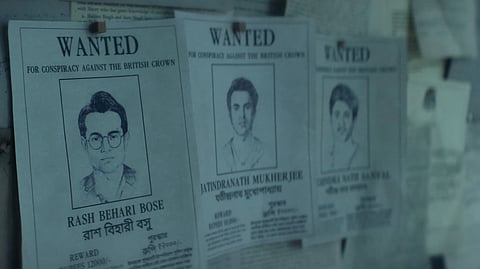
A Still From The Revolutionaries YouTube
India's independence movement involved competing methods, ideologies and political organisations. The revolutionaries depicted here accepted imprisonment, exile, torture and death as the cost of pursuing Azadi. Their stories deserve to be part of the national memory, and the series deserves credit for making audiences confront how much of this history remains unfamiliar.
The scale of the material, however, is also where the series begins to struggle. A story about Udham Singh can remain closely attached to one man, one trauma and one act of retribution. Chittagong can build itself around a defined group and a specific uprising. The Ghadar movement demands a far more complicated architecture. Rash Behari Bose, Bagha Jatin, Sachindranath Sanyal, Lala Har Dayal and several revolutionary organisations have to exist within the same historical ecosystem without reducing the story to a parade of names.
That is an audacious undertaking. The production effort is visible. The problem is that the execution rarely matches the ambition.
Advertisement
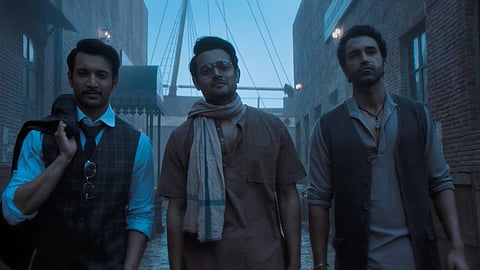
A Still From The Revolutionaries YouTube

The performances are one of the series’ stronger elements. Rohit Saraf and Pratibha Ranta develop convincing chemistry as Sachindranath Sanyal and Pratibha Lahiri, although their relationship occasionally slips into melodrama. The actors bring warmth to scenes that otherwise risk becoming purely functional.
Paoli Dam is exceptional as Pishima, based on revolutionary Nanibala Devi. Her performance has remarkable strength, especially because the character represents the many women whose participation in revolutionary movements has been pushed to the margins of popular history. Dam gives her an emotional weight that the writing does not always extend to other characters.
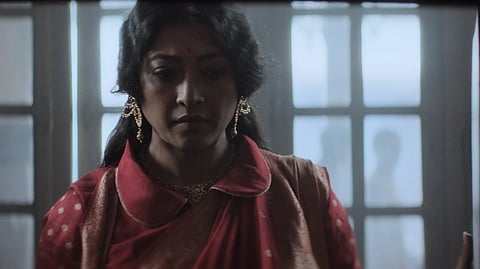
Paoli Dam As Pishima YouTube
Bhuvan Bam does well as Rash Behari Bose, and his dramatic ability is clearly visible in moments. Yet the screenplay gives him too little interiority. Bose is presented as a revolutionary leader and conspirator, but there is limited access to the strategist behind those actions. His failures, ideological convictions, exile and personal costs could have made the performance considerably richer.
Advertisement
The same problem runs through the ensemble. Characters constantly move the story forward but rarely develop within it. The series is so busy connecting historical events that the people behind those events can begin to feel like pieces being moved across a very large board.
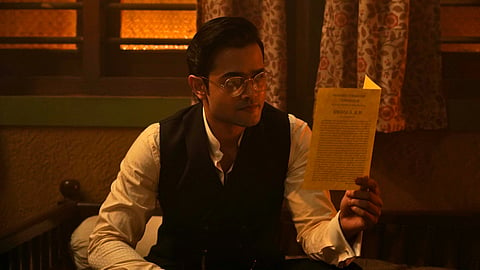
Bhuvan Bam As Rash Behari Bose Special Arrangement
The biggest dramatic issue is that the stakes rarely feel as high as they should. This was a life-and-death underground movement. A compromised message could expose an entire network. A single mistake could result in imprisonment or execution. Yet The Revolutionaries seldom creates the claustrophobia or anxiety necessary to make that danger immediate.
Compare this with Shoojit Sircar's Sardar Udham or Bedabrata Pain’s Chittagong, starring Manoj Bajpayee. Both films understand that historical danger becomes powerful when experienced up close. Their strongest sequences make the viewer feel trapped inside the moment. The Revolutionaries too often observes its own history from a distance.
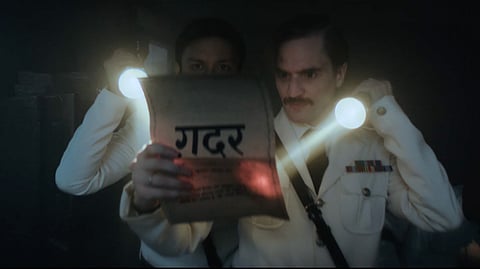
A Still From The Revolutionaries YouTube
The pacing does not help. The eight-episode structure should have given the material room to breathe, yet the screenplay is cluttered with songs, romantic tracks, side plots and tonal shifts. At times, two episodes can feel like a long wait for the central narrative to move. A tighter five-episode structure could have forced the series to distinguish between essential history and merely decorative material.
Advertisement
The visual language is similarly overworked. The colour grading, maximalist production design and frequent musical interventions sit uneasily beside the gritty reality of the subject. Cinematography, editing, and music often seem to operate independently rather than building a consistent atmosphere. Some sequences reach for historical grandeur while others resemble mainstream action drama. The result is visually heavy rather than immersive. The use of AI-generated or visibly synthetic imagery is particularly distracting in a story that demands physical texture and historical authenticity.
More importantly, the series does not go far enough into the ideology behind the revolution. These men were not "angry young Indians" who decided to pick up weapons. They read political theory, debated nationalism and economics and disagreed over what a free India should look like.
Lala Har Dayal's radical Marxist politics, the internal tensions within the Ghadar movement and the Hindu Nationalist positions of Sachindranath Sanyal and Rash Behari Bose could have provided the series with a fascinating intellectual conflict. These men did not necessarily agree on everything, yet different strands of the movement converged around the demand for Azadi. That contradiction is far more interesting than a simplified patriotic narrative.
Advertisement
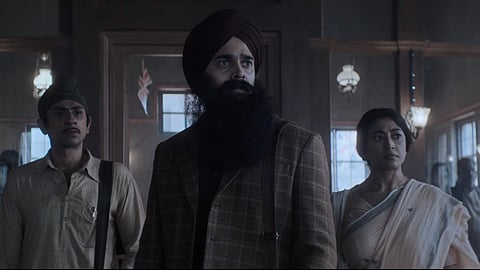
A Still From The Revolutionaries YouTube
The series also had an opportunity to show how revolutionary ideas travelled between generations. Sachindranath Sanyal's later role in the Hindustan Republican Association and his connection with Bhagat Singh and Chandrashekhar Azad could have formed a powerful epilogue. Similarly, the history surrounding P.N. Tagore, Kartar Singh Sarabha and the Komagata Maru gives the series access to stories most Indians rarely encounter outside specialised historical writing.
The treatment of 1857, Vande Mataram, India House and the akhada tradition could have gone further too. The symbolism surrounding Vande Mataram, the circulation of banned revolutionary literature and the transformation of physical-training spaces into political networks all point towards a fascinating history of how ideas travelled. The series often presents these details as symbols without spending enough time examining what they meant.
This is where Sanjeev Sanyal's source material becomes particularly important. His book offers a broad, interconnected account of revolutionary history, linking people, organisations and ideas across regions and generations. The Revolutionaries retains that breadth but not enough of the intellectual depth that makes the history compelling.
A truly great series is buried inside The Revolutionaries. Its subject is important, its scale is impressive and several performances are strong. But the series mistakes magnitude for depth. It wants to be a historical epic, political drama, romance, conspiracy thriller and action series simultaneously. In trying to accommodate everything, it rarely gives any one element enough space to breathe.
The Revolutionaries should have been a story about people who understood that freedom required sacrifice and were willing to pay an extraordinary price for it. Instead, the history frequently feels more powerful than the drama built around it.
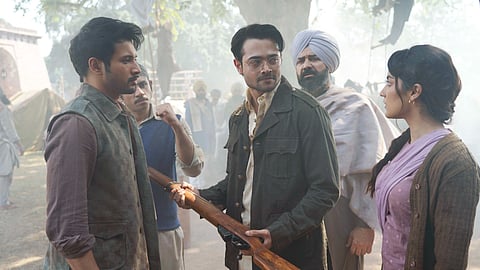
A Still From The Revolutionaries Special Arrangement
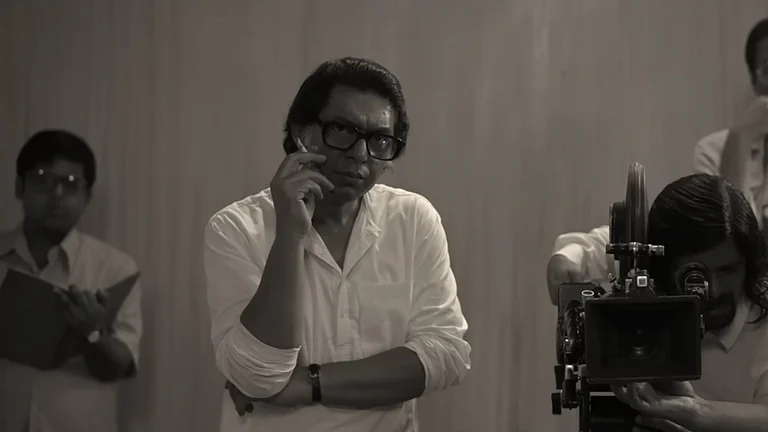
The series’ greatest success, then, may be the curiosity it creates. Viewers unfamiliar with Rash Behari Bose, Sachindranath Sanyal, Bagha Jatin, Pratibha Lahiri or the wider revolutionary networks may leave wanting to know more. That is valuable. But these revolutionaries deserved more than a grand production. They deserved writing as politically challenging, emotionally intimate, and intellectually restless as the history itself.
Published At: