Freedom at Midnight Season 2, created by Nikkhil Advani, began streaming on SonyLIV on January 9.
The series makes you anticipate encounters between historical figures, where each of their actions appear to directly impact rapidly worsening socio-political situations.
The verbal sparring between Siddhant Gupta’s Jawaharlal Nehru and Rajendra Chawla’s Sardar Vallabhbhai Patel is a clear highlight this season.
Freedom At Midnight Season 2 Review | War And Peace In Turbulent Times
Unlike its predecessor, the second season finds itself on much surer footing with what it wants to do with the abundance of the archive and delivers a poignant tale of belief over suspicion.

Summary
It would not be unusual for anyone who saw the first season of the SonyLIV prestige bureaucratic thriller-drama Freedom at Midnight (2024), to view the second season with a fair bit of apprehension. The first season of the show, while beautifully mounted and impeccably acted, lacked a clear sense of purpose for being told in 2024 beyond its cosmetic attractions. Flashes of brilliance here and there aside, the first season hurtled towards a tense climax with a radio announcement of the partition of India, where the viewer was expected to project whatever one thought of the event on to what was onscreen. Thankfully, the second season finds itself on much surer footing with what it wants to do with the abundance of the archive and delivers a poignant tale of belief over suspicion.
The second season, like the first, avoids framing itself as an expose of the fractious relationships between various members of the Indian National Congress. Instead, it provides us the gift of sharp dialogue that feels laden with the responsibility of both history and the present. The series is structured to make you anticipate encounters between historical figures, where each of their actions (or inactions) are shown to directly impact rapidly worsening socio-political situations. The verbal sparring between Siddhant Gupta’s Jawaharlal Nehru and Rajendra Chawla’s Sardar Vallabhbhai Patel is a clear highlight this season as their debates frequently devolve into a battle between idealism and pragmatism, especially during important decisions about handling the princely states as well as the region of Kashmir.

Freedom At Midnight S2 Still Youtube
The episode on Kashmir, in particular, rehabilitates the complex nature of the state’s politics from the oversimplified accounts of both the past and present floating around in all kinds of media in the contemporary. Chirag Vohra as Gandhi improves on an already uncanny impression of a man presumably out of tune with the movement he spearheaded. The decision to make these three the central figures of this season pays off immensely, as we see three different dreams of a nation emerging through them in a state of tussle. It also helps that the fourth dream, which emerges as Pakistan from the pride and ego of Muhammad Ali Jinnah, in contrast, evokes disquiet. Arif Zakaria turns the moustache-twirling figure from season one into a broken man with a withering body and a chip on his shoulder, more pitiable than an inspiring architect of a new nation.
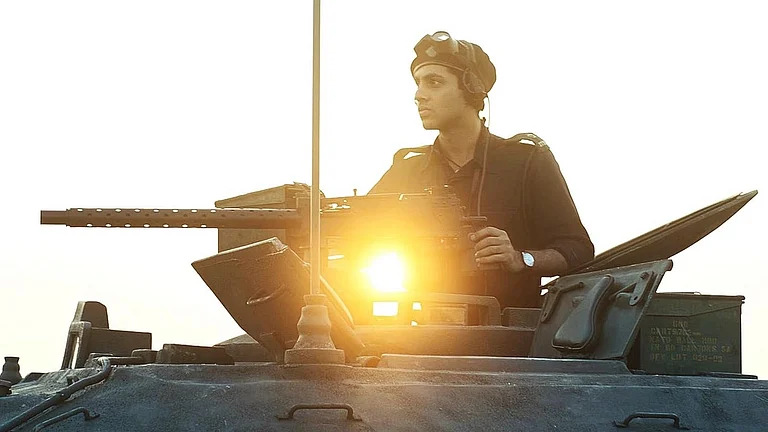
With character introductions out of the way in the first season, this one plunges straight into the action. The series begins, forming a great companion piece with the recently released Ikkis, by looking at the fallout of the partition within the Indian Army, as soldiers and comrades-in-arms find themselves in a dilemma over the consequences of the partition. This quartet of soldiers—two Muslims, one Hindu and one Sikh—provides the series its most efficacious moments outside of the corridors of power. Scenes featuring their interactions are peppered throughout the first half of the season, and even though one might immediately discern, from their introduction, the end of this sub-plot, it’s nevertheless a hearty reaffirmation of the ridiculousness of borders and the tragedy they bring.
Advertisement

Freedom at Midnight S2 Still Youtube
The other character whose story stands out is Madanlal Pahwa (played by an excellent Anurag Thakur in another great January release after 2025’s Black Warrant), who charts a traumatic journey from his Punjabi town in Pakistan to India. His character is framed as one who suffers the visceral costs of falling between the faultlines of the three competing dreams. He then finds a twisted sense of purpose in bringing more hurt and pain to those involved in peace efforts. Through his character, the series gestures towards a contemporary problem without naming it, but it does not feel irresponsible or lightweight, as his body eventually becomes the site where we witness the continuities of the colonial ways of policing.
One cannot deny that the series feels more urgent because of the conditions of the present. Archival wars, in the form of text message forwards with the heading “We were not taught this” are waged on WhatsApp groups, unsubstantiated with evidence but armed with unmatched speed and breadth. Television news, and increasingly popular Hindi cinema, give these messages image and decibel. In such a situation, a drama set during the foundational moment of the Indian republic, where the word ‘secular’ evokes not mockery or nostalgia but historical weight, sincerity and most significantly, intent—is a minor miracle. It activates the ideals that early Doordarshan television serials like Hum Log (1984) often assumed as their core values and asserts their presence as a dynamic and not a punchline.
Advertisement

Freedom at Midnight S2 Still Youtube
In this project, Gandhi’s role as a stern keeper of conscience, amid the clashing statecraft of Nehru and Patel, emerges as the most impactful examination of Gandhian values in popular media since Lage Raho Munna Bhai in 2006. Consider the sequence where Nehru recites his famed independence speech, filmed as a spectacle emerging from the hallowed grounds of India’s future parliament, as it travels through radio to various corners of the nation on both sides of the border. In one of these corners lies Gandhi’s frail, half-naked body, turned away from the jubilant fireworks in the sky, as the shot cuts to a close up of his face, a single tear rolling down his cheek. It’s a masterful moment, where the camera lingers on the toll of this half-realised dream on Gandhi’s soul. This frames his controversial actions later in the series just before he was assassinated—his fast unto death so that the Indian government release its pending financial dues to Pakistan and other conditions to safeguard the lives of Muslim minorities in India. In an environment of hate, where state, intelligence, army, populace, artists and sportspeople coalesce into one as the enemy, the series courageously addresses the blind spots in this vision and the power of empathy as political theatre.
Advertisement
Considering its contemporary popularity in progressive politics, the relative absence of B.R. Ambedkar’s vision of a free India as a central vector in this moment is sometimes glaring, as Gandhi’s views on caste are often his most critiqued. Perhaps, it would not have served the focused attempt to examine the Indian National Congress’ first brush with state power and bureaucracy. One scene, however, is striking in its gesturing towards this narrative absence, where on the eve of independence, a signboard outside a club that that states “Dogs and Indians not Allowed” is replaced with “Members Only”. Make of that what you may.
Published At: