Receiving calls from Rajkummar Rao and Arjun Kapoor, and seeing Karan Johar post about Raakh has been absolutely surreal, says Akash Makhija.
He won the IMDb ‘Breakout Star’ STARmeter Award for his role in the Amazon Prime Video series.
Treat mental health like any other ailment—if you're struggling, talk to a professional, is Makhija's advice.
Akash Makhija Interview | On Navigating Failures, Achieving Success With Raakh And Importance Of Mental Health
Playing Babu in Raakh earned Akash Makhija acclaim. In his 14-year career, it was the breakthrough role for Makhija, who proved he can also inhabit complex and dark characters after playing the innocent and lovable Govind in Gram Chikitsalay.

Summary
Some roles are written in destiny. Babu in Raakh was one such role for Akash Makhija that earned him acclaim. In his 14-year career, it was the breakthrough role for Makhija, who proved he can also inhabit complex and dark characters after playing the innocent and lovable Govind in Gram Chikitsalay. Viewers and critics are deeply shaken by Makhija’s chillingly accurate portrayal of the notorious villain in Raakh and sheer lack of remorse he displayed on screen.
To reach where he is today, Makhija went through auditions, rejections, and did small television roles and advertising campaigns. Following projects like Nirmal Pathak Ki Ghar Wapsi and Bhool Chuk Maaf, he is experiencing a massive breakthrough with Raakh after 14 years of struggle. He is India's most-searched profile, ranking top on IMDb and winning the IMDb ‘Breakout Star’ STARmeter Award.
The young actor is currently on cloud nine as celebs, viewers and fans have been messaging him, lauding him for his transformation into a chilling villain. In an interview with Garima Das for Outlook, Akash Makhija spoke at length about his journey, family, facing rejection for looks, mental health and more.
Edited excerpts:
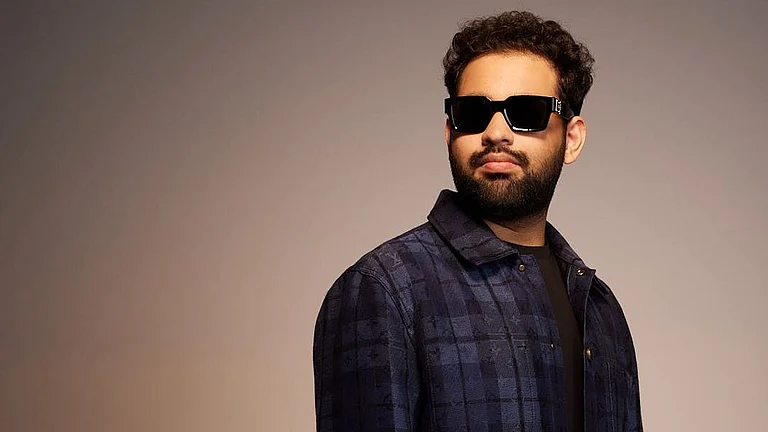
How are you processing the outpouring of love?
The response has been completely overwhelming; it is truly unbelievable. Even though I've been here for 14 years—this is my first true breakthrough show. As the saying goes, a performance only resonates when the show itself works.
I am filled with gratitude for everything that is happening. Every single day brings a new surprise or a heartwarming message. Receiving calls from Rajkummar Rao, Arjun Kapoor, and seeing Karan Johar post about the show has been absolutely surreal.

Akash Makhija wins the IMDb ‘Breakout Star’ STARmeter Award. Instagram
Karan Johar once said that success shouldn't give us ego, delusion or power. Do you agree?
More than staying grounded, you need to understand that this is simply how the industry works. Today, everyone is talking about you because of your great performance. Tomorrow, when another actor delivers a brilliant performance, the spotlight will shift to them. You must realise that all of this attention is just a byproduct of the profession. Ultimately, you just have to keep working and avoid getting carried away, especially since the audience’s attention span is short these days.
Advertisement
People are comparing your performance to Ashutosh Rana in Dushman and Prashant Narayanan in Murder.
Yes, I heard a lot about that, and it makes me happy. I think it's just the emotion that is coming out of people right now. I have grown up seeing those performances, which have only inspired me to grow.
Do you think playing a negative character has repercussions?
Honestly, I don't think so, because people are well aware that this is just a character. Yes, there is a tendency for people to view you as a villain and perhaps typecast you. But the industry is changing.
I’ve seen actors who usually play villains or negative roles do something completely different on screen. In fact, I had two shows released within a span of 10 days, where I played a villain in one and then the sweetest, most optimistic person in the village in the other. I've already shown my range, so I don't think there will be any repercussions. That said, I'm aware of the risk, and I hope it doesn't happen to me—but because I've already shown a different side on screen, I believe it’s all about balance.
Advertisement

A still from Gram Chikatsalay Instagram
What was your first reaction when you were offered the script of Raakh? Did you find it emotionally disturbing while reading it?
I was neither given a script beforehand nor was I in a position to ask for one. Instead, I was given just two scenes to audition with. Out of 800 actors who auditioned for the role of Babu, I made it to the top 14. I was the only urban actor in the group; everyone else had been recruited from the Marathi theatre industry. Eventually, only three of us were shortlisted.
The role initially went to someone else because of scheduling conflicts. However, when things didn't work out with that actor, the makers approached me again. After one more round of auditions, I finally received the script the night before the cast reading. I read it while travelling on the local train and was completely stunned. The shock you experienced while watching the show was exactly what I felt as the story unfolded on the page.
Playing this character terrified me. Also, had no idea who my co-stars were until the day of the reading. Since we were scheduled to go on floors just three or four days later, I had very little time to process the weight of the role. Fortunately, a rigorous workshop helped me quickly get into the skin of the character.
Advertisement
What was your process for getting the body language right? Did you improvise in certain scenes?
I believe this particular medium belongs to the writer and the director, not the actor. As an actor, you need to perform whatever your director wants; you cannot do anything that doesn't align with their vision.
To me, acting is truthful pretending. I take the sketch of the character in my mind and work with different theories. For Babu, I envisioned him as a mixture of multiple animals—he could be a tiger, a snake, a cow, or anything else. At the same time, Prosit (Roy) and I discussed making him look like a part of society, rather than portraying him as some stereotypical movie villain. The reason you fear Babu so much is that he feels like one of us, like someone who is around us. I always wanted to keep it that way, allowing the audience to perceive him that way.
Everything I have learned in this industry has been on set. I haven’t been to acting school or done theatre; whatever I've learned has come from being around cameras and working for so many years. Personal experiences help immensely as well. I travelled in local trains for 13 to 14 years of my life and observed so many people—how they talk, what they do, and how they look. Ultimately, it’s a mixture of everything: that lived experience, observation, and the craft itself. I am also a very instinctive actor who doesn't just stick rigidly to lines. If my co-actor changes a line, my response changes too, because I don't believe in just reciting lines—I believe in responding to the other actor.
It is incredibly important to align with your director, and Prosit and I are deeply aligned. If I ever got stuck, he would come over, give me a real-life reference, and I would run with it. We also spent a lot of time together in workshops, hotels, and vanity vans. That is exactly why our chemistry worked, and why the show beautifully captures the toxic marriage between Rajjo and Babu.
Advertisement

Rajjo and Babu in Raakh Instagram
Is it difficult to play a real-life character?
I was never told to read about the specific person you are referring to. I was only given 'Babu' on paper. I never did any external research on him. My goal was to portray him as a 1970s character whose personality was heavily influenced by Bollywood and films of that era. While it was already established that he belongs to the 70s, I never used Ranga or Billa as specific references.
Pankaj Tripathi mentioned in an interview that he always tries to find some kind of positivity even in negative characters. Do you agree with him?
I don't find any positivity in Babu, but I also don't view him as being wrong. If I start judging him, I won't be able to justify my character. I feel Babu lacks civic sense because I conceptualise him as an animal operating on pure instinct. He had no civic awareness around him. If she had just given him the earrings he asked for (referring to a scene in Raakh), nothing would have happened.
Even regarding his sexual desires—if he feels the urge, he simply takes what he wants without asking. I always approached Babu from this perspective and never thought of his actions as 'wrong.' If I start judging him morally, it will be the end of the performance, and I won't be able to convince the audience.
Do you believe we must occasionally confront our inner demons?
I completely agree. Introspection is vital because we all battle internal demons. If we want a better world, we must question ourselves rather than pointing out everyone else's flaws. From wars to daily violence and petty arguments, our chaotic reality highlights the desperate need for rational thinking.
The two characters in the show are products of our society, and not from some other planet. The decisions they made rippled far beyond those two kids, impacting their entire community. This underscores how our personal demons can harm the collective whole. To build a better world, we must embrace human values and focus on changing ourselves rather than demanding change from others.

Akash Makhija in Raakh Instagram

Playing this kind of character can take a toll on mental health. How do you keep yourself sane during tough times?
I'm incredibly privileged to live with a family of 10, which is rare these days. I choose to commute two and a half hours from Kalyan to Andheri just to keep that connection and stay sane. Speaking from personal experience, my advice is to stay away from substances like drugs and stuff, stay close to your family, and never hesitate to call them. Most importantly, treat mental health like any other ailment—if you're struggling, talk to a professional.
During those 14 years of struggle, did you ever experience any breakdowns?
Of course, I had breakdowns. I used to go to auditions and get rejected for not having a specific type of hair or skin. This happened every day.
In 2016, I was shooting Half Girlfriend, working on a show for Life OK, and filming a short film. I thought, 'I'm done, I've made it.' But by 2017, Half Girlfriend had come and gone without making an impact, the TV channel for my show went off the air, and the short film vanished into thin air. I was right back to auditioning and getting rejected all over again. In this field, you never know what tomorrow will bring.
I've cried a lot sitting by the window seat of local trains. Over these past 14 years, I can't even remember how many times I've cried.
After playing the same type of character several times in a row, actors often get stereotyped. Do you ever fear that happening to you?
Honestly, no. Directors and casting directors already know my range because of Gram Chikitsalay. My only fear is the lack of good work out there. Plenty of shows are coming up, but only one or two actually work in a year. I'm just starting out and want to give my absolute best, so I really just want to be part of shows with great stories.
Published At: