Tribeny Rai's debut, Shape of Momo, is currently running in theatres.
The Nepali-language indie set in Sikkim had its world premiere at the Busan Film Festival 2025.
In this interview with Outlook, Rai talks about writing and developing her first film as well as the reception.
Tribeny Rai Interview | On Shape of Momo, Sikkim and The Freedom In Being A Torchbearer
The Sikkimese filmmaker talks about an unsettled homecoming, why it’s a great time to be making films in her state, intersecting identities and questioning her protagonist in her debut, out in cinemas in India and Nepal

Summary
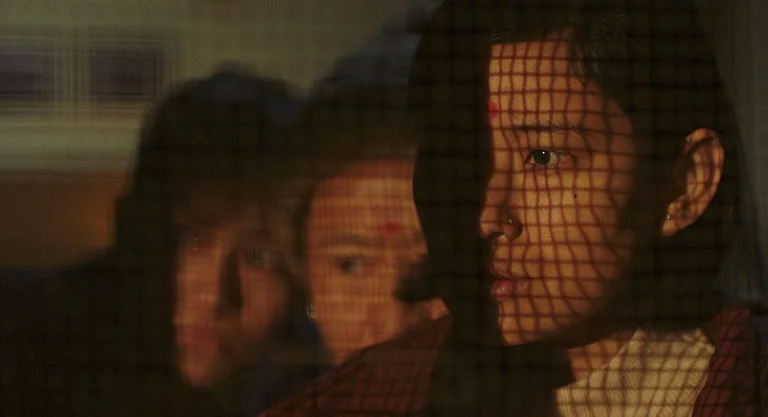
Tribeny Rai’s debut feature, Shape of Momo, has one of the most indelible heroines of any Indian film in a while. Bishnu (a bristling, unforgettable Gaumaya Gurung) returns home to Sikkim to superimpose her Delhi-imbibed expectations on a familiar place and people she thinks she can amend. But a rude awakening awaits her. Bishnu is prickly, wary and intensely reactionary, not eager to wrap herself in docility or submission which she judges both her sister, Junu (Shyama Shree Sherpa), and her mother (Pashupati Rai), as having compromised and living too cautiously. The fierce, unapologetic Bishnu refuses to soften or brook. You expect Shape of Momo to move in a certain direction until Rai, along with her co-writer, Kislay, daringly complicate the heroine’s centrality of assumption. The question of class intrudes and suddenly a linear, neat avowal of privilege and easy feminism interrupts.
Premiering at the Busan Film Festival last year, Shape of Momo marks Rai as a distinctive, firmly rooted voice to watch. Few days after the theatrical release, Outlook’s Debanjan Dhar caught up with Tribeny Rai for a chat. Edited excerpts from the conversation…
Distance expands and changes your perspective towards a place you thought you knew. I want to begin by knowing how your own relationship to identity, home and equations back in your place in Sikkim shifted when you went home after film school in Kolkata. What were some of the things you sensed you would no longer endure or tolerate, which maybe you might have done previously?
While I was studying in SRFTI, I’d visit my family once in a while. After film school finished, many of my friends went to work in Bombay and other larger film industries but I decided to return to Sikkim. We don’t have a full-fledged industry as such. I just felt like having studied at an institute like SRFTI, I needed to come back and tell our stories. At the institute, I’d see a lot of Malayalam and Bengali films and wondered when Sikkim’s representation would appear. Earlier, this film was quite different. It had a female sub-inspector. I wanted a woman in a position of power. While writing the film, I was going through some of the experiences that you see in the film. I felt like a modern, independent woman who has lived in Kolkata and comes back to Sikkim with an idea of changing the place. I saw my people as poor and needing help. But I realised they don’t really need my help. That’s their life. I realised I came from a place of privilege. I came from an informed place yet I felt I was invading a place that wasn’t very welcoming. It was heartbreaking in the beginning because you come back home thinking it’s waiting for you. But as I built my work and my agency elsewhere, things are changing back home. My understanding of home has also shifted. I felt the transition deeply and it hurt me initially. Then, I decided to make a film about it.
Advertisement
You graduated from SRFTI a decade back. When did you first think of this project? Of course, it has been through extensive rewriting…
Maybe six years back, because I was still working with the sub-inspector protagonist. Then I saw a lot of films and series with women as cops: Soni, Delhi Crime etc. The narrative wasn’t quite shaping out. It took me some time to remould it.
At what point did Kislay come in?
So, I had a couple of drafts ready, which seemed like a rant against my village. Kislay brought in a lot of perspective. He told me to look at the story from an objective lens and encouraged me to be critical of the protagonist as well. Otherwise, so many things intersect in life. I’m a woman, a filmmaker, a person from the Northeast. Our identities aren’t in isolation.
Advertisement
There’s this rich, fascinating intersection of patriarchy, class and xenophobia at the heart of this film. How difficult is it to measure the rage as a storyteller? How do you decide what emphasise and what to just indicate, suggest and evoke? Do you arrive at this through constant rewriting?
I think so. One of the challenges with the protagonist is how she’s not your regular, perfect heroine. Audiences also told me they were championing Bishnu but then halfway in, she became the devil. We only tend to champion heroes only if they are righteous, especially women. We idolise only those who epitomise sacrifice. As writers, Kislay and I wanted to be as objective as we could. I’m not saying Junu’s way of life is better than Bishnu’s or vice versa. It was important to give an honest representation of these women. Taking sides is totally left to the audience.

Still Tribeny Rai
One of the most powerful scenes is when the tenant’s son throws the apples. I wondered if he would react the same way had it not been a woman challenging him…
Advertisement
If a man challenges the modern and independent Bishnu, she’d give it to him. What if a young boy challenges her? He’s a child and you don’t know how to fight and negotiate. At the same time, we were aware that had it been Gyan, an MLA’s son challenging the boy, the latter would never confront him the way he did Bishnu. Also, if you notice whenever Bishnu gets angry, she’s pacified with the excuse of what others might say. However, whenever the tenant’s son flies into a rage, his mother would find a reason, citing he is tired or sick.
Bishnu will do anything to safeguard her family. But the boy is doing the same thing as well. At any chance she gets, Bishnu grabs it to exploit another woman who comes from a lower class. For example, in that orchard scene where Bishnu is fighting with the man and that guy is arguing with Bishnu, both are literally acting in the interests of their parents.
Advertisement

Can you share how you established that ease and tight-knit familiarity which was essential for the women?
I think the actors playing the protagonist, her mother, and the tenant’s wife are like best friends. They have known each other for the longest time. It became easier for me as a director when they already came with that chemistry. We did a lot of workshops much before the shoot. When the actors come from the same community, armed with similar experiences to that in the script, it makes things a lot easier to communicate. Pashupati Rai had played a lot of mother roles. She was wary when I approached her with the role. When she read the script, she sensed the difference. Gaumaya Gurung has been through a lot of experiences as Bishnu does. The same holds true for Shyama Shree Sherpa. All these women brought their collective experiences, not just with themselves but what they had seen with their mothers, sisters and neighbours.

Still Tribeny Rai
Were your workshops and rehearsals very tailored to the script?
I’d share backstories with the actors only if they asked. It varies from actor to actor. We stuck to the script. Also, we were shooting and living in the same house which is mine. We would recreate few scenes whenever we’d get time. The house has been inhabited by several women so that energy lingered.
You’ve gone to several labs, from Filmlab South Asia to NFDC Film Bazaar and Hong Kong Asia Film Financing Forum (HAF). And you already had a rough cut in place by the time you attended Film Bazaar. What were some things you wish you knew about navigating such circuits that you think you’ll be better prepared for the next project?
It has been very helpful. But you do have to know how to stick to your story and vision. There will be mentors from all around the world who wouldn’t understand your culture and might ask you to elaborate on the context way more than you would want. But you do have freedom to preserve your voice in these labs. At the labs, you go, pitch and justify everything that you have thought of. It’s a great place to interrogate your intention with making the film. I keep encouraging young filmmakers to apply to these labs. When you are planning to make your film, you feel like the whole world is waiting for it. Actually, nobody cares. You’re announcing in the film market about your coming with a project. We got in touch with a couple of programmers who saw our rough cut at Film Bazaar. But again, you should be careful in sticking to your vision because the suggestions can get to your head as in what works for European markets and so on.

Still Tribeny Rai
What do you have to say to sales agents who’d told you this film is unmarketable? How do you weather doubt when you get told such stuff?
The market is confusing to understand and follow. There is this burst of genre films, propelled further by Parasite. There are such expectations from India as well. So, when I took a small, heartfelt and ordinary film to the market, there was cynicism. But then we found Celluloid Dreams. Everybody has their type. It’s just a matter of finding like-minded people.
Is there pressure in being perceived as a torchbearer of being the first female filmmaker from Sikkim who has properly broken out? Or is it just exhilarating?
Sometimes, it’s exhausting. It’s one of the first films from Sikkim that has travelled so extensively in festivals, so I had to explain where Sikkim is in India. People would assume we have come from Korea or Vietnam. Then, they see the film and ask the characters don’t look so Indian, given the usual palette they are accustomed to. It’s a diverse country. But it’s also rewarding. Not everyone gets a chance to introduce their land and people with their film. There are limitations to being the first female filmmaker from Sikkim. But the best thing is there are no set rules. I have all the freedom to do whatever exploration I want because I’m the first one. It’s a mixed bag (smiles).
But do you find aspiring filmmakers walking up to you for counsel of any kind? What do you usually end up suggesting?
Every other person just wants to make their first film. Just to come to a place where you can look at your project objectively is very important for a filmmaker or an artist. I encourage them to apply to labs and grants because that fetches a lot of credibility. These are the films that also travel the festivals by default.
I know you did get a finishing grant from Sikkim's Chief Minister and he’s been encouraging but on a wider level, do you see infrastructural state support being given to young filmmakers or artists?
We do have subsidies for people making films. Sikkim has a small population and every other person has a government job. For the state government to recognise artists, it’s great. Sikkim held its first international film festival recently. It even had a film market! I was blown away. It had professional workshops. I think it’s a great time to be making films in Sikkim. Who gets a chance to be a part of history so often? We are building something that’ll create a legacy for filmmakers not just in Sikkim but also Nepali language and from the mountains. We also had the 3rd edition of Sikkim Kalakar Bharosa Sammelan where all artists from different sectors came together. That spirit has grown stronger in Sikkim. I hope this continues.
The most joyous thing about following your festival run is watching your mother beaming with pride and delight while travelling to all these different countries with the film, from Busan to Russia. Can you talk about that a bit, what your mother had to say when she watched the film for the first time? Was it in Busan or San Sebastian?
Yes, she first saw it in Busan with the press. I didn’t want her to watch it with the audience because I was very nervous myself. She likes different kinds of films. She loves South Indian films. When I was writing the film, she asked me to add a few songs. When she watched Baahubali, she wondered how the production managed to feed so many people (laughs). It was so lovely to present the film with her and travel together as a director-producer duo. She’s been very supportive and enjoyed all the limelight. Very often, people don’t get to see their children achieve their dreams. I’m missing my father but it’s wonderful that my mother is getting to experience all this. It’s one of the most special moments of my life.

How special was winning the Best Indian Film prize at Kolkata International Film Festival 2025?
I think the Kolkata International Film Festival was one of the earliest festivals I attended as a film school student. It came full circle. I hadn’t visited Kolkata since I passed out of SRFTI. It was almost like I’d promised myself I’d come back with my debut film. Winning the prize at the festival meant to me a lot more because it was Kolkata that gave me my understanding of cinema. It taught me a lot about life, helped me build my community. It was really emotional but also surprising. It took me some time to soak it in.

Still Tribeny Rai
What has the response in Sikkim been like?
All the mothers are crying, young girls have been writing essays in my DMs. They have found resonance. Perhaps the most surprising thing is even younger men connecting with Bishnu. In smaller places, conventional societies like us, just breaking out of your mould, irrespective of gender, hits a chord. For men, it has been an extraordinary experience because they are getting a glimpse at how women view life. It has been so lovely to see people celebrating our film like it’s theirs.

It’s been a super busy ten months since the Busan premiere. Have you had any breather to think of any new project?
In about two weeks, I think I’ll have time to think of something. This time, I do want to venture out of my comfort zone. Every other film I’ve worked on has dealt with women and my experiences. This time, I hope to be working with purely human emotions and relationships because I find them so complex. I really like how Nuri Bilge Ceylan writes and makes his films.

Still Tribeny Rai
Do you have plans to go back to an experimental mode which you earlier worked in?
I do intend to put some of my experimental thoughts in the film. I shifted to narrative purely for my mother. She wouldn’t understand my SRFTI films. I did struggle with a narrative script because I didn’t know how to write linearly. That was challenging. I think this film was for mother. I’ll make another for myself (smiles).
Published At: