Relations between heteronormative masculinity and nationalism have been receiving increased attention over the years.
However, with Dhurandhar 1 & 2, the patriarchal framework of propagandist cinema is moving away from the traditional image of the male-patriot to a war-machine shorn of all attachments.
To transform into an authentic weapon for state use, the warrior must renounce his past and surrender his sexuality.
Dhurandhar: The Asexual Saviour Of A Divided Nation
The redeemer of Naya Bharat is the middle-aged, ultraviolent asexual hero—a machine being that can effortlessly simulate human sexuality, but the single-minded purpose of its construction is to do away with the nation’s enemies.

Summary
Let us take a brief pause and believe that we are, in all probability, moving toward the glorious days of a mythical past. Let us also believe that this road to everlasting tranquility is stained with the blood of insurrectionists and dissenters. Let us, one last time, put all our faith in the powers that be, when they serve hot and gory revenge on a silver petri dish to micro-emotional organisms. We must, then, eventually ask ourselves: who delivers us from this archaic evil / what is the nature of our neoliberal-neotraditional saviour? I believe the redeemer of Naya Bharat is the middle-aged, ultraviolent asexual hero. Broadening the scope and definition of asexuality, I talk of a machine being that can effortlessly simulate human sexuality, but the single-minded purpose of its construction is to do away with the nation’s enemies. Asexuality, here, doesn’t concern itself with the orientation or life choices of individuals. This asexual hero derives satisfaction only from killing, overkilling and killing repeatedly.
Relations between heteronormative masculinity and nationalism have been receiving increased attention over the years. This narrative of gendered militarism is built not only by othering women, but also by constructing over-sexed and over-aggressive enemy men. However, this patriarchal framework of propagandist cinema is undergoing a paradigm shift. It is moving away from the traditional image of the male-patriot to a war-machine shorn of all attachments. The new agenda for this ruthless man is to alter his procreative and disciplined sexuality into an asexual assault hardware with the singular intention of killing for the nation.

Hamza Ali Mazari aka Jaskirat Singh Rangi aka Dhurandhar (Ranveer Singh) washes off blood with blood. It’s an irony, almost elusive, that Jaskirat’s deshbhakti and anonymity in Pakistan are a compensation for killing 12 men in a land dispute case involving his murdered father and gang raped elder sister. Here, love for the country is a byproduct of misdirected violence. Once again, what is upheld and legitimised is state-sponsored, organised bloodshed against a specific community/ religion/ neighbourhood as opposed to what is simply a crime of passion. Jaskirat must decide between a life rotting away in jail or as a homicidal maniac messing up the grand scheme of terrorists. For a while, in theory, even this extreme possibility feels convenient and effective—until Dhar stuffs our eyes with a festival of butchery to justify the anomalies of the ruling government. From demonetisation to the Babri verdict of 2019, every decision has been a means to end the Karachi underworld. Blindfolded allegiance and propaganda seem to be the eendhan/fuel for the honsla aur badla (courage and revenge).
Advertisement
And why not annihilate a place that is already savage, uncivilised and self-sabotaging! We are continually in the middle of gang wars between the Baloch and the Pathan communities in Dhurandhar’s Lyari (emerging out of a 6-acre set in Bangkok). Days begin with gunshots and grenades and end with riots and immolations. In one of the most brutal scenes, Uzair Baloch beheads a Pathan gang-leader and kicks around the severed head in full public view. These foreshadow the kind of violence that Hamza inherits from the barbaric Pakistanis. Hamza learns his skills, his fortitude and resilient silence from the Indian military, but his overwhelming inhumanity is a collateral upshot of Karachi cruelty.
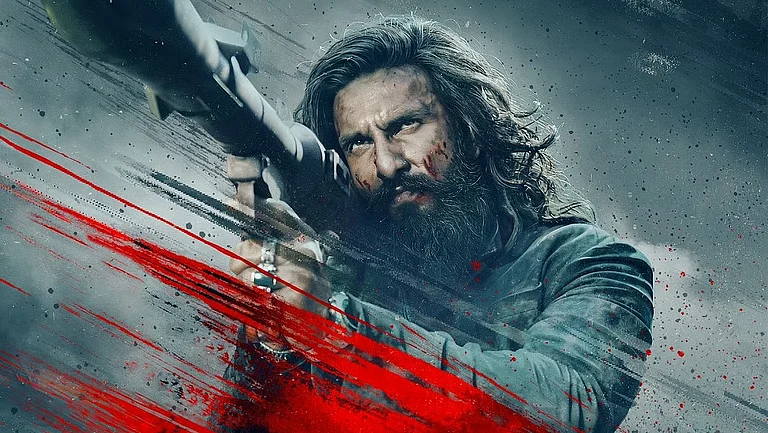
Our savage Samaritan believes only in all-encompassing sacrifice for the cause of the nation. Family and sex (and by extension, all women) are relegated to a secondary status, a comparatively weaker subordinate in this realm of muscle and manhood. Somehow, it becomes increasingly difficult to accommodate women within the context of man-made suffering. They are either a reproductive tool for a higher objective or caretakers in a household of vanishing males. To transform into an authentic weapon for state use, our warrior must renounce his past and surrender his sexuality. It is perhaps a debate for another day, if it is indeed this severance from sexuality that makes him so full of rage to begin with.
Advertisement
We are at the heart of toxic manosphere. Sanjay Dutt’s SP Chaudhary Aslam, often gifted with the best lines in this tragedy of terrors and mistaken identities, quips, “Jahan dard hai, wahan mard hai” (“Wherever there’s pain, there are men”) before shooting a man begging for his life. Men avenging, men plotting, men betraying each other, men immersed in arms and drugs trading, suicide-bomber men, insensitive, unregulated, manufactured men. Dhurandhar: The Revenge is a four-hour long spying into an all-male world of jingoistic destruction.

But Aditya Dhar is brilliantly manipulative. In an extensive post-credit sequence, we are stopped by Jaskirat’s training in the Indian army, where the entire focus is to turn the soldier’s body into an unfeeling, resistance machine—one equipped to endure physical torture and agony. We are witnessing the birth of the first nation-devised automaton in Indian popular cinema. This unkillable hero is a sadomasochistic pilgrim in a bloodthirsty quest. He is a free-floating and asexual nomad, who has been programmed to dispatch only one kind of people (the resonance to some such men already in power is unmistakable). Sex, if at all, functions as a strategy or solution to crack open the nationalistic objective; never as relief or pleasure. Is it comical to assume that the lack of real sexuality is somehow recompensed by countless sex-related expletives and reference of male genitalia? In the ending sequence, Jaskirat turns away from his estranged family, looks left, looks right and finally breaks through the lens to gaze directly at the audience. It resembles a message passed on to millions of unemployed youths of our country that there is only the issue of national security and nothing else and their lives, or whatever is left of it, belong to governments, present and future.
Advertisement
It is rather difficult to comprehend the elation of an entire crowd at the midnight screening I attended, when the Prime Minister appeared on screen or every time a Muslim traitor was assassinated; on the other hand, I also don’t know how to interpret the silence of a few who were stilled by some strange blow to the senses. And to make things even more complicated, there is the aspect of enjoyment. Periodically, the enormity of violence is tempered by the nostalgia of foot-tapping songs from the 80s and 90s. It’s a cushion to a terrified brain to be soothed every now and then by these familiar throwbacks. We forget almost immediately that the last of the action series comprises blasting an entire mosque. Maybe someday, someone ought to write about the pleasures and guilts of being enchanted by cinema built on bigotry and xenophobia.
Published At: