There were a bunch of players, the shining stars, who built the edifice of Indian tennis over the past six to seven decades. While Ghaus Mohammad Khan was the first Indian to reach the quarterfinals at Wimbledon way back in 1939, Ramanathan Krishnan was twice a semifinalist at Wimbledon in 1960 and 1961. As a junior player in the late 1970s, Ramesh Krishnan won the singles titles at both Wimbledon and the French Open. Recently, in 2024, at 43, Rohan Bopanna created history by becoming the oldest men’s doubles player to be ranked world number one. Apart from these Grand Slam achievements, India managed to reach the final of the Davis Cup—the holy grail of team competition—thrice: in 1966, 1974 and 1987.
Column | Who Will Carry the Legacy of Indian Tennis After Paes, Bhupathi and Mirza?
A legitimate question being asked in the tennis circuit is—who after Sania Mirza, Leander Paes and Mahesh Bhupathi and where does Indian tennis go from here

Then, of course, there were Leander Paes, Mahesh Bhupathi and Sania Mirza who inspired millions of youngsters to pick up the tennis racket instead of a cricket bat. They were the poster boys/girl of Indian tennis for a very long time. And then came the slowdown. While many players have been constantly striving to keep Indian tennis alive on the global stage, few like Yuki Bhambri, Ankita Raina, Sumit Nagal, Sahaja Yamalapalli and Rutuja Bhosale, among others, have made headlines and won medals for the country. Legitimate questions being asked in the tennis circuit are these—who after Paes, Bhupathi and Mirza, where does Indian tennis go from here and why have we not been able to replicate the success of the tennis stars mentioned above?
Lack of Administrative Support
“We should look at how Sweden, France and Italy have managed to produce so many top players in recent years. They must be doing something right and we should try to replicate their model,” says Nandan Bal, former tennis player and coach, who is presently the chief national selector.
Talking about the lack of administrative support, Bal says: “The past two-three years have been especially bad. The All India Tennis Association [AITA] is bogged down with court cases and is unable to function. An ad hoc body was set up, and it is trying to do something, but it’s not been able to make any ground without the system’s support.”
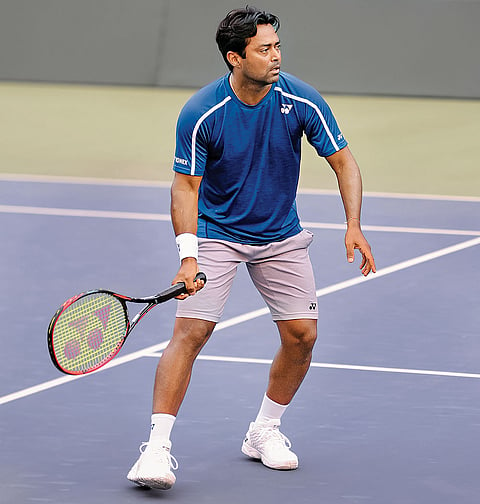
Leander Paes won many Grand Slams for India | Photo: Jitender Gupta
The court cases that Bal referred to are the ongoing, high-profile legal battles in the Delhi High Court concerning the governance, elections and constitutional reforms of the AITA. These legal disputes are primarily driven by former tennis champions Somdev Devvarman and Purav Raja.
Talking about the incredibly high benchmark set by Paes, Bhupathi, Bopanna and Mirza, Vishnu Vardhan, Olympian and veteran pro tennis player, feels it won’t be easy to fill their shoes.
“That said, I believe we have a very promising second generation of players coming through. Bhambri is leading that charge. He is currently ranked inside the ATP Top 20 in doubles and has already reached the semifinals of the US Open, which shows that he has the potential to become a Grand Slam champion. Alongside him, we have around eight to ten players ranked inside the ATP Top 120 in doubles,” says Vishnu, who is also the co-founder of Sportslet, a sports-gear supplier.
Advertisement
Indian tennis recently got a serious budget. The Sports Authority of India (SAI) has finalised a comprehensive development plan for tennis, approving a budget of Rs 10.05 crore for the 2026-27 financial year. The AITA has committed to rigorous performance targets for upcoming major global events—2026 Asian Games, 2028 Olympic Games and 2026 Youth Olympic Games.
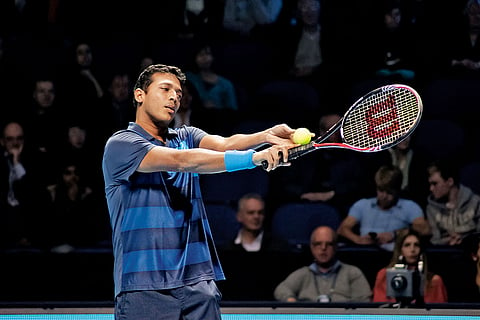
Mahesh Bhupathi won many Grand Slams for India | Photo: Shutterstock
“The good thing is that there is now government backing as it has realised the potential of sports other than cricket. It’s good to have finances because we have enough talent to work with,” Bal says.
What needs to be done to let our talent shine on the world stage? “The biggest challenge is the ecosystem,” asserts Vishnu. “India still lacks a structured pathway that allows aspiring players to train, compete and eventually make a sustainable living from professional tennis. I strongly believe in what I call the ‘Three Cs’ of player development—courts, competition, coaching. These are the three pillars required to produce world-class players,” he adds.
Advertisement
While there have been significant improvements in infrastructure, at the same time, professional training has become very expensive. Most quality coaching is offered through private academies, and while that’s a positive, it also means the cost of pursuing the sport at a higher level is beyond the reach of many talented players.
“We also host more tournaments in India today than ever before, but they are not yet part of a structured national pathway that consistently supports player development,” Vishnu says, adding: “What we really need is a stronger ecosystem with government-supported and CSR-backed high-performance centres that make quality coaching, competition and facilities accessible and affordable.”
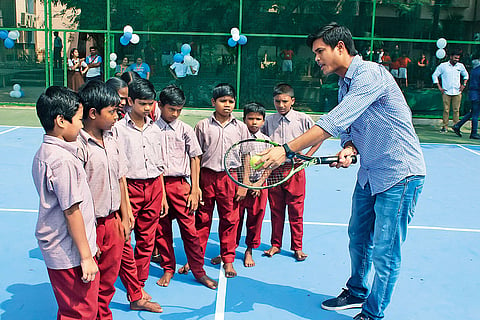
Former Champ: Padma Shri Somdev Devvarman at a tennis academy in Thane | Photo: Imago
Lack of Domestic System
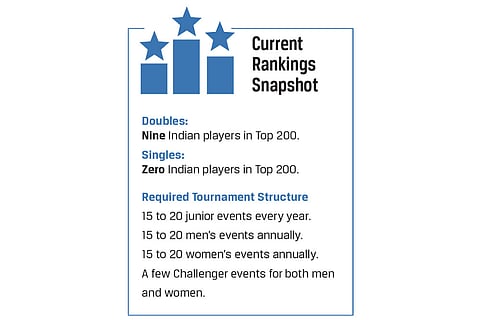
Talking about why we don’t have as many successful players as we once had, Prajwal Hegde, one of India’s leading tennis writers and the winner of ATP’s global media excellence award in 2021, feels that not having a regular top-level circuit has been a big bottleneck. “Look at Italy. They host 10 to 20 tournaments at every level, starting from J30s, J60s, and J100s for the juniors. This progresses to Futures—now known as World Tennis Tour events—such as the W100s or M100s. We do not have those events regularly in our country, which is the main reason we haven’t had the success many other countries enjoy,” says Hegde.
Advertisement
Another factor contributing to this problem is the historical success of our doubles players. When Bhupathi and Paes achieved massive success, followed by Sania and then Bopanna, it gave people a lot of hope and a viable path to make their careers work in doubles. “Doubles is not as competitive or as difficult to break into as singles, which is the glamour part of tennis,” Hegde says.
Going forward, the key for India is to produce dedicated singles players. We have a good crop of juniors currently coming through.
The key for India going forward, according to Hegde, must be to produce dedicated singles players. While we haven’t had that in a while, hopefully, the tide is beginning to change now with a good crop of juniors currently coming through.
Interestingly, we have quite a number of tennis academies functioning in the country. While most of these are amateur, recreational units and have nothing to do with serious tennis, some academies did have big names attached to big-ticket facilities but have had zero success.
Advertisement
Hegde thinks the most important thing is for the AITA to function as a federation should. “It is ultimately up to them to provide a proper pathway for the country, the juniors and the players who are transitioning to the professional circuit.”
(Views expressed are personal)
They Showed The Way
Ghaus Mohammad Khan: The first Indian player of distinction, he made it to the quarterfinals of the Wimbledon Championships in 1939. Khan annexed the Essex Championships the same year, besides reaching the finals at the Irish Championships and the London Hard Court Championships.
Ramanathan Krishnan: The greatest singles player India has ever produced, Krishnan wowed the tennis world with his artistic and eye-pleasing game in the 1950s and 1960s. He twice reached the semifinals at Wimbledon—1960 and 1961—and was once ranked third.
Vijay Amritraj: A contemporary of all-time tennis greats Bjorn Borg and Jimmy Connors, Amritraj made a dashing entry into the world arena in the early 1970s with his dazzling serve-and-volley game. In fact, Amritraj, Borg and Connors were called the ‘ABC’ of tennis.
Ramesh Krishnan: Son of Ramanathan, Ramesh emulated his father by winning the 1979 junior Wimbledon boys title and also added the French Open junior title to go with it. He bagged eight ATP singles titles and reached three Grand Slam quarterfinals—Wimbledon 1986 and the US Open in 1981 and 1987.
Leander Paes: Heralded as one of the greatest doubles players of all time, Paes won an astounding 18 Grand Slam titles—eight doubles and 10 mixed doubles—while excelling in singles too. He carried the national team on his shoulders for almost two decades.
Mahesh Bhupathi: The Paes-Bhupathi duo achieved voluminous success in the late 1990s and early 2000s. Bhupathi was the first Indian to win a Grand Slam title when he and Rita Haraki of Japan took the mixed crown at the 1997 French Open. He won a total of 12 Grand Slam doubles/mixed titles.
Rohan Bopanna: Bopanna has won 26 ATP Tour doubles titles, was a member of the Indian Davis Cup team for 21 years and has participated in three Olympics.
Sania Mirza: By far the best women’s tennis player produced by the country, Mirza became a role model for young Indian girls. Mirza remains the only Indian woman to win a WTA singles title. She won six Grand Slam titles.
Shashank Shekhar is a senior sports journalist
(This story appeared in Outlook magazine’s August 3 issue, 'The AI Divide', which focuses on how India's AI education ambitions are colliding with the reality of inadequate digital infrastructure, undertrained teachers and AI tools that are not built around Indian students' cultural context)
Published At: