On a humid afternoon in Rajokri Harijan Basti in southwest Delhi, barely 10 kilometres from the glittering terminals of Indira Gandhi International Airport, Savi stands outside her home watching a Delhi Jal Board water tanker pull in. Women and children rush out of homes with plastic cans and buckets.
Water Emergency: Why India has Turned into a Water-Stressed Nation
As cities expand, taps run dry, reservoirs shrink and groundwater depletes, policies around water management need an urgent overhaul

Savi watches people jostle for water but does not join the long queue. “It’s not my turn today,” she says. In Rajokri, residents have devised an informal roster to avoid scuffles over water, arguments that have, at times, ended at the local police station. Savi waits two or three days, sometimes longer, before her turn comes around again. Until then, every drop counts.
The basti has been grappling with severe water shortage for over six months now. While tap water is inconsistent, the limited supply is not fit for drinking or using. The 7,000-odd residents are dependent on water tankers, which in itself is frustrating. If a Delhi Jal Board tanker has arrived today, the next one might come a week or 15 days later. “We have no option but to buy bottled water or pay for a private tanker,” says Rekha, another resident. Shelling out thousands on water impacts the monthly budget severely.
The problem is not unique to Delhi. A water emergency is unfolding across India.
Muthulakshmi, who lives in the Chepauk neighbourhood of Chennai and works at a shop close to her house, has learnt to organise her daily life around the arrival of corporation water tankers. “We have to plan our work according to their timings,” she says. “There are times when we are left with literally no water until the next water tanker arrives,” Jayantika, a Bengaluru resident, says.
In Pune, Kaashi bai, a domestic worker living in a cluster of tin huts, relies on a single municipal tap shared by several families and a borewell that often runs dry. Alternate-day water cuts have turned storage into a daily exercise in rationing. “Families with children don’t have enough vessels to store water for two days. They end up borrowing from each other,” she says.
Her farmer family, who lives in a village near Solapur, is also enduring two-day water cuts. While they have resorted to storing water in large barrels and are drawing it from wells, delayed monsoons have pushed back crop sowing.
Advertisement
Even the financial capital of the country has been left high and dry. The Mumbai civic body has implemented a mandatory 10 per cent citywide cut for households and the city’s seven primary lakes are at critically low capacity with about a couple of days of water supply remaining.
While Mumbai’s near-empty water reservoirs have been making headlines, the story is not limited to the city alone. The country’s 166 major reservoirs were only about 28 per cent full in mid-June, as per the Central Water Commission data.
With cities expanding faster than the capacity of their rivers, reservoirs and aquifers, India stares at a water crisis every summer, which at times, extends beyond the hot months.
While recurring heatwaves and delayed monsoon patterns have been making water shortage more visible, they have also exposed deeper vulnerabilities that have been building for decades: fragmented governance, inadequate planning, unequal distribution and a chronic failure to protect local water bodies. The result is a paradoxical reality—cities that receive heavy rainfall and spend billions on water infrastructure still leave millions queuing for tankers every summer.
Advertisement
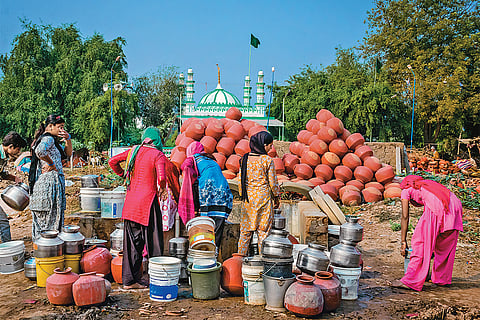
Summer Woes: Women filling water from a well in Ahmedabad’s Makarba area | Photo: Shutterstock
In addition, issues like uncontrolled and unlawful extraction of ground water, ageing pipelines leaking vast quantities of treated water, mismanagement in handling wastewater, among others, are pointing at an urgent need to fix the existing policy loopholes.
Data gap, for instance, is one of the challenges. A NITI Aayog report said 600 million Indians face high to extreme water stress—they live in areas where water is scarce or unusable—the data, however, was released nearly a decade ago. Similarly, a 2019 data by the policy think tank says by 2030, the country’s water demand is projected to be twice the available supply, putting millions at risk of severe scarcity, but there is no reliable data on where, how quickly and for whom water is vanishing.
Most of the data provided by multiple platforms is available at the district or state level, but it’s of no use because water bodies are not bound by boundaries. Planning based on insufficient data rarely produces lasting solutions, leading to efforts not producing impactful results.
Advertisement
The country has limited access to the world’s fresh water—while we are 18 per cent of the world’s population, only four per cent fresh water is available to us. India can no longer continue with its business-as-usual non-policy towards water. There is an urgent need to fix the crisis driven by governance deficits because slipping through the cracks are ordinary people whose everyday lives are getting impacted.
The Invisible Crisis
For Noor Jahan, who lives in Bapu Shambhu Colony in South Delhi’s Jaunapur, running water has never been a reality. Outside her home sit large blue storage containers, carefully filled and rationed until the next tanker comes. The colony is home to more than 5,000 people and they have spent more than a decade without a regular piped water supply.
A driver operating a water tanker for the Delhi Jal Board, who has been working for more than 12 hours daily this summer and travelling across different parts of the city, noted that many areas lack water pipelines altogether, making residents dependent on water tankers. But the areas that had pipelines faced different kinds of problems. Almost half of Delhi’s pipelines are estimated to be nearly three decades old, resulting in leakages, inadequate water pressure and contamination.
Advertisement
People complaining about dirty water was a pattern that emerged during ground visits, not just in bastis but even in upscale areas. So, while the water that Savi gets in Delhi’s Harijan Basti looks like chai (tea) and, at times, even the tanker water arrives with a yellowish tinge, a resident of Delhi’s Malviya Nagar says that since she moved into her flat a month ago, she has been experiencing severe itching and rashes around her vaginal area and suspects tap water to be the culprit. A resident of Bapu Shambhu Colony says: “The tanker water carries visible sediments, prompting the residents to strain it through a cloth before storing it.”
With cities expanding faster than the capacity of their rivers, reservoirs and aquifers, India stares at a water crisis every summer, which at times, extends beyond the hot months.
The consequences of poor water quality have been visible across cities. Earlier this year, a major sewage contamination outbreak in Indore led to hundreds of hospitalisations and several deaths. With more than half of the city’s government borewells dry, many residents in 75 of its 85 wards are relying on tankers, but after the recent crisis, they are scared to consume that water.
A NITI Aayog Report says nearly 70 per cent of water in India is contaminated, placing the country at 120th position among 122 countries in the water quality index. Just like contamination, the wear and tear of water pipeline networks is an issue that is common across cities. As cities are forced to source water from increasingly distant rivers and reservoirs, the cost of supplying every litre of water is rising. Yet utilities continue to lose enormous quantities through leakages, theft and ageing infrastructure.
“If we spend Rs 100 to bring 100 litres of water but receive only 60 litres because of losses, the cost of every litre increases significantly,” says Subrata Roy, director of the Water Programme at the Centre for Science and Environment (CSE).
Most urban local bodies do not recover the full cost of producing and distributing water. Water tariffs often remain politically sensitive and utilities struggle to generate enough revenue to maintain pipelines, repair infrastructure or invest in new systems. This creates a vicious cycle: underfunded utilities fail to maintain infrastructure, leakages increase, non-revenue water rises further and cities face water scarcity.
Delhi illustrates the challenge. According to available estimates, nearly 58 per cent of the water entering the city’s network is lost before it can be billed. “No utility can sustainably function when more than half of its water never generates revenue,” says Sagari Gupta, an independent policy researcher.
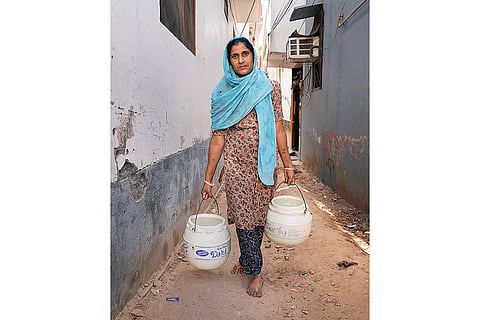
Daily Struggle: A woman returning home after filling water from a tanker at Rajokri’s Harijan Basti in Delhi | Photo: Suresh K. Pandey
The “Waste” Paradox
India’s water crisis is also being deepened by the way it handles its waste. India produces millions of litres of sewage per day, enough to fill 30,000 Olympic-sized pools, but treats only 28 per cent. The disposal of domestic sewage from cities and towns is the biggest source of pollution of water bodies, says the Central Pollution Control Board (CPCB).
Cities are expanding rapidly, but infrastructure is developing at a slower pace. Take the IT hubs of Hyderabad and Pune, for instance. A CSE data says, in Hyderabad, only 30-40 per cent of expanding areas have sewer networks; although 95 per cent of Pune is covered by sewer networks, collection efficiency is only 64 per cent. Both cities are treating only a small share of the sewage they are generating.
Far away in Jammu, a petition filed by environment activist Raja Muzaffar Bhat led to the National Green Tribunal directing the setting up of sewage treatment plants to prevent untreated wastewater from flowing into drinking water sources. Illegal sand and boulder mining has contaminated major water sources such as Dal Lake and the Dudhganga River.
According to the CSE, wastewater generation will increase by about 80 per cent by 2050, highlighting an urgent need to significantly scale up wastewater treatment infrastructure.
Presently, a majority of urban wastewater is directly discharged into open water bodies, leading to another vicious cycle—cities pollute nearby lakes and rivers and then spend enormous sums transporting water from distant sources.
Roy estimates that roughly 80 per cent of the water used by households eventually returns as wastewater. “If we manage wastewater properly, we can manage drinking water better as well.”
Experts estimate that treated wastewater could potentially meet between 20 and 30 per cent of urban demand over the next decade. “The question policymakers need to ask is not where the next new source is, but why the existing water cycle is so incomplete,” says Gupta.
Experts also argue that cities need to fundamentally rethink how they manage water. Rather than treating it as a one-way resource that is extracted, consumed and discarded, urban centres must adopt a circular approach by treating wastewater, protecting lakes and recharging groundwater, says Roy. “We are not facing a crisis because there is no water. We are facing a crisis because we are not managing water properly.”
Depleting Ground Water
Over the past 50 years, the number of borewells has grown from 1 million to 20 million, making India the world’s largest user of groundwater, says a World Bank report. Half of urban India’s water supply comes from groundwater. In rural India, the figure rises to nearly 85 per cent. The Central Ground Water Board’s 2025 assessment classifies around 26 per cent of India’s 6,762 groundwater blocks as over-exploited, critical or semi-critical.
Gupta says borewell depths that once stood at 50 or 100 feet now routinely exceed 600 or even 1,000 feet in many cities. Water drawn from these depths frequently contains fluoride, arsenic, nitrate and salinity beyond safe limits. “So urban India is increasingly extracting groundwater that is both harder to reach and unsafe to drink without treatment. It is paying more for a worse product from a shrinking source,” she says.
For cities that have expanded beyond their original boundaries, groundwater has become the default source of water. Hyderabad, for instance, now imports drinking water from as far as 225 km (Godavari).
Experts say the problem lies less in policy design and more in implementation. Weak governance, poor coordination among agencies and inadequate monitoring are some of the roadblocks.
“The speed of expansion of cities is far greater than the speed of expansion of water supply lines,” Roy says. In Bengaluru, for instance, despite a year of above-normal rainfall and the expansion of water supply through the Cauvery Stage V project, several parts of the city continue to rely heavily on groundwater. According to the Groundwater Assessment Report 2025, extraction levels in some areas have reached 378 per cent of sustainable limits.
Depleting groundwater is also leading to land subsidence. A 2025 study published in Nature Sustainability found that more than 2,400 structures in Delhi, Mumbai and Chennai are at high risk of damage.
“More concretisation means less space for water to percolate into the ground,” says Roy. Instead of replenishing aquifers, rainwater now rushes into drains and rivers. “It increases flooding and reduces groundwater recharge. Gupta points to Mumbai’s disappearing catchments, Bengaluru’s lost lakes and Chennai’s shrinking wetlands as examples of cities dismantling their natural water-storage systems.
Even Jammu and Kashmir, long regarded as a water-abundant region, is beginning to show signs of water stress. Repeated years of below-normal snowfall, shrinking glaciers and drying springs have weakened drinking water sources. A recent Comptroller and Auditor General of India report found that nearly half of the lakes and water bodies in J&K have disappeared.
Existing Policies
The Centre has rolled out a range of initiatives to tackle India’s water challenges, from the rural drinking water-focused Jal Jeevan Mission and groundwater conservation under the Atal Bhujal Yojana to urban water security through AMRUT 2.0 and river rejuvenation under the Namami Gange programme.
However, experts say the problem lies less in policy design and more in implementation. Weak governance, poor coordination among agencies and inadequate monitoring have often prevented these schemes from translating into lasting improvements on the ground.
Despite an outlay of Rs 2.77 lakh crore under AMRUT 2.0 and more than Rs 1.19 lakh crore worth of water supply projects already approved, implementation has struggled to keep pace. Government data shows that across AMRUT and AMRUT 2.0, projects worth Rs 2.74 lakh crore have been sanctioned, but works worth only about Rs 1.12 lakh crore have been completed so far—highlighting the gap between allocations and execution.
“If we want to address the problem of water, we have to understand that water is one. Whether it is groundwater, surface water or wastewater, all these forms are interconnected,” says Roy.
Yet the country manages each through different departments and agencies that often work in silos. “More collaboration and joint action are required. It is not really a matter of policy that we are lacking. It is more in implementation, development and management,” says former Central Water Commission chief S. Masood Husain.
Until that happens, people will continue to put their lives and livelihoods on hold.
While Adith, an IT professional from Bengaluru, has been dependent on water tankers for five months now, Sonu, a driver employed by a family, often skips work to make sure his household has enough water, risking the job that keeps them afloat. “It’s a dilemma, but who cares?” he says.
(With inputs from NK Bhoopesh and Snehal Srivastava)
Published At:
Tags