Former devadasis are emerging as organisers, educators, and community leaders, reshaping rural power structures even as social prejudice continues to shadow their lives.
Economic and educational mobility is breaking the chain, with daughters stepping away from inherited roles and building identities no longer defined by their mothers’ pasts.
Reclaiming the system’s history reveals how it was reshaped into a caste-bound mechanism, one that quietly persists today under new names and altered rituals.
The Lesser Daughters Of The Goddess: Former Devadasis Rewrite A Caste-Bound Legacy
The Dravidian movement waged an ideological war against the devadasi system. As former devadasis lead a new wave of resistance, the practice is quietly sustained by caste, poverty, superstition and inherited ritual

Summary
On a humid afternoon, Dr Sitavva Jodatti stands in front of a group of young boys and girls gathered in a courtyard. They sit cross-legged on mats, notebooks open. She speaks with the practised clarity of someone who has retold her story again and again. “I was seven,” she begins. “In Class 1. They dressed me in new clothes and green bangles. Everyone gave me sweets.”
The girls listen, some wide-eyed since they know the outlines of the ritual. They have seen the posters warning their parents not to do it. But hearing it from a woman who lived it feels different.
Sitavva was one of six daughters in a family with no sons. Three of her sisters had already died young. Neighbours suggested that dedicating a daughter to Goddess Yellamma would “protect” the household and ensure support for aging parents. Initially, her father resisted. But then poverty pressed harder than principle, and eventually he yielded.
She remembers the festival atmosphere and feeling special. There were turmeric baths and the feast on the ninth day. “I was the centre of attraction,” she says. What she did not understand was that she had just been marked for a lifelong path without marriage. Belonging instead to an invisible deity and then, inevitably, to men. Somehow, her father insisted she continue school and that saved her briefly. But not from cruelty.
“Other children teased me,” she says. “‘You’re married to the Goddess therefore any man can have you’.”
Without pausing for effect, she states it plainly. When her father fell ill, food vanished from the home. There were no savings or support. She was 14 years old when the first man came forward. He was thirty. “He was kind,” she says, not defensively, only truthfully. He paid her mother. “But I didn’t choose,” she says.
Her second partner, too, was selected for economic reasons. He had land, eighteen acres, and a wife who could not conceive. Sitavva’s child “proved” his fertility and earned her a space in his life. Decades later, he still comes during harvest season with grain. He lives with his wives, but visits her regularly.
Advertisement

She explains the system almost clinically. “Everything was decided for us. Who we go to, when, and why. It was all arranged by others,” she says. From these two partnerships came her son and daughter. Even as both men built “legitimate” families elsewhere, she raised her children on her own.
Now, as the CEO of Mahila Abhivruddhi Mattu Samrakshana Samsthé (MASS) in Belgaum, Jodatti is guiding women like herself and the children born into the devadasi system.
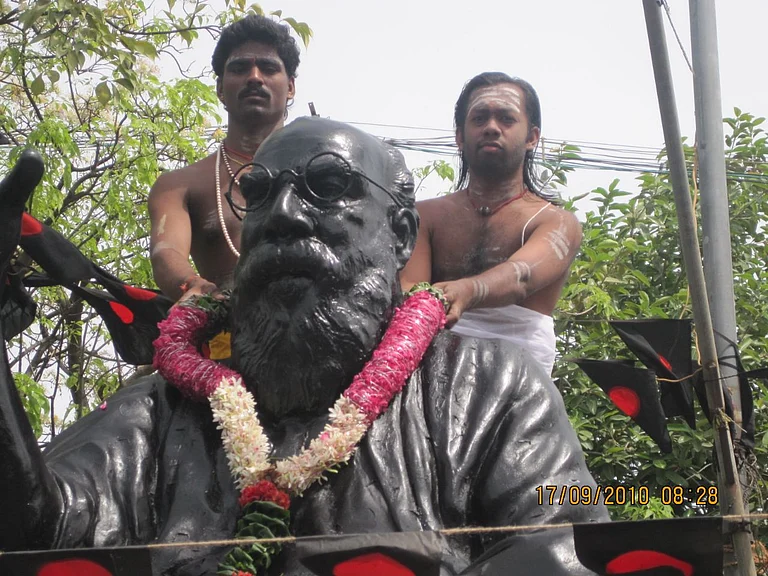
If Sitavva’s strength represents individual defiance in this region, the Dravidian movement in Tamil Nadu, drawing energy from the Self-Respect Movement, sought to dismantle caste power in all its forms, including religious, economic, and sexual.
Dr. B.L. Patil, activist and founder of Vimochana, notes that the campaign to abolish the devadasi system cannot be separated from the impact of Dravidian thought, which fundamentally challenged caste hierarchy and Brahminical dominance. In the 1920s and 1930s, activists held confrontational rallies. The devadasi system, reliant on temple sanction and caste hierarchy, became a central target.
Advertisement
The legislative struggle to abolish the system was fierce. Key figures included Periyar, Dr. Muthulakshmi Reddy, India’s first woman legislator and first female medical graduate, and Moovalur Ramamirtham Ammaiyar, herself born into a devadasi family. Ramamirtham Ammaiyar’s 1936 novel, Dasigalin Mosavalai (The Treacherous Net of the Devadasis), exposed the exploitation inherent in the system.
“Long before many states acknowledged the issue, Dravidian leaders framed dedication as a violation of dignity and pressed for the law that abolished it. That legacy is crucial to understanding how social reform can be engineered,” says Dr. Patil.
The Dravidian parties carried this critique forward. The Madras Devadasis (Prevention of Dedication) Act, 1947, was more than a legal measure. It was the culmination of a cultural rupture. “By the 1940s, Dravidian discourse had made the system socially shameful. A law can criminalise an act, but a movement can criminalise the idea,” says Dr. Patil.
Advertisement
The movement directly challenged caste structures that legitimised dedication, temple economies profiting from female labour, and the deeply entrenched notion that a woman could ‘serve’ God through sexual availability. Terms like sumangali, bhakta, and seva were exposed as veils for exploitation.
By contrast, Karnataka, Maharashtra, and Andhra Pradesh lacked a comparable ideological movement. “Reform came from scattered activists and social workers, not a sweeping political force. This difference matters,” says Dr. Patil.
“A movement can change public consciousness. Law alone cannot.”
In these non-urban regions, the system quietly adapted and mutated, taking on new forms such as Murali, Mathamma, Jogappa, Jogini, or simply “service to Yellamma.”
Dr. Patil observes, “It stopped being an artistic or ritual institution and became a caste-bound mechanism controlling Dalit women’s labour and sexuality. It’s no longer about dance or cultural service, it became about availability, a word that reveals the economic dimension of caste.”
Advertisement
According to historian Dr. S. Chandnibi, author of Kalvettukalil Devadasi or Devadasi in Inscriptions, inscriptions reveal that terms such as Devaradiyar (‘Servant of God’) and Devar Magalar (‘God’s daughters’) denoted respected temple functionaries. These women once held positions of authority, received land grants, and contributed meaningfully to temple and cultural life. However, over time, these roles were disrupted. “Devadasis lost their social and economic status, leaving these women vulnerable to exploitation under the guise of religion, custom, and tradition. Erasing their history, their agency, and their land rights makes it harder to see how the system fell, and how violently it was reconstructed on Dalit women’s bodies,” Dr. Chandnibi notes. “If we misunderstand history, we misunderstand what women like Sitavva and Ningavva are resisting today. They are not resisting a ‘tradition’. They are resisting a caste economy.”

Meanwhile, amid the borderlands, women like Ningavva Kanal, 52, carry the weight of the past. Today, she runs a modest kirana shop in her village. But her life began in stark contrast. Born into a family of six sisters and one brother, Ningavva’s father was unemployed and abusive. Her mother laboured tirelessly to feed the children. She was just 12 when “she had to be” dedicated to the temple, “adorned with a pearl”, and sent to Benaras alongside her sister.
There, in a two-storey building where women sang and danced, she became a tawaif. Her voice, clear and melodic. She soon drew paying patrons, marking the beginning of a life, shaped by ritualised exploitation. She eventually returned home, carved out an existence, and raised two daughters. One is an engineer in Bengaluru, the other married. Today, she has brought her extended family under one roof, redefining resilience on her own terms.
“As a former devadasi, I should have ended in the temple or on the streets,” Ningavva says, adjusting the packets on her shop counter. “But I decided mine would end differently. My daughters will never carry what I carried.”
Like Ningavva and Sitavva’s, former devadasis across the region have taken control of their lives, turning exploitation into activism.
Shobha Gasti, 51, is one such woman. Part of a family where her grandmother and elder sisters were devadasis, Shobha was dedicated at 12 after her father’s death left them impoverished. After social workers intervened, she resolved to be the last in her family to endure this life. Now, running the organisation Amma in Modelgi, she focuses on working for the children of former devadasis as many of them still carry the burden of stigma and invisibility. “Breaking the system isn’t just about stopping dedications,” Shobha says. “It’s about making sure the next generation walks into school with confidence, not stigma. That is where real change begins.”
Experts point to the challenges as the devadasi system, leading to exploitation of women, quietly persists. In 2011, the National Commission for Women estimated that there were 48,358 Devadasis in India. However, a 2015 Report by Sampark submitted to the International Labour Organisation estimates that the number of Devadasis all over India would be close to 4,50,000. Director Centre for Law and Policy Research (CLPR) Jayna Kothari, summarising decades of bureaucratic inaction, says, “The law exists. The political will does not.” CLPR research, The Devadasi Practice: Intersectionality of Caste and Gender, in Tamil Nadu, Andhra Pradesh, Karnataka, and Maharashtra on the current status of devadasis in the region highlights that deeply entrenched caste beliefs, coupled with economic desperation, sustain this system. According to the report, one of the biggest hurdles in understanding why the devadasi practice is not diminishing is the lack of accurate data on its prevalence. Kothari urges periodic surveys, documentation of at-risk children, and dedicated district officers, along with awareness campaigns that must educate communities about laws, reporting mechanisms, and alternative livelihoods. The devadasi system may no longer be visible in public ceremonies, but its logic persists, encoded in poverty, ritual, and the unequal valuation of Dalit women’s lives, she says.
“If a girl can stay in school and her mother can earn, dedication is no longer seen as the only path. Education is the first act of rebellion,” Sitavva underscores.
Fozia Yasin is a journalist and researcher exploring the stories and lives at the margins. She is senior associate editor with Outlook.
Published At: