Arunachal Pradesh CM Pema Khandu rejects claims of forced displacement over the proposed Siang Upper Multipurpose Project.
Khandu cites China's upstream dam on the Yarlung Tsangpo as a reason to assess SUMP's potential role.
Sections of the Adi community oppose the proposed 11,200-MW project over fears of village submergence, displacement, loss of ancestral land and ecological damage.
Siang Dam Project: Arunachal CM Pema Khandu Denies Forced Displacement, Says No Decision Without Public Consultation
In a letter addressing concerns over the project, Khandu said the state government remained committed to dialogue, transparency and addressing the apprehensions of local communities

Summary
Arunachal Pradesh Chief Minister Pema Khandu on Monday rejected claims that residents would be forcibly displaced by the proposed Siang Upper Multipurpose Project (SUMP), calling the allegations false and assuring that no decision would be taken without extensive public consultations.
In a letter addressing concerns over the project, Khandu said the state government remained committed to dialogue, transparency and addressing the apprehensions of local communities. He also cautioned that protests involving violence, blockades and attacks would not resolve the dispute.
"Some people and groups are spreading false information about the SUMP. They claim that a decision regarding dam has already been taken, that families will be forced from their homes and that land will be taken without consent. None of this is true," Khandu said.
He added that misinformation had caused anxiety among residents, particularly the Adi community, and stressed that people deserved accurate information about the project's strategic importance and potential concerns.
Khandu Cites China's Dam, Says SUMP Needs Technical Assessment
Khandu said China had begun construction of a dam on the Yarlung Tsangpo River, around 40 kilometres from the Indian border, on July 19, 2025, without consulting India.
He argued that the development could expose the Siang valley to water-related risks, including sudden high-volume flows with little warning and water scarcity during dry winter months. According to the Chief Minister, nearly 65 per cent of the Aane Siang originates in China.
Khandu said the proposed SUMP should therefore be scientifically and technically examined as a possible means of managing seasonal water fluctuations and maintaining ecological flows in the Siang and Brahmaputra rivers.
However, he clarified that the project's pre-feasibility report was only an initial assessment intended to establish basic feasibility and provide a factual basis for further technical investigation. It did not amount to a final decision on the dam.
The Chief Minister reiterated that neither the state nor the central government would proceed without detailed public consultations. He said the government was willing to listen to residents, understand their concerns and address them transparently.
Advertisement
"Dialogue requires trust and mutual understanding, and we remain committed to dialogue, consent and finding a constructive way forward," Khandu said.
He also warned that those resorting to violence, threatening people or taking the law into their own hands would face legal consequences.
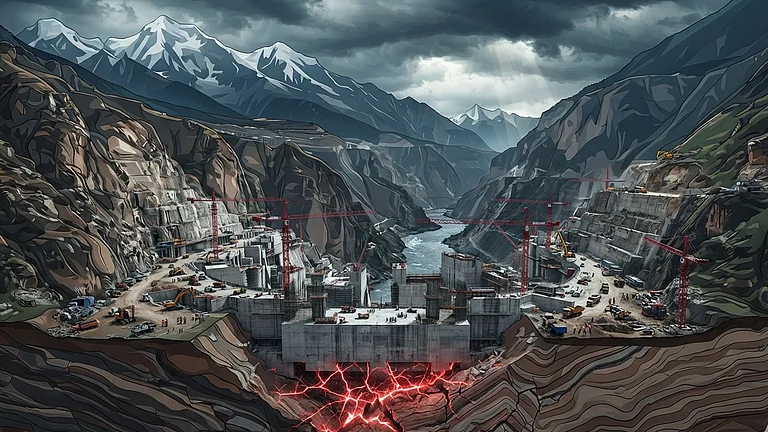
Adi Community Opposition Intensifies Amid Displacement And Safety Concerns
The government's latest outreach comes amid sustained opposition from sections of the indigenous Adi community, whose members have raised concerns over possible village submergence, displacement, loss of ancestral land and livelihoods, and environmental consequences. The project's location in a seismically active region has also prompted questions about dam safety.
Opposition intensified in October, with protests turning violent in late September and again on October 23. Protesters set fire to a National Hydroelectric Power Corporation office and a police station in Pasighat, while vehicles and properties linked to political leaders were damaged. The unrest prompted additional security deployment and renewed efforts by the state government to initiate dialogue.
Advertisement
On October 25, Khandu held separate meetings with legislators and representatives of indigenous communities to discuss the pre-feasibility report, environmental concerns and the project's national security implications.
The proposed project, estimated at around 11,200 MW, is intended to generate hydropower and provide a strategic response to China's planned upstream dam. However, local residents remain concerned about the scale of the project and its potential impact on their communities. The project remains under pre-feasibility assessment, with consultations and further technical investigation expected to shape decisions.
At the conclusion of his letter, Khandu appealed to the Adi community to engage in free and frank discussions, reiterating that the government would not take a decision without addressing public concerns. The situation in the Siang valley, however, has remained tense amid continuing opposition and demands for clarity on the project's future.
(With Agency Inputs)
Published At: