Days after the National Eligibility cum Entrance Test-NEET (UG) 2026, India’s largest medical entrance examination, was scrapped over allegations of a paper leak, Pradeep Manich, a 23-year-old medical course aspirant who had spent years preparing for the test in Rajasthan’s coaching hub of Sikar, died by suicide. A labourer’s son, Manich had been living in rented accommodation in Sikar, away from his home in Jhunjhunu. His family had reportedly sold land and taken on debt to sustain his coaching and living expenses. This was Manich’s third try at the exam, and according to media reports citing relatives, he had hopes of securing a high score in the May 3 exam. Relatives were cited as saying that the cancellation of the exam by the National Testing Agency (NTA) on May 12 had left him devastated after years of rigorous preparation and mounting stress related to the exam.
NEET-UG 2026 Paper Leak Scandal: Collapse of Trust, Student Suicides and India’s Medical Entrance Crisis
As the NEET-UG 2026 paper leak forced the cancellation of India’s biggest medical entrance exam, more than 22 lakh aspirants find themselves trapped in uncertainty

Students and their families are struggling to come to terms with the aftermath of the cancellation. And once again, the NEET-UG is facing a full-blown credibility crisis after having been engulfed in controversy two years ago over alleged paper leaks, grace marks, suspiciously high scores and organised cheating networks. This year, the alleged NEET-UG paper leak was first unearthed inside a coaching institute in Rajasthan’s Sikar, one of India’s largest coaching hubs after Kota. According to teachers associated with the institute, suspicion first emerged when a landlord walked into the centre and showed a PDF circulating as a ‘guess paper’ shortly after the May 3 exam. As a teacher began scrolling through the chemistry section, he realised that all 45 questions matched the actual NEET paper.
At first, many dismissed it as another fake paper that routinely circulates in coaching circles during exam season. But over the next few days, teachers quietly verified the material with students before approaching local police and alerting the National Testing Agency (NTA). Within hours, Rajasthan Police’s Special Operations Group (SOG), local police officials and members of central agencies reached Sikar to begin an investigation into a leak that would eventually snowball into one of the biggest examination scandals in recent years.
For 19-year-old Divyansh Sharma, a student from Rajasthan’s Chirawa who completed his coaching for his second NEET attempt from a renowned coaching centre in Sikar, the collapse of the examination meant much more than another delayed result. Last year, Sharma moved nearly 100 kms away from home to prepare for what he hoped would finally be his success. His father is no more. His mother manages the household and farm-related work while his elder brother runs a small taekwondo academy. The family pooled together money for coaching, hostel rent and study material in the hope that this year would finally change their lives.
After scoring 615 in his first attempt during Class 12, Sharma spent another year preparing through ed-tech company Physics Wallah’s offline centre in Sikar while living in a paying guest accommodation that cost nearly Rs. 8,000 a month. This time, after answer key corrections, he expected around 664 marks, enough, he hoped, to finally secure a government medical college seat.
Then came the cancellation of the exam by the NTA after allegations of paper leak surfaced across multiple states. In a major breakthrough in the case, the Central Bureau of Investigation (CBI) later arrested Pune-based professor P.V. Kulkarni, who was allegedly associated with the NTA question-setting committee and is suspected to have been the source of the leaked paper. The CBI has also arrested Manisha Mandhare, a biology lecturer at a Pune college who had been appointed by the NTA to set question papers for NEET-UG this year.
Investigators are probing an alleged interstate network involving “guess papers” that reportedly matched a large number of actual exam questions and were allegedly sold for anywhere between Rs. 10 to 25 lakhs.
The controversy has now reached the Supreme Court, with petitions alleging a “systemic failure” in the conduct of the examination, as more than 22 lakh aspirants across India remain affected.
For many students, however, the crackdown has failed to provide any sense of relief or closure.
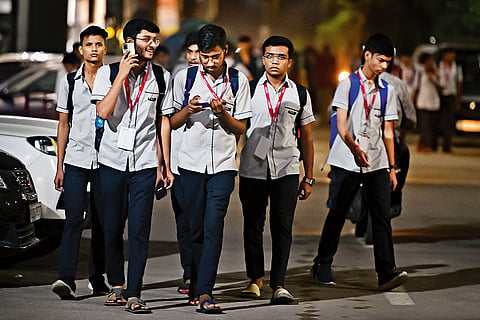
The NTA or investigating agencies cannot restore the months and years of labour lost. Many students who were confident of high scores had already vacated hostels, sold books and notes, and returned home, believing their NEET journey was finally over. Some had planned vacations or were reconnecting with family after months, or years, of isolation and relentless preparation. Now, many like Sharma are going back to coaching hubs, anxious and emotionally exhausted, but scrambling to restart preparation for the June 21, 2026 re-examination.
Psychological Uncertainty
Following the cancellation, Union Education Minister Dharmendra Pradhan announced several relief measures for the rescheduled exam. The government has extended the duration of the re-exam by 15 minutes, waived exam fees, opened a one-week correction window for students to choose exam cities again. Pradhan also declared that the government believed the pen-and-paper OMR system had become vulnerable and announced that NEET would transition to a Computer-Based Test (CBT) format from next year.
Despite the assurances, students grapple with uncertainty. “When someone spends one or two full years preparing and then the paper gets leaked, it feels devastating,” Sharma says. “More than money, the biggest loss is time.” He describes Sikar as emotionally exhausting; endless classes, overcrowded hostels and routines revolving around mock tests and revision. “You study the entire day because competition is so high,” he says. “Then, suddenly, you hear there will be another exam because of the leak. That is demotivating.” He adds, “The biggest challenge is mindset… You fear whether you will be able to perform the same way again.”
‘When someone spends one or two full years preparing and then the paper gets leaked, it feels devastating... More than money, the biggest loss is time.’
Eighteen-year-old Devadrita Dam, a first-time aspirant from Gurgaon was really happy because the paper was comparatively easier than previous years and she thought this would finally be the year she could get in. Dam had been preparing since Class 11 through Allen Career Institute’s online coaching programme, studying nearly 12 to 14 hours daily after her Board examinations. “The week after the exam, I was finally catching up with friends and making up for all the plans I had missed during preparation,” she says. “Then my best friend texted me saying the paper had been cancelled.”
She thought it was a prank until her uncle called to confirm the news. “I immediately started crying because I was so devastated that we would have to go through the entire process all over again.” The leak has deeply affected students’ confidence in the system according to her. “Before the exam, the NTA had said that this was not an ordinary school exam and that there was heavy security,” she says. “But now, it almost feels like a joke because people are openly talking about buying papers, even for the re-exam.”
Investigators probing the latest leak say this uncertainty may have been created by a structured criminal ecosystem operating across multiple states. According to Rajasthan Police officer Vishal Bansal, the investigation initially began after information was shared with the NTA by a whistleblower and later passed to the Rajasthan SOG for verification.
The Rajasthan SOG and the CBI are now examining what officials describe as a ‘paper-leak mafia’ operating across Rajasthan, Bihar, Haryana and Maharashtra.
Investigators suspect the leaked papers moved through a hybrid chain involving both physical access and rapid digital dissemination. Question papers were allegedly photographed or scanned into PDFs before being selectively circulated through WhatsApp groups and encrypted messaging platforms.

Bansal says the racket relied on controlled circulation. “The moment anything comes on a social media platform you can’t earn money,” he notes, explaining that those attempting to monetise leaked papers would avoid placing them too widely in the public domain too early. Investigators believe this controlled circulation model, where access is selectively sold through trusted networks rather than openly published online, is one of the defining features of organised exam leak rackets.
Drawing from his experience heading the Bihar Police’s Economic Offences Unit, Additional Director General of Police of the Bihar Special Armed Police, Nayyar Hasnain Khan, who supervised the 2024 NEET paper leak probe before it was handed over to the CBI, describes exam leaks as a “well-entrenched organised crime” run through syndicates involving insiders, vendors and criminal networks. Khan says vulnerabilities emerge throughout the examination process, especially when there is “compromise or laxity” at the top level. He notes that “if the body decides that we have to be transparent and fair, the chances of paper leaks are minimal.”
‘What happens to the morale of these students? What happens to their future? The academic year will be delayed, and entire careers can be altered.’
Referring to the 2024 NEET investigation, he says the Bihar Police established that the paper had been leaked despite initial “non-cooperation” from the NTA. “Although the general perception and the government version at that time was that there was no leakage, we were able to break the presumption that the papers were leaked,” he points out. “There is there is no problem in the standard operating procedure,” he stresses. “The problem is in the execution.”
Political parties have seized on the wave of public anger. Congress president Mallikarjun Kharge accused the Bharatiya Janata Party-led government of allowing paper leaks to become “a recurring betrayal of India’s youth”. He alleged that more than 90 examination leaks have taken place during the Narendra Modi government’s tenure and claims that investigations are repeatedly handed over to the CBI without accountability ever being fixed. “The guilty must be punished,” Kharge demanded. “The investigation must cease to be mere eye-wash.” He pointed out that when the NEET paper had leaked in 2024, the role of the then director general of the NTA came under severe suspicion. “The Modi government pretended to take action against him and suspended him,” Kharge said. “But within months, when the storm had settled, he was appointed to the coveted and powerful post of principal secretary to the chief minister of Chhattisgarh.”
Samajwadi Party spokesperson Udaiveer Singh alleged that a “powerful lobby” had turned examination malpractice into a business and questioned why repeated investigations had failed to identify the main operators. Another Samajwadi Party spokesperson, Abhishek Mishra, called the crisis “a structural problem”, arguing that repeated leaks were affecting not only students but entire families whose futures depend on competitive examinations.
“What happens to the morale of these students? What happens to their future?” Mishra asked. “The academic year will be delayed, and entire careers can be altered.”
Trinamool Congress MP Saugata Roy described NEET as “a complete failure” and demanded accountability from the Union Education Ministry. “The minister responsible, Dharmendra Pradhan, should take responsibility and resign,” she said.

A Crisis Years in the Making
For many aspirants and legal experts, the NEET-UG 2026 controversy does not represent an isolated collapse. It represents the continuation of a pattern.
Established in 2017 as an autonomous body under the Societies Registration Act, the NTA was created to bring standardisation, digital integration and specialised examination management under one national umbrella. Instead, the agency has repeatedly found itself at the centre of controversies involving security breaches, irregularities and allegations of institutional mismanagement.
In 2024, NEET-UG faced massive protests after allegations surfaced regarding paper leaks, grace marks and unusually high scores. The controversy intensified after results were released ahead of schedule and students claimed mathematically impossible scores had been awarded under the marking scheme. What investigators uncovered during the 2024 probe, and now suspect again in 2026, was not simply cheating, but an organised underground economy built around high-stakes entrance examinations.
In the earlier case, the CBI traced the leak trail to Hazaribagh in Jharkhand, where examination centre officials allegedly allowed unauthorised access to question paper trunks before the exam began. Candidates were allegedly transported to safe houses, made to memorise answers overnight and coached by “solver gangs”. This year’s investigation has revived fears that many of those networks may still be active.
The Supreme Court later ordered a re-test for 1,563 candidates who had been awarded compensatory marks due to time loss during the examination. However, the court stopped short of cancelling the entire examination. The judiciary drew a distinction between isolated malpractice and systemic collapse. The SC observed that “a body such as the NTA, entrusted with immense responsibility in relation to highly important competitive exams, cannot afford to misstep, take an incorrect decision, and amend it at a later stage, flip flops are anathema to fairness.”

Sonam Chandwani, Managing Partner at KS Legal & Associates, says that the SC has consistently held that competitive examinations must satisfy standards of transparency, fairness and procedural integrity. “At the same time, courts have also recognised that cancellation of an exam is an extreme measure and cannot be ordered in the absence of material establishing systemic compromise affecting the exam as a whole,” Chandwani says, adding that the legal threshold therefore is not the existence of isolated malpractice but “whether the sanctity of the process stands irreversibly undermined.”
But for students, the distinction offers little emotional relief. “Sometimes it does make me question my decision to pursue NEET at all,” Devadrita says. “Watching everyone else finish their entrance exams while we are stuck preparing again is frustrating.”
Even before NEET came under the NTA, the All India Pre-Medical Test (AIPMT) was cancelled by the Supreme Court in 2015 after investigations found that question papers and answer keys had been circulated electronically across multiple states.
Following the NEET and UGC-NET controversies in 2024, the Centre constituted a high-level committee headed by former Indian Space Research Organisation (ISRO) chairman K. Radhakrishnan to recommend reforms. The committee proposed sweeping changes including encrypted digital delivery of question papers, hybrid examinations, AI-backed authentication systems, standardised testing centres and a transition to computer-based testing. Yet, many of those recommendations remained unimplemented.
Sayak Dutta, a recent graduate from RG Kar Medical College in Kolkata, says the continued dependence on pen-and-paper OMR systems despite repeated breaches is difficult to understand. “Only a few days after the cancellation, we are already seeing groups like ‘Re-NEET’ on Telegram where allegedly confirmed question papers were already being auctioned off even before the re-test date was announced,” he says. “This just goes to prove how the nexus behind these leaks is ever so confident of the security lapse under the NTA.”
Can the System Still be Fixed?
Experts say the most immediate structural reform lies in moving away from physical question paper systems altogether. Several global medical entrance examinations already function through computer-based models. The Medical College Admission Test (MCAT), used for admission into medical schools across the United States, Canada and other countries, operates through computer-based testing systems with decentralised question banks. Similarly, the United States Medical Licensing Examination (USMLE) uses tightly monitored digital examination systems with biometric verification and standardised centres.
Many countries also rely on AI-assisted surveillance, adaptive testing and encrypted digital question delivery to minimise risks associated with physical transportation of papers. Some systems generate unique sets of questions for individual candidates from massive secure repositories, making large-scale leaks far more difficult. Countries like China and South Korea additionally rely on strict chain-of-custody protocols, surveillance systems and severe criminal penalties for examination malpractice.
In India’s fiercely competitive medical entrance system, dreams are rarely abandoned after one setback, only delayed, repeated and carried forward at huge emotional and financial cost.
In India, comparisons are increasingly being drawn to the Union Public Service Commission (UPSC), whose examinations have historically remained insulated from large-scale leak controversies. In February 2026, the Central government informed the Rajya Sabha that no paper leaks had been reported in UPSC or Staff Selection Commission examinations between 2021 and 2026.
Prateek Maheshwari, co-founder of Physics Wallah, says the current system places excessive psychological pressure on students because their entire future depends on one examination. “The examination system needs to be made more comfortable and student-friendly,” Maheshwari says. “It should be moved online and there should be multiple attempts within a year so students do not feel trapped by a single opportunity.”
He points out that long travel distances, extreme weather conditions and financial burdens intensify stress for aspirants and their families.
According to him, many students from villages are now uncertain whether they should continue staying in coaching hubs for the re-examination. “There is fear that if a re-test happens, it could be much tougher than the earlier paper,” he says, adding that “there has already been an announcement that NEET may move online in the future, and that is a positive indication overall.”
For students like Sharma and Dam, however, promises of reform offer little immediate comfort. Sharma has returned to offline mock tests while preparing for the June 21 re-exam, while Dam has resumed revision despite fears over whether the next paper too will remain secure.
Both know they have little choice but to continue. In India’s fiercely competitive medical entrance system, dreams are rarely abandoned after one setback, only delayed, repeated and carried forward at enormous emotional, financial and psychological cost.
(With inputs from Agnideb Bandyopadhyay, Ashlin Mathew, Jinit Parmar, Mohammad Ali and Mrinalini Dhyani)
Zenaira Bakhsh is an Assistant Editor at Outlook. She covers governance, minority rights, gender and conflict
Tags