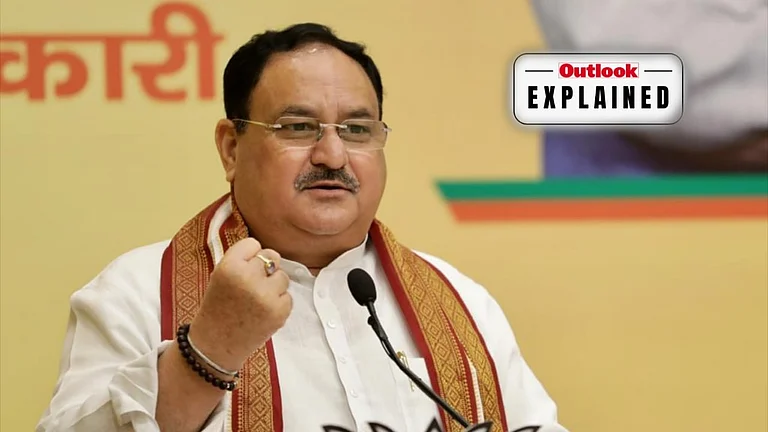
Union Health Minister JP Nadda reviewed the preparedness for NEET-PG 2026, scheduled to be held on August 30 across 340 cities
A record 2,73,183 candidates have registered for the examination, marking a 12.5 per cent increase from the previous year
Key reforms include closer test centre allocations based on candidate correspondence states and a revised pattern of 180 questions in 210 minutes
Nadda Reviews NEET-PG 2026 Readiness, Security Measures
Union Health Minister JP Nadda reviewed preparations for NEET-PG 2026, with over 2.73 lakh candidates set to appear in the August 30 exam under enhanced security measures, Aadhaar-based authentication and revised centre allocation rules.

Summary
Union Health Minister JP Nadda on Sunday reviewed preparedness for the National Eligibility-cum-Entrance Test for Postgraduate (NEET-PG) 2026, scheduled for August 30, according to PIB. A total of 2,73,183 candidates have registered for the exam, representing an increase of over 12.5 per cent compared to last year. The examination will be conducted in a single shift across around 340 cities and more than 1,300 centres.
Closer Centres, Revised Pattern
The government altered centre allocation rules to help candidates get centres closer to their place of residence. Candidates must indicate three state preferences, with their correspondence state being the mandatory first preference. To give candidates more time to plan travel and accommodation, officials will issue the test city intimation slip nearly three weeks before the examination.
The government also revised the examination pattern to give candidates more time per question. NEET-PG 2026 will now consist of 180 questions to be answered in 210 minutes, keeping the overall duration of the examination unchanged.
Enhanced Security and Authentication
To strengthen the integrity of the examination, the government introduced Aadhaar-based authentication during both the application process and on the examination day. If fingerprint authentication is unsuccessful, iris-based biometric verification will be used.
During his review, Nadda was briefed on extensive security measures. These include advance sealing and verification of examination centres, CCTV surveillance, biometric authentication, candidate frisking, deployment of signal jammers, dynamic computer allocation, live monitoring through central and regional command centres and real-time supervision by independent observers and appraisers. More than 60,000 examination functionaries will be deployed to ensure the smooth conduct of the examination.
To protect the integrity of the test papers, the government reinforced the end-to-end question paper preparation and delivery process. This process involves multiple layers of encryption, secure offline preparation, time-bound finalisation of the question paper shortly before the examination and controlled digital decryption only at the scheduled commencement of the test.
Advertisement
Warning Against Fraudulent Claims
During the review meeting, Nadda urged candidates not to fall for rumours or fraudulent claims regarding the examination.
"The final question paper is selected through a highly secure, encrypted and time-bound process shortly before the commencement of the examination. Any claim of prior access to the question paper by anyone is entirely false and intended to mislead candidates," Nadda said.
The NBEMS and the Ministry of Health and Family Welfare informed candidates to rely only on official communications and to report any suspicious activity. The NBEMS has also operationalised a dedicated email address for reporting instances of impersonation, touting and other unfair means.
Published At: