Modi revisited his 2013 ‘half-full glass’ metaphor, contrasting the pessimism then with India’s growth and opportunities today.
He contrasted the ‘policy paralysis’ of 2013 with what he described as India’s current phase of policy dynamism.
At SRCC, Modi urged young Indians to think beyond conventional careers and pursue ambitions across technology, entrepreneurship, space and innovation.
Modi At SRCC Revisits The ‘Half-full Glass’ And Takes On ‘Dimagi Naxals’
Modi’s return to SRCC after 13 years revisits his 2013 ‘half-full glass’ metaphor, while highlighting India’s economic transformation, youth aspirations and his sharper political attack on critics

Summary
On Saturday, Prime Minister Narendra Modi returned to Shri Ram College of Commerce (SRCC), 13 years after his first address at the institution, to speak at its centenary celebrations in Delhi.
The occasion brought together the college’s long legacy, Modi’s association with some of its former students and a larger message to a young audience about India’s economic journey and its ambitions for the future.
Much of the address, however, carried echoes of his 2013 speech, when Modi, then Gujarat chief minister and a BJP leader in opposition, spoke about three ways of looking at a glass - half-full, half-empty or full, with half water and half air.
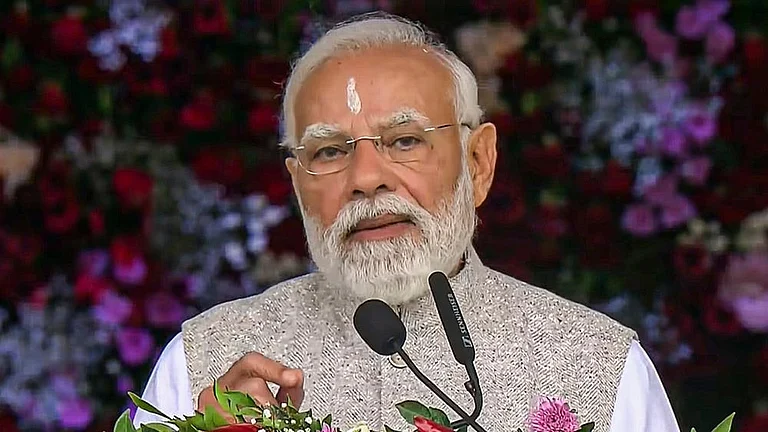
The Half-full Glass Returns
In his 2013 SRCC speech, Modi, then Gujarat chief minister and a BJP leader in opposition, had spoken about three ways of looking at a glass, half-full, half-empty, or full with half water and half air.
He returned to that metaphor, recalling that India was then surrounded by “despair” and citing headlines on slow growth, inflation, the current account deficit, terrorism and policy paralysis. He said he had chosen to see the glass as full despite the circumstances.
Modi urged students to look back at the news from 2013 to understand the context in which he had made those remarks, arguing that his optimism at the time was rooted in a belief that India could overcome its problems.

From ‘Policy Paralysis’ To Growth
The Prime Minister then used the contrast between 2013 and the present to make his case for the economic performance of his government.
He cited India’s 7.8% quarterly growth, along with higher electricity consumption, vehicle sales and steel and cement consumption, as indicators of rising economic activity. He also pointed to the expansion of banking through the Jan Dhan Yojana, mobile-phone manufacturing and defence production.
Advertisement
The figures, Modi argued, showed that India had moved from being described as a fragile economy to being seen as a fast-growing major economy.
Yet his target was not only the economic criticism of his government. He said those who viewed the glass as half-empty in 2013 continued to do so, suggesting that their assessment of India had remained unchanged despite the country’s economic expansion.
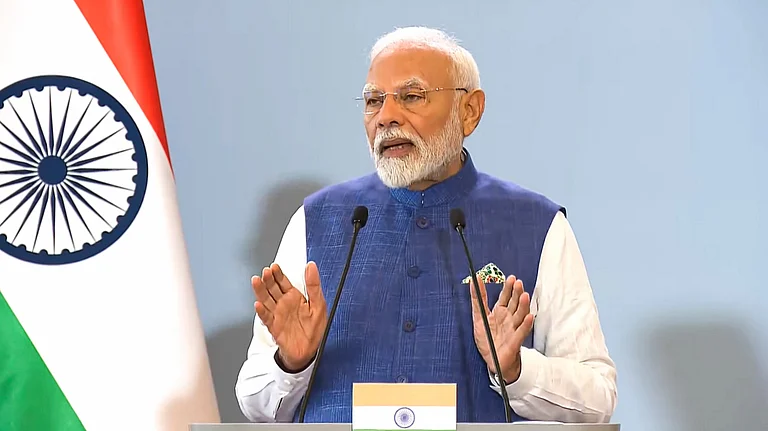
‘Dimagi Naxal’ & ‘What Is The Need?’ Crowd
The speech also acquired a sharper political edge when Modi took aim at what he portrayed as a habitual culture of opposition to government projects.
He referred to people who repeatedly ask, “What is the need for this?” when the government undertakes major initiatives, citing the Statue of Unity, high-speed rail, the new Parliament building and a memorial for soldiers as examples.
At another point, he reused the term “Dimagi Naxal” while attacking those he accused of opposing development initiatives.
Advertisement
The remarks fitted into his larger argument that India’s progress requires not merely government action but a change in the mindset with which ambitious projects are viewed.
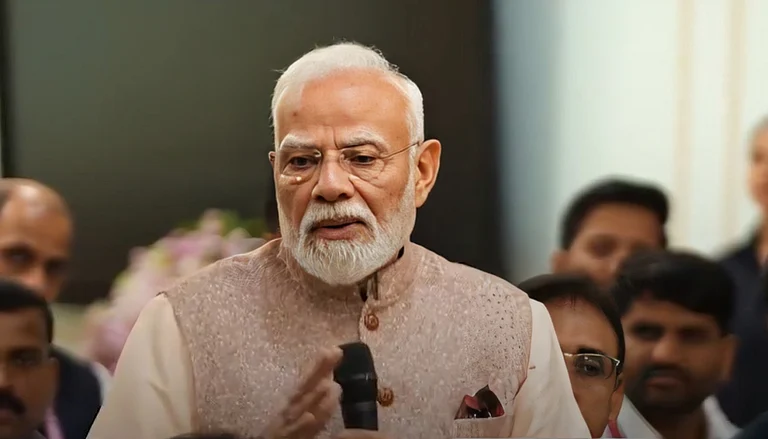
'A New Generation Of Dreams'
Away from the political sparring, Modi repeatedly connected his address to SRCC’s legacy. Calling its alumni “OG”, he praised former students who had made their mark across politics, business, economics and other fields.
He recalled former Union minister Arun Jaitley and economist Sanjeev Sanyal among the SRCC alumni with whom he had worked.
For the students before him, however, Modi had a different challenge: to think beyond conventional career paths. He asked why India could not produce global consulting, accounting, legal and financial firms, and urged young people to consider entrepreneurship, artificial intelligence, space, drones and agricultural innovation.
Modi’s return to SRCC also comes at a time when the BJP is recalibrating how it speaks to young Indians, particularly Gen Z. The Jantar Mantar protests exposed the limits of conventional political messaging, prompting a greater emphasis on social media, direct engagement and youth-oriented communication.
Advertisement
Published At: