The Jharkhand State Election Commission announced single-phase civic elections for 48 urban local bodies, including Ranchi, with nominations beginning on January 29 and symbols allotted on February 7.
The model code of conduct has come into force, ballot papers will be used without a NOTA option, and extensive security arrangements have been planned across 4,304 polling booths.
Jharkhand Civic Polls To 48 Urban Local Bodies On February 23, Counting On February 27
Over 43.33 lakh voters will elect mayors or chairpersons and ward councillors directly, while deputy mayors and vice chairpersons will be chosen indirectly; polls will be held on a non-party basis.

Summary
The Jharkhand State Election Commission (SEC) on Tuesday announced that civic polls to 48 urban local bodies (ULBs) in the state, including Ranchi, will be held on February 23, with the counting of votes scheduled for February 27.
“The voting for the civic polls to 48 urban local bodies in the state will be held in a single phase on February 23,” State Election Commissioner Alka Tiwari said while issuing the notification.
Tiwari said the nomination process will begin on January 29 and continue until February 4. Scrutiny of nominations will take place on February 5, while candidates may withdraw their nominations until February 6. Election symbols will be allotted on February 7.
More than 43.33 lakh voters, including 21.26 lakh women, are eligible to cast their votes in elections to 1,087 wards across nine municipal corporations, 20 nagar parishads and 19 nagar panchayats.
“The elections for the mayor or chairman posts, and ward councillors will be held directly, while the deputy mayors and vice chairmen will be elected indirectly,” Tiwari said.
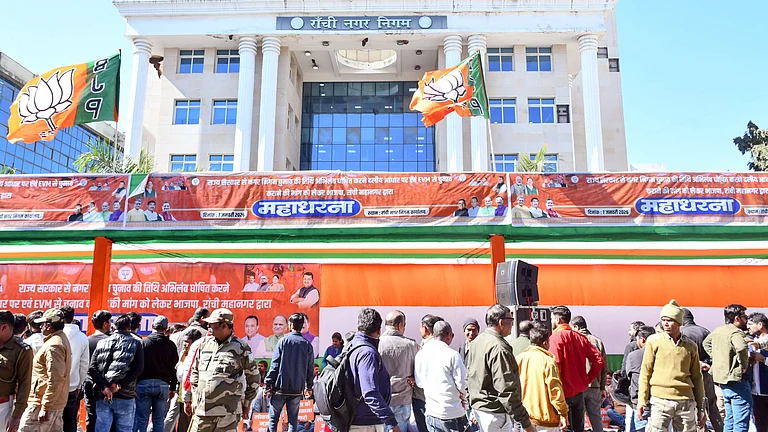
Urban local body polls in Jharkhand are not contested on the electoral symbols of political parties, though candidates are backed by political outfits. In 2018, elections to the posts of mayor and deputy mayor of municipal corporations, and chairman and vice chairman of municipal councils, were held on party lines.
After coming to power in 2019, the Hemant Soren government amended the rules and decided to conduct ULB polls on a non-party basis. The Congress, a constituent of the JMM-led ruling alliance, and the main opposition BJP had both demanded that the elections be held on a party basis.
The model code of conduct (MCC) has come into force across the 48 urban local bodies, excluding panchayats and cantonment areas, following the issuance of the election notification.
Tiwari said voting will be conducted using ballot papers and there will be no option for NOTA. She added that adequate security arrangements would be made to ensure peaceful polling at 4,304 booths.
Advertisement
“Of the total polling booths, 896 have been identified as hyper-sensitive and 2,445 as sensitive,” she said.
The commission has also fixed expenditure limits for candidates contesting the elections. According to the SEC notification, candidates contesting for the post of mayor in municipal corporations with a population of over 10 lakh can spend up to Rs 25 lakh, while the limit is Rs 15 lakh for corporations with a population below 10 lakh.
For candidates contesting for the post of chairman in nagar parishads and nagar panchayats, the expenditure limit ranges between Rs 5 lakh and Rs 10 lakh, depending on population size. Candidates contesting for ward councillor posts can spend between Rs 1 lakh and Rs 5 lakh, the notification said.
The Jharkhand High Court had earlier criticised the state government over delays in conducting local body elections. In November 2025, the commission informed the high court that it would complete the formalities and issue the election notification within eight weeks.
Advertisement
Elections to 14 ULBs have been pending since May 2020, while polls to the remaining 34 ULBs have been due since April 2023. All civic bodies are currently under the administrative control of government officials.
Published At: