For Rohit Nahata, his daughter's Class 10 board results marked the beginning of another phase in her education. He enrolled her in a government school with low fees and minimal attendance requirements, freeing up both time and money for what he believed would matter more: private coaching. At nearly Rs 60,000 a month, the one-on-one classes offered individual attention and preparation for the competitive entrance examinations that increasingly shape academic trajectories in India.
Coaching Centres as India’s Parallel Classrooms: A Symptom of Educational Faultlines
Parents are increasingly relying on coaching centres to bridge perceived academic gaps and prepare children for competitive examinations

Until then, Nahata's daughter had studied at a private school in New Delhi, where the annual fee was close to Rs 1.5 lakh. But despite the investment, he felt the school was unable to address her academic needs. Aspiring to pursue higher studies in business, she struggled with mathematics, a subject critical to her plans. Nahata says he repeatedly raised the issue during parent-teacher meetings, hoping for additional support, but was told that she simply needed to “study harder”.
Nahata believes the issue extends beyond his daughter's performance alone. He argues that teachers, burdened with administrative work, school events and other non-teaching responsibilities, are unable to devote sufficient attention to individual students. "How will they teach properly?" he asks. "If a child is weak in a subject, someone needs to identify that and work on it." His decision reflects a wider shift, with many parents increasingly relying on coaching centres to bridge perceived academic gaps and prepare children for competitive examinations.
The Comprehensive Modular Survey (CMS) on Education 2025, part of the 80th round of the National Sample Survey, covered more than 52,000 households and nearly 58,000 students and found that almost one-third of Indian students now take private coaching, with participation higher in urban areas than in rural India. Government schools continue to educate 55.9 per cent of students nationwide, but coaching centres have increasingly become the primary avenue for competitive exam preparation. For Nahata, whose daughter's coaching class has only five students, the attraction lies in focused teaching and individual attention. He believes coaching has become deeply embedded in students' academic journeys and now operates alongside formal schooling from an early stage.
"The system itself has become such that children start coaching from Class VI,” Nahata tells Outlook.
‘Symptom of Deeper Structural Problem’
The National Education Policy (NEP) 2020 identifies India's growing coaching culture as a by-product of high-stakes examinations and proposes assessments focused on conceptual understanding rather than memorisation. Six years later, however, experts say the trend has only deepened. CB Sharma, former chairman of the National Institute of Open Schooling (NIOS), argues that weak school governance, inadequate teacher preparation and an admissions system driven by competitive examinations have fuelled the rapid expansion of coaching centres. “India needs an independent School Education Commission, a statutory body outside day-to-day government control, that can regulate and guide school education professionally,” he says. Sharma also argues that varying standards across school boards have encouraged universities to rely on entrance examinations, creating space for coaching centres. “Different school boards across India follow different standards. Some boards award marks more liberally than others.”
Advertisement
Meanwhile, Poonam Batra, former professor at the Department of Education, University of Delhi, argues that privatisation, centralisation and the growing disconnect between school education and higher education admissions have reinforced the coaching culture. She says entrance examinations such as the Common University Entrance Test (CUET) have made Class 12 performance increasingly irrelevant. “When admissions are standardised nationally, you encourage coaching because everyone begins preparing for the same test,” she argues. Sharma and Batra both contend that board results alone no longer determine entry into higher education, making coaching a key site of learning. “What coaching has done is deepen and widen inequality. Just as we have an unequal school system, we now have an unequal coaching system,” adds Batra. Outlook sought responses from the Union Education Ministry but had not received one at the time of publication.
Providing Alternatives
Entrance examinations have become the primary gateway to higher education in India, including the National Eligibility Cum Entrance Test (NEET) for medicine, the Joint Entrance Exam for engineering and the CUET for many universities, though some institutions continue to conduct their own tests. As students navigate admissions, experts say many struggle with limited career guidance and remain focused on conventional pathways such as engineering and medicine. It is in this gap that a different kind of coaching has emerged. Mohammad Nayyar Azam, 23, a recent master's graduate from Jamia Millia University, coaches aspiring media students for the university's entrance examinations, helping them build reading habits, improve language skills, follow current affairs and develop critical thinking over six to seven months. Azam believes one of the biggest failures of India's education system is that it does not encourage students to imagine careers beyond a narrow set of professions.
Advertisement
“Nobody tells them that they can pursue other professions. These possibilities are never discussed,” he says.
Spending on private coaching rises sharply as students progress through the education system, with urban households consistently spending far more than their rural counterparts. According to the CMS 2025 survey, expenditure on coaching increased steadily with each stage of schooling, rising from Rs 525 per child at the pre-primary level to Rs 6,384 at the higher secondary stage.
Charging about Rs 3,000 for an entire coaching cycle, Azam says his work is shaped by his own experience. A science student through Class 12, he knew he wanted a different future but found little guidance about careers in media. “I somehow managed to find my own path,” he says. “Now I want to help students who are caught between finishing school and figuring out what they really want to become.”
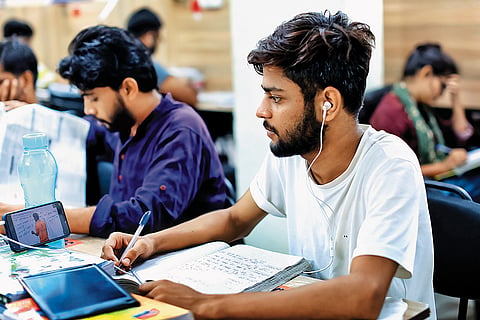
Stress and Anxiety: Students studying at a coaching centre in Jaipur | Photo: Suresh K. Pandey
Supplement or Replacement?
For most Indian students, Class 12 board examinations and competitive entrance tests demand two very different forms of preparation despite being conducted within months of each other. Board examinations primarily assess a student's understanding of the school curriculum and often reward detailed, structured answers based on prescribed textbooks. Competitive examinations such as JEE, NEET, CUET and CLAT, on the other hand, test conceptual clarity, analytical reasoning, problem-solving speed and the ability to apply knowledge in unfamiliar situations.
Advertisement
As a result, students preparing for higher education often juggle two parallel academic tracks, studying textbook-based content to score well in board exams while simultaneously attending coaching classes, taking mock tests and mastering exam-specific strategies for entrance tests. The overlap between the two is limited, forcing many students to spend long hours balancing schoolwork and coaching schedules during one of the most demanding periods of their academic lives.
Former physics teacher Manoj Sharma, who taught Classes 11 and 12 in a private school for nearly two decades, argues that schools and competitive examinations are increasingly disconnected from one another, leaving students little choice but to seek external support. He sees coaching as a consequence of deeper structural problems. "The syllabus taught in schools and the questions asked in NEET, JEE, CUET and CLAT (Common Law Admission Test) are not linked. So where will students get those answers from? Coaching centres provide them," he says.
Advertisement
For Sharma, the issue extends beyond schools. He believes India's higher education system has failed to keep pace with the aspirations of millions of students competing for a limited number of seats. "The real problem is the mismatch between the number of students and the opportunities available to them," he says.
Mubashir Hassan, the director of Kashmir Institute of Excellence, a renowned coaching institute in Srinagar, Jammu and Kashmir, however, rejects the idea that schools have failed outright, arguing instead that they were never designed to prepare students for highly specialised national-level entrance examinations. He says while schools provide foundational knowledge, social development and character building, coaching institutes focus on conceptual understanding, problem-solving and examination strategies. "I see coaching primarily as a supplement to school education rather than a replacement for it," he says.
Varying standards across school boards have encouraged universities to rely on entrance examinations creating space for coaching centres.
Yet despite approaching the issue from different directions, both educators arrive at a similar conclusion. India's education system requires greater public investment, stronger institutions and better preparation for the realities students face after Class 12. "The government has failed. Not Congress or BJP, the system has failed,” says Sharma, adding that India should “copy-paste” the techniques used by some of the best education systems in the world, including Finland and Canada.
Need to Strengthen Mainstream Schooling
Finland is widely regarded as one of the world's most successful education systems, consistently combining strong learning outcomes with high levels of student well-being and relatively little dependence on private tutoring. According to Pasi Sahlberg, an Adjunct Professor at the Faculty of Educational Sciences, University of Helsinki, in Finland, and a Professor of Educational Leadership at the University of Melbourne in Australia, one of the key reasons is that education in Finland has never been narrowly organised around examinations. Instead, schools focus on the overall development of children, while teachers, who are highly trained and professionally trusted, play a central role in assessing student learning.
Sahlberg tells Outlook that the growth of coaching industries around the world is often a sign of a deeper imbalance between what schools provide and what competitive examinations demand.
When a single test determines access to higher education and future opportunities, families begin to see coaching not as a choice but as a necessity. The result, he says, is greater stress, widening inequality and declining trust in schools. For countries such as India, Sahlberg believes the answer is not simply to regulate coaching centres but to strengthen mainstream schooling. That means investing in teachers, reducing inequalities between schools, broadening assessment systems and restoring public confidence in education.
“Families will not stop relying on coaching simply because they are told to do so. They will stop only when they trust schools to provide their children with the teaching, support and opportunities they need to succeed,” Sahlberg says.
A shorter, edited version of this appears in print
Published At: