A first-year BDS student was found dead on the college campus.
An audio clip of deceased student Nithin Raj reveals alleged caste-based harassment by faculty.
Two teachers, Dr Ram and Dr Sangeeta Nambiar, have been suspended, and cases registered against them.
‘Harassed for Caste, Colour’: Kerala Student’s Death Under Probe
A student’s death lays bare how caste bias continues to affect marginalised communities in Kerala.

Summary
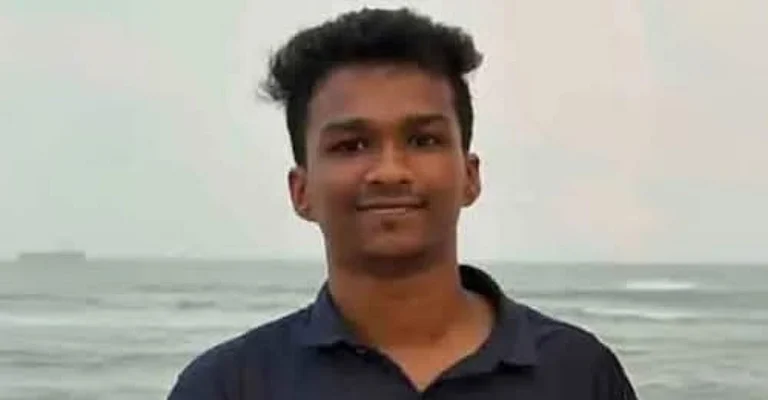
Nithin Raj R.L., a native of Uzhamalakkal village in Thiruvananthapuram district, had called his parents to say he would be home the next day. But for the family waiting to welcome their son, what arrived instead was devastating news.
A medical student at a college in Kannur, Nithin was found dead after a fall from a building on the college campus in Ancharakandi, Kannur district. His death, described as unnatural, has triggered serious allegations from relatives and friends, who claim he was subjected to sustained caste-based harassment by faculty members.
A Dalit student, he was allegedly targeted with caste slurs, racist remarks, and body-shaming by professors. Following the incident, two faculty members have been suspended pending inquiry, and police have registered cases against them. According to relatives, Dr Ram and Dr Sangeetha Nambiar consistently targeted Nithin for his caste, colour, and financial status.
The tragedy has sent shockwaves across Kerala, a state that often prides itself on its egalitarian ethos and progressive social fabric. The incident has laid bare the deep fault lines of caste prejudice that continue to persist beneath this veneer of progressiveness. The death of a professional college student has once again brought into focus how caste continues to operate as a discriminatory force on campuses, despite constitutional safeguards.
An audio clip reportedly sent by Nithin to his family points to the extreme humiliation and discrimination he is said to have endured at the hands of certain faculty members. According to his sister, Nikitha, there are additional voice recordings that further suggest the role of two professors in subjecting him to sustained harassment.
The family alleges that this persistent targeting ultimately drove the young student to take his own life.

In an audio clip that has surfaced on social media, the student can reportedly be heard describing the mental distress and humiliation he said he endured. In the recording, he alleges that he was insulted in the staff room, mocked in the classroom, and that his marks were deliberately reduced. He also recounts telling a professor at one point that he no longer wished to attend his class.
Advertisement
Following the incident and the allegations, two faculty members, Dr Ram and Dr K.T. Sangeetha Nambiar, have been suspended. Police have registered cases against them and initiated an investigation.
Nithin’s body was brought to his native Uzhamalakkal in Thiruvananthapuram district, where political leaders and members of the public paid their respects. General Education Minister V. Sivankutty and Opposition Leader V.D. Satheesan visited the grieving family.
The Minister expressed concern over the conduct of the college authorities, remarking that “none of them have come to this house.” He also raised suspicion that the management may have informally directed students and faculty to stay away from the residence.
Meanwhile, some students, speaking on condition of anonymity, alleged that certain faculty members routinely targeted students based on caste and skin colour, subjecting them to public humiliation.
“This incident once again exposes the fallacy of the claim that Kerala is a casteless society,” said Dr T.S. Syam Kumar, a scholar on caste issues. “Nithin’s death is an institutional murder, nothing short of it. He was allegedly subjected to harassment over his caste, complexion, and his family’s financial background. It reveals that beneath the veneer of progressiveness, sections of Kerala society continue to practice deeply entrenched caste discrimination,” he added.
Advertisement
“Marginalised students who gain admission to professional colleges often have to endure an antagonistic environment,” said Sunny M. Kapikad, a Dalit thinker. “They are burdened with the stigma of belonging to a category eligible for affirmative action,” he added.
Incidents pointing to such discrimination are not new. Two years ago, a Class 10 student died by suicide after allegedly facing caste-based discrimination. The family of Athira had claimed she was subjected to relentless harassment by her teachers. Earlier, in 2004, the death of Rajani S. Anand, a Dalit engineering student who was denied an educational loan, had triggered widespread outrage across the state.
In a 2021 report to the Lok Sabha, the Education Ministry noted that of the 122 student suicides reported in top higher educational institutions, 68 were from SC, ST, or OBC categories, while 54 belonged to the general category.
Advertisement
According to NCRB data, student suicides in India reached a record high of 13,892 in 2023, a 6.5 per cent increase from the previous year. Analyses indicate that nearly 29 per cent of these cases were reported from southern states.
A 2024 report titled “Student Suicides: An Epidemic Sweeping India” further noted that while overall suicide rates increased by about 2 per cent annually, student suicides rose at a sharper rate of 4 per cent, despite likely underreporting. The report stated that the incidence of student suicides continues to surpass both population growth rates and overall suicide trends. In the last ten years, while the population of 0–24-year-olds declined slightly from 582 million to 581 million, the number of student suicides increased from 6,654 to 13,044.
Published At: