Nearly eight years after Gauri Lankesh’s assassination, the absence of convictions highlights a culture of impunity.
Her killing is a consistent reminder of the growing dangers faced by journalists who challenge power.
From Lankesh to Mukesh Chandrakar, killings and delayed justice reflect India’s declining press freedom and the normalisation of violence against dissent.
Gauri Lankesh Birth Anniversary: When Journalism Becomes a Death Sentence
Remembering Lankesh is a call to defend free expression, demand accountability, and ensure that silencing one voice does not silence the truth.

Summary
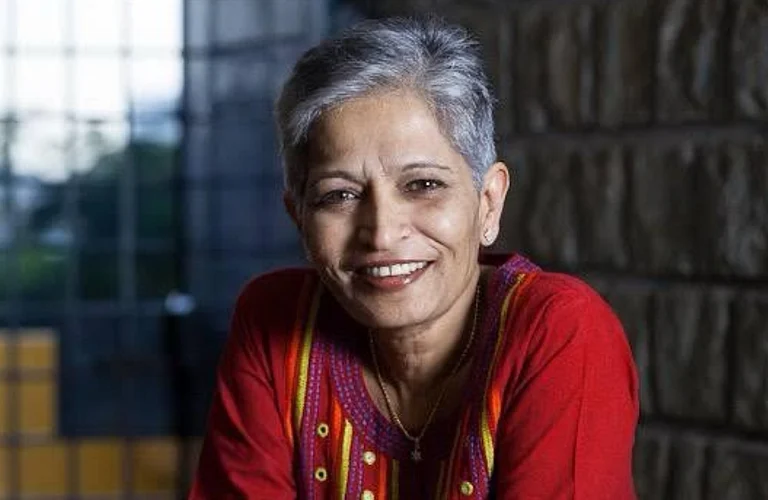
Gauri Lankesh would have been 64 years young today.
That is if she was not shot dead outside her home on September 5, 2017. Lankesh published and edited Gauri Lankesh Patrike, a Bengaluru-based Kannada-language weekly known for its criticism of right-wing extremism and the authorities.
Almost a decade later, nobody has been convicted for her killing. More so, after her trial which began as late as in 2022, all the 17 accused facing trial in the case are now out on bail. In fact, one of the accused enlisted in Maharashtra’s Jalna Municipal Corporation polls as an independent candidate.
The news of her assassination was carried widely. The Indian Express ran it on the front page, headlined: ‘Journalist who spoke her mind is shot dead’. The Hindu wrote: ‘Gauri Lankesh: A firebrand journalist who never minced words’.
The act of violence against her enraged many. Demonstrators carried placards reading “I am also Gauri.” International organisations, including Reporters Without Borders and Amnesty International, cited her assassination as evidence of the erosion of press freedom in India.
UNESCO posthumously awarded her the Guillermo Cano World Press Freedom Prize in 2018. The Gauri Lankesh Memorial Trust was established to sustain her legacy of promoting communal harmony and freedom of expression.
However, justice for her killing remains elusive. It also reflects the state of journalism in India and across the world, where the murder of journalists has become so routine that it shames the idea that the pen is mightier than the sword.
On the first day of 2025, freelance journalist Mukesh Chandrakar was killed, with his body discovered two days later at a road construction site in Chhattisgarh. Chandrakar had been reporting on corruption involving local contractors in the road-building sector, according to DW. The postmortem report revealed severe injuries to his head, chest, back and abdomen, and police said they suspected the killing was linked to his journalistic work.
India’s standing on press freedom has continued to deteriorate. In the 2025 World Press Freedom Index compiled by Reporters Without Borders (RSF), the country was ranked 151 out of 180. This marked a steady decline from 140 in 2019 to 142 in 2020 and 2021, then to 150 in 2022, 161 in 2023, and 159 in 2024.
Advertisement
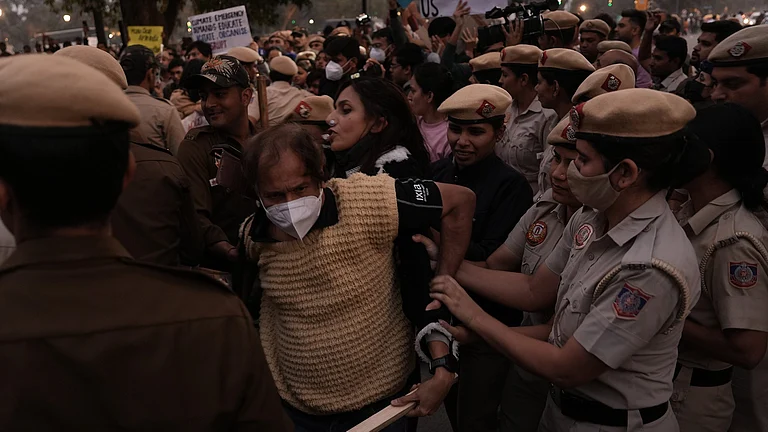
In 2025, India, the world’s largest democracy, ranked above only a small group of countries, including Bhutan, Pakistan, Turkey, Palestine, China, Russia, Afghanistan, Syria and North Korea.
RSF has also highlighted the risks faced by journalists covering environmental issues. In 2024, the organisation reported that at least 13 of the 28 journalists killed since 2014 had been working on environmental-related stories, primarily involving land seizures and illegal mining for industrial purposes.
At Outlook, we vividly and continuously speak of the silencing of the media and the systematic actions of the state. The Gauri Lankesh murder case remains a pivotal legal matter with far-reaching implications for justice and accountability.
In Gauri Lankesh Murder Case: 7 Years Of Delayed Justice, Supreme Court Calls For Speedy Trial Saihaj Kaur Madan writes of the trial, and the waiting.
“The Supreme Court’s recent order to expedite the trial reflects an urgent need to address delays and ensure that those responsible for this grievous crime are held accountable. As the legal proceedings move forward, there is a collective focus on achieving justice for Gauri Lankesh and reaffirming the principles of freedom of speech and the protection of dissenting voices in India.”
Advertisement
Apeksha Priyadarshini recounts her shock and despair upon learning of Lankesh’s killing, and reflects on how the journalist’s legacy continues to live on within her—particularly after watching Gauri, Kavitha Lankesh’s semi-autobiographical documentary that revisits the reportage which led to the firebrand journalist’s assassination seven years ago.
In “Seeing Hope Beyond Despair”: Kavitha Lankesh Pays A Fiery Tribute To Her Sister In Gauri, she writes: “Step by step, the story unveils the many reasons why Gauri attracted the ire of the right wing regime, even before they assumed power at the Centre in 2014. The narrative is strung together from reporting footages and “behind-the-scenes” videos.”
Death threats are an all-too-frequent part of life for journalists and activists. For 2014 Jnanpith award winner Bhalchandra Nemade, a death note came his way in the form of a scribbled scrap. It was slipped into his hands by an unknown person at a Sahitya Akademi function in Nagpur in 2015.
Advertisement
In ‘Guns & Proses: Can 'Dakshinayan Abhiyaan' Instil Confidence Among Writers And Artists?’ Mayabhushan Nagvenkar speaks about the state of fear, and dissonance, lived by activists who report beyond what would be considered comfortable.
“Nemade, along with noted writer and scholar Ganesh Devy, was sipping tea at the venue that day. Just two days before, Kannada scholar and rationalist M.M. Kalburgi had been gunned down by unknown youngsters at his home in Dharwad. Kalburgi’s wife Umadevi had stepped into the kitchen to fetch coffee for the soon-to-be killers of her husband, who had posed as students.”
Nearly a decade after Gauri Lankesh was gunned down for speaking truth to power, the lack of accountability in her case mirrors a broader culture of impunity that emboldens violence against dissenting voices. From her assassination to the killing of Mukesh Chandrakar, from delayed trials to routine threats against writers and activists, the message is chillingly consistent.
Advertisement
Yet, the persistence of her colleagues, the memories carried by those she inspired, and the continued insistence on justice refuse to let that message be final. Remembering Gauri Lankesh at 64 is not an act of nostalgia; it is a reminder that even though the fight for press freedom is unfinished, it is still holding strong, every day.
Published At: