The DRDO successfully executed three consecutive flight tests of advanced, unidentified exo- and endo-atmospheric interceptor missiles within a 48-hour window
Defence Minister Rajnath Singh confirmed the milestones elevate India into a select group of nations capable of intercepting long-range and intercontinental ballistic missiles (ICBMs)
Alongside a maiden medium-range anti-ship defence test, these trials counter regional advancements and bolster India's wider efforts
DRDO Completes 3 Ballistic Missile Defence Tests in 2 Days
India joins elite global force after DRDO successfully executes triple missile defence trials

Summary
The Defence Research and Development Organisation (DRDO) successfully conducted three consecutive flight tests against long-range ballistic missiles on June 10 and 11. The completion marked a big step in India’s defence capabilities. Along with these tests, a maiden flight test of an anti-ship defence at medium range was also successfully conducted.
Congratulating the DRDO for both these achievements, Defence Minister Rajnath Singh, in a social media post on X, said that India has now joined an elite group of countries. Singh, on Friday said, “India is now part of a select group of countries possessing the capability to defend against ballistic missile attacks, including threats posed by long-range and intercontinental ballistic missiles (ICBMs).” He did not specify which other nations are part of the list.
The coordinated efforts by the DRDO scientists, industry partners and the armed forces towards successfully executing multiple complex tests within a span of 24 hours earned heaps of praise from Senior DRDO officials as well.
Inside the Tests
The two interceptor missiles tested by the DRDO can destroy enemy Intermediate-Range Ballistic Missiles (IRBMs) with operational ranges between 2,000 km and 5,000 km, an HT report indicated.
Government sources stated that these interceptors, whose identities have not been officially disclosed, are designed for both exo-atmospheric and endo-atmospheric interception. Following the successful flight tests, the systems will soon proceed to upcoming trials.
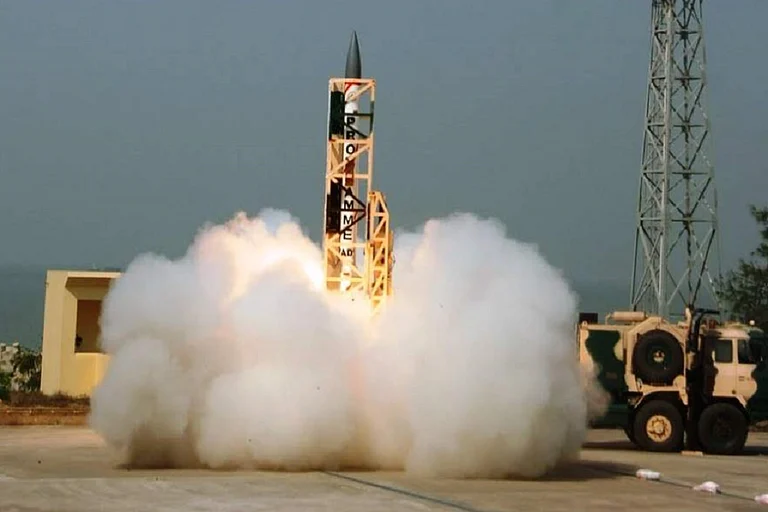
India’s Ballistic Missile Defence Mission
India’s growing interest and focus on strengthening ballistic missile defence capabilities, over the past few years, comes as a result of Pakistan’s development of long-range ballistic missiles such as Fateh-I, Fateh-II and the Chinese-origin P282, sources said.
Last year, the DRDO reported to have begun work on modifying the Agni-5 intercontinental ballistic missile, making a version that could penetrate reinforced subterranean facilities.
Recently too, in April, a new nuclear-powered ballistic missile submarine, INS Aridaman was commissioned by the Navy. It will be India's third Arihant-class submarine possessing the capability to become a launch platform for delivering nuclear warheads thousands of kilometres away.
Advertisement
India has been developing a new class of high-powered missiles designed to target heavily fortified enemy installations buried beneath layers of concrete, with some variants featuring even bunker-buster capabilities.

Published At:
Tags
Pakistan Defence Defence Research & Development Organisation (DRDO) Ballistic Missile Defence Minister Rajnath Singh DRDO DRDO (Defense Research And Development Organization) Ballistic Missile Defence (BMD) Defence Research And Development Organisation (DRDO) Union Defence Minister Rajnath Singh Ballistic Missile Test