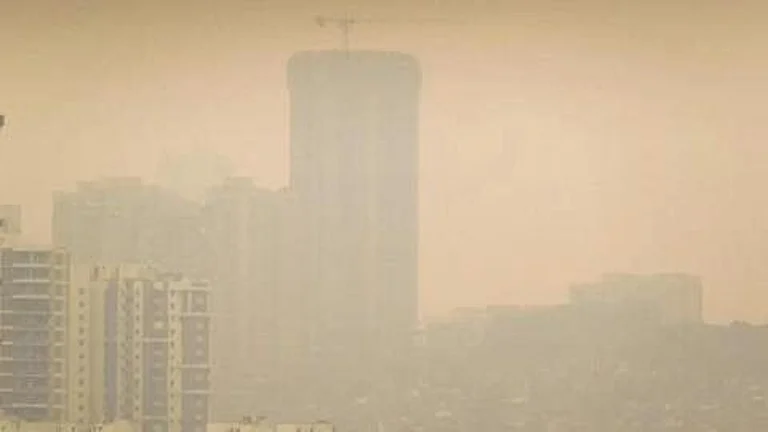
Delhi’s hourly AQI stood at 314 at 3 am on Thursday, keeping the city in the Very Poor category.
IITM projects Delhi’s PM2.5-driven AQI could climb to 428 by Friday, entering the Severe category.
Stubble burning, firecracker emissions and unfavourable weather conditions are adding to the pollution burden.
Delhi’s Air Set To Turn ‘Severe’ As AQI Forecast To Hit 428
Delhi recorded an AQI of 314 on Thursday morning, with weak winds, falling atmospheric mixing depth and stubble burning expected to worsen pollution levels.
Summary
Delhi’s air quality remained in the ‘Very Poor’ category on Thursday, with the hourly citywide Air Quality Index (AQI) reading at 321 at 7 am, up 22 points from the same time on Wednesday. Delhi’s air quality could deteriorate further by Friday, with IITM projections indicating that the PM2.5-driven AQI could reach around 428 by 9 am, entering the ‘Severe’ category.
Delhi’s 24-hour average AQI rose to 313 on Wednesday from 299 on Tuesday, moving back into the ‘Very Poor’ category, according to CPCB data. The forecast comes days after Diwali, with firecrackers continuing to contribute to particulate pollution and stubble burning in neighbouring states expected to add to the pollution load.

Firecrackers, Stubble Burning Add To PM2.5 Pollution
IITM's source-apportionment estimates put firecrackers' contribution to Delhi's PM2.5 pollution at 7.4% on Wednesday, down from 29.8% on Tuesday morning. Their estimated contribution had peaked at 71.1% between 1 am and 9 am on Monday, November 9, the morning after Diwali. Meanwhile, the Indian Institute of Tropical Meteorology’s (IITM) Decision Support System projected that stubble burning could contribute around 20% of Delhi’s PM2.5 pollution on Thursday, before declining to 11% over the following days.
Other sources accounted for significant shares of Delhi’s PM2.5 pollution on Wednesday, with secondary organic matter contributing 22.7%, followed by domestic solid biofuel burning at 22.3% and vehicular emissions at 19.3%, according to IITM estimates.
Delhi’s pollution levels were already elevated before Diwali. A Centre for Science and Environment (CSE) assessment found that Delhi’s average PM2.5 concentration in the week before the festival stood at 236 micrograms per cubic metre, a three-year high. This was 97% higher than the corresponding period in 2025 and 32% above 2024 levels.
“Diwali pollution is an annual tipping point, but elevated particulate levels before the festival this year show that baseline pollution is higher than in previous years. Year-round emission control across key sources remains inadequate,” Anumita Roychowdhury, Executive Director of Research and Advocacy at CSE, said.


Advertisement
Weather Conditions May Push AQI Higher
Weather conditions are expected to become less favourable for pollution dispersal by Friday, according to the India Meteorological Department (IMD). The mixing depth is expected to fall from 2,000 metres on Thursday to 1,400 metres on Friday. Winds are also forecast to shift from north-westerlies reaching up to 15 km/h on Thursday to variable south-westerlies and westerlies at 5-10 km/h on Friday, according to IMD projections.
Stage III of the Graded Response Action Plan (GRAP) has been in force across Delhi-NCR since November 6, according to the Commission for Air Quality Management (CAQM). Restrictions include curbs on non-essential construction and demolition activities, road dust suppression measures and hybrid classes for schools up to Class V. Offices have also been advised to implement work-from-home arrangements as directed by the CAQM.
The CAQM has also advised residents to use public transport, avoid open burning and wear masks outdoors. Under CPCB’s classification, an AQI of 301–400 is categorised as ‘Very Poor’, while readings of 401–500 fall in the ‘Severe’ category.
Advertisement
Published At: