Small roadside shrines have vanished from Benares. They were not relocated with ceremony or rebuilt elsewhere. They were simply erased.
The Kashi Vishwanath Corridor, the most celebrated symbol of Benares' transformation, is repeatedly presented as a triumph of devotion.
The creation of Gyanvapi complex involved the clearing of entire neighbourhoods and the erasure of smaller temples.
Benares Demolitions | When Faith Is Rebuilt And Memory Erased
During my recent visit to Benares, I found myself walking through a city reshaped by ambition, reordered by authority, and increasingly uncomfortable with the very rituals that had sustained it for centuries

Summary
I detested my love for holy cities. Yet Benares, Varanasi, Kashi, whichever name one chooses, remains a civilisational signpost. I loved the city from a distance, and like all civilisations, it has always been threatened, not primarily by Hindu rulers destroying Jain temples or Muslim rulers destroying Hindu ones, but by the cowardice of modernity and capitalism.
One does not visit Benares. One either falls into it or rejects it completely, regardless of social or religious position. It is a city of thousands of years, now eroded not by faith but by modern religion. Benares implicates you in belief even as it frees you from sectarian loyalty. Its ghats and winding alleys recall a time when things, beings, and orders existed in a strange, schizophrenic harmony, listless yet paradoxically structured. For the white, the brown, and the occasional Western tourist, even scamming in Benares was once done with a peculiar kind of courtesy.
I returned to Benares two years ago to perform my parents’ pind daan. It was not a journey of nostalgia. It was an act of obligation, grief, guilt, and, torment. It demanded slowness, familiarity, and the anonymity the city once offered mourners with quiet generosity. Instead, I found myself walking through a city reshaped by ambition, reordered by authority, and increasingly uncomfortable with the very rituals that had sustained it for centuries. It had become a mirror that was only advertised.
From Godhowlia to Dashashwamedh Ghat, the transformation was immediate and unmistakable. Red tiled pathways stretched out in disciplined lines. Railings channelled bodies into obedient movement. Surfaces gleamed with a confidence that suggested conspicuous consumption rather than continuity of wandering about having faith. The lanes I remembered, fractured, mesh-wired, monkey-proof, had been straightened into corridors. This unapologetic redecoration reflected the taste of the current dispensation, a taste that borrows freely from Lajpat Nagar wedding markets and the sanitised aesthetic of Dilli Haat.
Advertisement
This was not accidental change. It bore the imprint of an impaired/lame political imagination.
Benares today is governed not merely as a city, but as a symbol. As the parliamentary constituency of the Prime Minister and under a state government that claims civilisational guardianship, the city has been turned into a flagship store. It is now an architectural and ideological showcase. Faith here is not simply practiced. It is displayed, tiled, landscaped and continuously sold.
What unsettled me during the rituals was not only what had been built, but what had quietly disappeared.
Small roadside shrines I remembered, unassuming structures that interrupted walking and demanded pause, had vanished. They were not relocated with ceremony or rebuilt elsewhere. They were simply erased. When I asked a priest near Dashashwamedh about one such shrine, he gestured vaguely towards an open tiled stretch and said, almost casually, “yahin tha”. He spoke without outrage, as one speaks of weather, fate, and impending incarceration. Another religious cog absorbed into the large wheel of development under Hindutva, capitalism and the wills of the business world.
Advertisement
These were not monumental temples. They carried no plaques, no donors’ names, no architectural pedigree. They belonged to neighbourhoods rather than narratives. They did not photograph well, and sometimes they did. They complicated history and movement. The face-down statue of Ahilyabai Holkar alone generated endless debate, whether Nehru dismantled it or whether social media would soon declare it artificial intelligence. Nobody knows, nobody knew. Maybe IT cell would have a definite answer on this.
The same political leadership that claims exclusive custodianship over Hindu civilisation has overseen the demolition, displacement, and, reconfiguration of Hindu religious spaces in the name of development. Shrines have been removed because they interrupt traffic flow. Temples have been flattened because they disrupt sightlines. Sacred geographies have been redrawn to fit infrastructural logic. In Ahmedabad, roadside temples vanish for development. Elsewhere, entire localities are penalised for opening schools if they happen to be non-Hindu.
History does not forget the slights of powerful men. And it will keep on remembering, timelessly and without effort.
Advertisement
The most celebrated symbol of this transformation, the Kashi Vishwanath Corridor, is repeatedly presented as a triumph of devotion and as a final definition of what it means to be Hindu. Conveniently, this triumph does not extend to the Gyanvapi complex nearby. Its creation involved the clearing of entire neighbourhoods, the erasure of smaller temples, and the displacement of religious lives that had existed for generations. What survived was not an ecology of faith, but a monumental centrepiece.
This is not continuity, its substitution, and for the lack of any civil words, simply TACKY.
Hinduism, as it has lived in Benares for centuries, is not orderly. It spills into streets, interrupts traffic, resists homogenisation. It thrives in spontaneity, in jugaad, in shrines built overnight, in rituals adapted to circumstance, in gods who belong to corners rather than complexes. This lived religion has always been difficult to manage precisely because it refuses uniformity.
Advertisement
The current political project does not erase Hinduism. It narrows, insists on alignment, loyalty, and, spectacle. Either you are with us or you are a suspect/Pakistani/khalistani/ Bengali eating non-veg during Durga puja. America kya kehta hai becomes a measure of faith and a monotony of success that unity in diversity has had a violent, painful, indiscriminate death since 2014.

The Manikarnika Ghat in Varanasi | Photo: Suresh K. Pandey
At Manikarnika, the shock is especially stark. The cremation ground, once chaotic, dense, unapologetically raw, now feels regulated, fractured, and exposed. A man arranging funeral logs told me business continued, but the atmosphere had changed. “Ab sab dikhta hai,” he said. Now everything is visible. In Benares, visibility was never a virtue. Grief requires shadow. Mourning requires the freedom to be unremarkable. Even the debate around Ahilyabai’s statue now oscillates between IT cell outrage and amateur archaeology.
Yet the city increasingly seems designed to eliminate shadows.
The ghats resemble managed experiences, engineered for uninterrupted movement and uninterrupted sightlines. They are built for drone footage, televised rituals, and ceremonial visits. Grief has become legible, and therefore intrusive. The city that once absorbed sorrow without comment now appears eager to organise it. The Namo ghat overshadows Ghat Assi, the irony is unsolved here.
This transformation is justified in the language of reverence and care. But the language of action reveals something else. What is prioritised is not continuity, but coherence. Not intimacy, but legibility. Not lived religion, but governable religion.
In this country, irony governs every moment. A political leadership that claims to defend Hinduism appears deeply uncomfortable with how Hinduism actually functions, messily, locally, without permission. Faith that cannot be standardised becomes suspect. Devotion that cannot be displayed becomes expendable.
As I carried my parents’ ashes through these sanitised spaces, I felt an unexpected alienation. The city that once taught me how to mourn no longer seemed capable of holding mourning itself. The lanes that once allowed one to disappear into grief now led relentlessly into openness. There was no place left to be small. While I was waist-deep in muck, I got struck by a rusty nail from a wayward boat, punishment perhaps.
Cities that remember too much are inconvenient. Their memories interrupt slogans. Their rituals resist efficiency. To remake Benares is not merely to modernise it, but to discipline it, to turn an unruly civilisational consciousness into a coherent, consumable experience.
What is preserved in stone is often what has already been emptied of life.
This is not nostalgia speaking. Nostalgia is indulgent, safe and doesn’t land you in jail. This is grief sharpened by observation.
Benares has survived centuries of political change by absorbing disruption, without surrendering its rhythm. What feels different now is not the change itself, but its direction. This is not evolution from within, but correction from above. Not continuity, but control.
In this process, something essential is at risk—the right of the city to be inconvenient.
As I completed the final rites, dispersing my parents’ ashes into the river, I was struck by a bitter irony. A city built around death now appears increasingly uncomfortable with it. Death has been sanitised, reorganised, made efficient, even as it remains central to the symbolism being celebrated.
I left Benares with my parents’ ashes dispersed, but with another weight carried home, the sense that I had witnessed not renewal, but substitution. Not preservation, but performance.
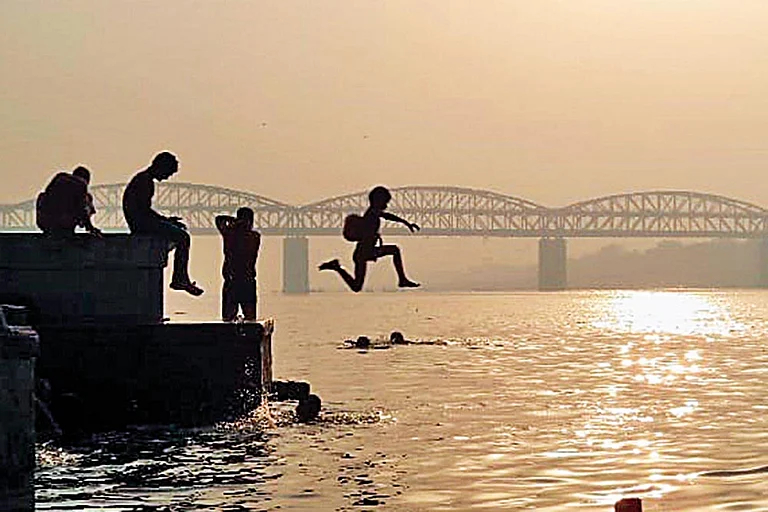
Benares does not need amplification. It needs to be what it is. Let it be, let it be, for the love of all things dear and religious, let the scammers get the tourists, let the boatmen charge more, let the lone agnostic sit at Radha ghat and watch the sunset.
Anirban Ghosh is an Assistant Professor at Centre for Writing, Shiv Nadar Institute of Eminence

Published At: