LGBTQIA+ citizens do not need majority acceptance as a precondition for their constitutional rights.
Appeals to gradual change and social stability can allow majoritarian norms to determine the pace of minority rights.
Genuine inclusion requires moving beyond rhetoric to confront discrimination and ensure equal citizenship for queer and transgender persons.
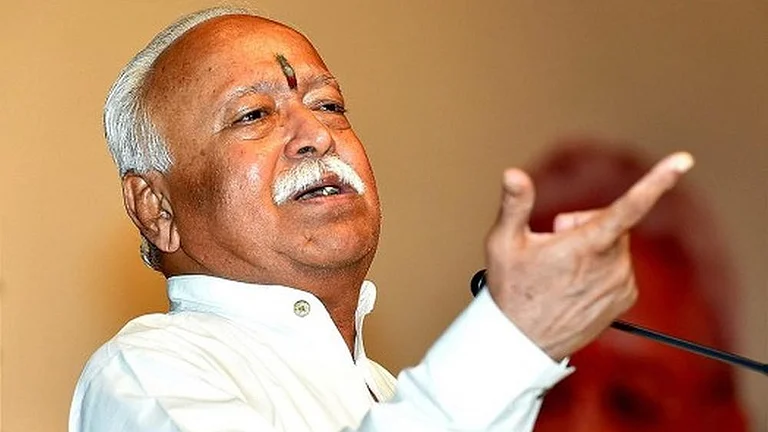
Accommodation Or Equality? Decoding RSS Chief Mohan Bhagwat’s LGBTQIA+ Remarks
RSS Chief Mohan Bhagwat’s conciliatory remarks on LGBTQIA+ rights reveal the deeper tension between cultural accommodation and the constitutional promise of equal citizenship.

During a recent interaction with members of Generation Z, Rashtriya Swayamsevak Sangh (RSS) chief Mohan Bhagwat was asked to share his views on the LGBTQIA+ community. While the exchange has been celebrated in certain circles as a sign of ideological openness, a closer examination reveals the persistence of long-standing assumptions regarding queerness, citizenship, and social legitimacy in India.
The conversation illustrates not merely an individual opinion but a broader ideological framework through which the Indian Right continues to negotiate questions of gender, sexuality, and constitutional equality.
The framing of the question itself deserves critical attention. The discussion was introduced by observing that "an issue which was once a conversational discourse within foreign students is now a topic among Indian youth."
Such a formulation reproduces one of the most enduring myths surrounding queer identities in South Asia — the belief that LGBTQIA+ identities constitute a Western cultural import rather than an intrinsic part of India's own social and historical fabric. This narrative has been repeatedly challenged by historians, anthropologists, and legal scholars who have documented diverse expressions of gender and sexuality across the Indian subcontinent long before colonial intervention.
From references in Sanskrit literature and temple iconography to the historical presence of Hijra, Kinnar, Jogappa, Aravani, and other gender-diverse communities, the subcontinent possesses a rich archive of sexual and gender plurality. Ironically, it was colonial law, particularly Section 377 of the Indian Penal Code—that criminalised non-heteronormative sexualities, making homophobia, rather than queerness, one of colonialism's enduring legacies.

The moderator of the talk further remarked that these conversations are now emerging primarily among Generation Z and Generation Alpha. Such a statement overlooks decades of political mobilisation by queer, transgender, intersex, and gender-diverse communities in India. The contemporary visibility of LGBTQIA+ issues is not a spontaneous generational trend but the outcome of sustained struggles by activists, community leaders, lawyers, academics, and civil society organisations. Landmark developments — from the resistance against Section 377, the recognition of transgender persons in the NALSA judgment (2014), the decriminalisation of consensual same-sex relations in Navtej Singh Johar v. Union of India (2018), and continuing movements for marriage equality and anti-discrimination protections — represent generations of collective resistance rather than a recent cultural phenomenon.
Advertisement
Bhagwat's own response appears conciliatory at first glance. Referring to LGBTQIA+ persons as "LGBT or whatever," he remarked that they are "part of the society" and subsequently added that Indian society has "a tradition of accommodating" such people. Yet these two statements reveal an important conceptual contradiction.
If LGBTQIA+ persons are already an inseparable part of society, then the language of "accommodation" becomes fundamentally problematic. Accommodation presupposes that a dominant social group possesses the authority to decide whether, when, and how a marginalised community may be included. Constitutional citizenship, however, does not derive from the generosity or tolerance of the majority.
Rights are neither charitable concessions nor cultural favours; the Constitution guarantees them. Equality before law, dignity, liberty, and non-discrimination cannot be contingent upon social acceptance or ideological approval. The question, therefore, is not whether queer people should be accommodated but why equal citizens should require accommodation at all.
This distinction between accommodation and equality is central to constitutional democracy. Accommodation often reinforces hierarchical power relations by positioning dominant groups as gatekeepers of inclusion. Equality, by contrast, recognises individuals as rights-bearing citizens whose dignity is inherent and non-negotiable. The language employed in Bhagwat's remarks therefore reflects a “paternalistic” framework rather than an egalitarian one.
Advertisement
The discussion becomes even more revealing when Bhagwat describes marriage as a social institution that sustains societal order and argues that introducing new familial structures could generate social conflict. According to this reasoning, broader social transformation must precede legal recognition of queer relationships.
This argument reflects a familiar majoritarian logic: that minority rights should wait until society is sufficiently prepared to accept them. However, constitutional democracies have rarely advanced through consensus alone. History demonstrates that transformative social reforms have almost always disrupted entrenched hierarchies before becoming socially accepted.
The struggles of Jyotirao and Savitribai Phule to establish schools for girls and oppressed castes challenged Brahmanical patriarchy and generated intense resistance. Pandita Ramabai's advocacy for women's education and emancipation was condemned as socially disruptive. Dr B. R. Ambedkar's project of annihilating caste fundamentally questioned the foundations of Hindu social order and continues to provoke resistance today. None of these transformative interventions emerged after society had voluntarily embraced change; rather, they confronted dominant structures precisely because those structures perpetuated inequality.
Advertisement
If every demand for justice must first negotiate the approval of the majority to avoid social conflict, democracy itself becomes subordinated to majoritarian comfort. Constitutional morality, as articulated by Dr B. R. Ambedkar and later reaffirmed by the Supreme Court, requires institutions to protect fundamental rights even when these challenge the prevailing social norms. Rights cannot be indefinitely postponed until prejudice disappears.
Equally significant is Bhagwat's suggestion that LGBTQIA+ persons should receive rights while ensuring that the existing social structure continues to function "smoothly." This formulation assumes that queer identities threaten social stability. Such an assumption misidentifies the source of conflict.
The existence of LGBTQIA+ persons does not destabilise society. Rather, the discomfort arises from heteronormative and patriarchal systems that organise citizenship, family, inheritance, and social legitimacy around rigid binaries of gender and sexuality. Queer communities do not create these anxieties; they merely expose the exclusions already embedded within these institutions. Demands for equal marriage, inheritance, healthcare, housing, employment, and protection from discrimination seek participation within democratic citizenship, not the destruction of social order.
Advertisement
This also raises an important question for organisations such as the RSS, which often present themselves as custodians of Indian society and culture. If meaningful social transformation must precede legal equality, what institutional efforts have been undertaken to facilitate such transformation? Has the organisation actively challenged homophobia within its own ranks? Does it envision queer individuals occupying positions of ideological or organisational leadership? Can one imagine an openly queer Sarsanghchalak or senior office bearer within the RSS? Without confronting exclusion within its own institutional structures, appeals for gradual social acceptance risk becoming rhetorical gestures rather than commitments to substantive equality.
Ultimately, the conversation reflects a broader tension between two competing imaginations of citizenship. One is rooted in cultural accommodation, where minorities are accepted conditionally so long as they do not disturb dominant social arrangements. The other is rooted in constitutional democracy, where dignity, equality, and liberty belong equally to every citizen irrespective of social approval.
The struggle for LGBTQIA+ rights in India has never been about demanding exceptional privileges or seeking cultural validation. It has consistently been a struggle for constitutional equality—for the recognition that queer and transgender persons are not outsiders waiting to be accommodated, but citizens whose rights exist independent of the majority's willingness to accept them. The language of accommodation may appear inclusive, but unless it is accompanied by an unequivocal commitment to equal citizenship and institutional transformation, it ultimately reinforces the very hierarchies it claims to transcend.
Ritwik is a queer-feminist activist and founder of Trans Queers For Constitution.
Note: The views expressed are those of the author.
Published At:
Tags