Ajit Pawar’s political journey in Baramati went far beyond electoral success.
Ajit Pawar transformed the Pawar legacy into an execution-driven development model.
However, analysts point at structural vulnerability with Baramati’s success story.
A Baramati Without Ajit Dada: Development For Posterity Or Departure From Personality Politics
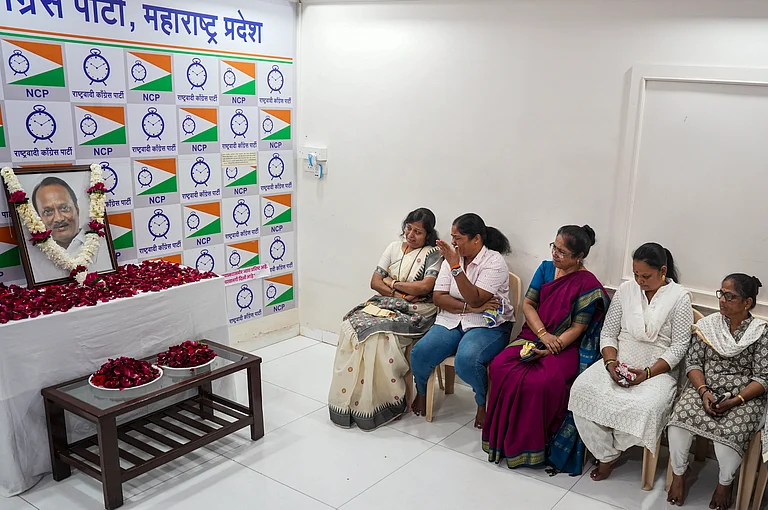
Following NCP chief Ajit Pawar’s untimely death, Baramati negotiates a future of uncertainty and a past of privilege, as it to be seen if Pawar succeeded in building durable systems or merely enforced efficiency through authority.

Summary
For more than three decades, Baramati functioned not merely as a constituency but as an extension of Ajit Pawar’s political will. Development in the town did not unfold slowly through policy cycles or institutional momentum; it moved with the urgency of a leader who believed governance was a daily, hands-on responsibility. Roads were widened because he demanded it, hospitals expanded because he followed up relentlessly, and officials worked with the knowledge that delays would invite direct scrutiny. With Ajit Pawar no longer around, Baramati now faces a question it never truly had to confront before: can a development model built so closely around one individual sustain itself in his absence?
Ajit Pawar’s political journey in Baramati went far beyond electoral success. After establishing himself early in state politics, he quickly consolidated his grip over the town’s administrative and political machinery. Over the years, Baramati became an exception in Maharashtra — a town where civic amenities worked, infrastructure grew, and public services functioned with relative efficiency.
Former district collector Dilip Band, who served in the region in the early 2000s, recalled the pressure officials worked under. “Ajit Pawar believed that roads were the lifeline of development. He would not accept excuses. If a structure was illegal and blocking progress, he would tell us to go ahead and demolish it,” Band said.
Supporters argue that this style of governance delivered visible results. Baramati today boasts 24x7 potable water supply, upgraded drainage systems, wide internal roads, footpaths, improved public transport and a healthcare network that includes a medical college, an Ayurveda hospital, a hospital exclusively for women, a cancer facility under development, and an upgraded civil hospital.
Imtiaz Shaikh, former NCP Baramati president, said these facilities were unmatched for a town of Baramati’s size. “You can go anywhere in Maharashtra, but the kind of medical infrastructure Baramati has is rare. Ajitdada personally ensured that health was treated as a priority, not as an election promise,” Shaikh said.
Advertisement
Those close to the Pawar family stress that while Sharad Pawar laid the ideological and cooperative foundation of Baramati, Ajit Pawar transformed that legacy into an execution-driven development model. Kiran Gujar, a long-time family associate, said Ajit Pawar brought speed and scale to what his uncle had envisioned decades earlier. “Pawar saheb laid the foundation, but Ajit Pawar took development to another level,” Gujar said, adding, “He monitored projects personally. He was meticulous and extremely demanding, but that is why Baramati moved ahead.”
Gujar recalled that Ajit Pawar ensured funding was never a constraint, particularly during his tenure as Finance Minister and Deputy Chief Minister. “He made sure that money did not become an excuse for delay. He wanted every project completed on time, and he followed up constantly,” he said.
However, embedded within Baramati’s success story is a structural vulnerability that analysts now say cannot be ignored. Ajit Pawar’s governance style was deeply centralised. Decision-making authority rested almost entirely in him, and institutions functioned efficiently largely because of his constant oversight.
Advertisement
Political analyst Avinash Chilekar described Baramati’s development model as effective but fragile. “This was command-driven governance, not institution-driven governance. It worked because Ajit Pawar was always present. The real test begins now,” Chilekar expressed.
Serving officials admit privately that Pawar’s presence created both pressure and accountability. A senior government officer currently posted in the region said the atmosphere has changed since his death. “Earlier, officers worked with a sense of urgency because Ajit Pawar could ask questions at any time,” the officer said. “Now there is no single authority who commands that level of fear and respect.”
The officer added that while no major project has been officially shelved, delays are becoming harder to challenge. “Earlier, even a week’s delay needed an explanation. Now responsibility is spread out, and that affects execution,” he said.
Politically, Baramati remains a Pawar stronghold, but leaders within the Nationalist Congress Party acknowledge that Ajit Pawar’s authority was personal and cannot simply be transferred. Senior NCP leader Ajit Gavhane said Pawar’s control over Baramati was built over decades. “Ajitdada did not need to assert himself. His reputation ensured discipline. Whoever comes next will have to earn that position — it cannot be inherited,” Gavhane said.
Advertisement
The uncertainty extends to Baramati’s cooperative sector, which has long been the backbone of its rural economy. Sugar factories, milk cooperatives and educational institutions flourished under Ajit Pawar’s political protection, which insulated them from interference. A senior cooperative sector official, who has worked with Baramati’s sugar cooperatives for over two decades, said Pawar’s absence could make these institutions vulnerable. “He ensured that cooperatives functioned smoothly and without political disturbance. Now there is concern about outside forces trying to assert control,” he said.
For residents, the loss is felt less in policy terms and more in everyday governance. Local trader Prakash Jadhav, who runs a shop near Baramati’s main market, said people no longer know where to take their grievances, adding, “Earlier, people would say Ajitdada will take care of it. Now there is uncertainty. People feel there is no final authority.”

That sentiment reflects how deeply Ajit Pawar’s influence had permeated Baramati’s civic life. For many, he was not just a political leader but the town’s default problem-solver. From stalled drainage work to hospital staffing issues, his intervention was often seen as the last resort.
Advertisement
Some civic activists, however, believe Baramati now has an opportunity to move away from personality-driven governance. Social activist Manav Kamble argued that development cannot depend on one individual forever. “Ajit Pawar brought development, there is no doubt. But now institutions must be strengthened. Otherwise, Baramati will always remain dependent on one leader,” he observes.
Analysts believe Baramati’s future will determine whether Ajit Pawar succeeded in building systems or merely enforced efficiency through authority. “If development continues without disruption, it will show that systems have taken root. If it slows down, it will expose how personality-dependent governance really was,” Avinash Chilekar said.
There is also concern that Baramati’s privileged access to state resources may diminish. A retired senior bureaucrat who served in the Maharashtra government said Baramati always enjoyed special attention.
“Baramati was never treated like an ordinary town…It had a direct line to power. That line is gone now,” he says.
Published At: