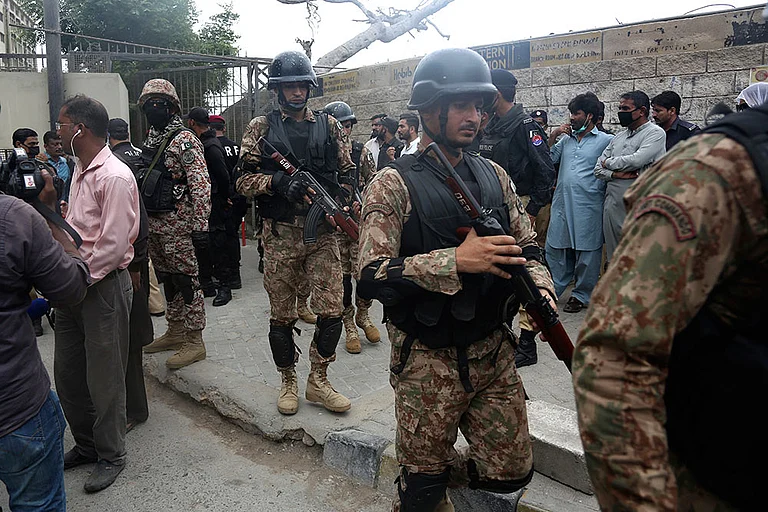
Militants launched a coordinated assault on the headquarters of Pakistan’s Sindh Rangers in Karachi on Saturday, first detonating an explosives-filled vehicle at the entrance before opening fire and storming the compound, according to police and witnesses. At least three paramilitary personnel were killed in the attack.
Why Karachi Keeps Coming Back To Pakistan's Terror Map
Militants launched a coordinated attack on the Sindh Rangers headquarters in Karachi, using an explosives-laden vehicle and gunfire, killing at least three paramilitary personnel.

The assault targeted the Rangers facility in Karachi’s Gulistan-i-Jauhar area, a district in the city’s east that is home to universities and government institutions. The explosion was followed by an exchange of gunfire that continued for around 15 minutes and was heard across the surrounding area.
Karachi, widely known as the “City of Lights” (Rooh-e-Roshan), served as Pakistan’s federal capital from 1947 to 1961 and continues to be the country’s foremost economic centre. As Pakistan’s largest commercial hub, the city handles more than 95 per cent of the nation’s foreign trade, contributes nearly 30 per cent of industrial output, and generates around 60 per cent of total revenue. Its strategic importance is reinforced by two major ports: Karachi Port, situated on Karachi Harbour between Kiamari, Manora and Kakapir and positioned near the city’s central business and industrial districts; and Port Muhammad Bin Qasim, located next to Bin Qasim Town in the southern part of Malir District in Karachi Division, Sindh.
According to a September report by Bloom Pakistan, Karachi handles nearly 76 per cent of Pakistan’s total exports through its port infrastructure, including Port Qasim, Karachi Port East and West, and MCC Port Qasim.
Data from PK Revenue shows that during the fiscal year 2023–24, the Karachi Port Trust (KPT) recorded a substantial increase in cargo operations, with total freight handling rising by 23.43 per cent to reach 51.65 million tonnes. The growth was driven largely by a 31.39 per cent increase in cargo volumes.
The City's History Of Terror Attacks
On October 18, 2007, two explosions targeted the motorcade of former Prime Minister Benazir Bhutto in Karachi as she returned to Pakistan after nearly eight years in exile. The attack killed 139 people. Bhutto, who became the first woman democratically elected to lead a Muslim-majority country, was later assassinated in a separate attack in Rawalpindi on December 27 that year.
Advertisement
In 2014, Karachi witnessed another major militant attack when heavily armed assailants stormed the old terminal of Jinnah International Airport. At least 26 people, including 10 attackers, were killed in the assault on Pakistan’s financial hub.
On May 13, 2015, armed assailants opened fire on a bus in Karachi’s Safoora Goth area, killing at least 46 people. The victims belonged to the Ismaili Shia Muslim community. The banned militant group Jundallah claimed responsibility, and pamphlets expressing support for the Islamic State group — to which Jundallah declared allegiance, were recovered from the site.
In June 29, 2020, heavily armed militants launched an attack on the Pakistan Stock Exchange in Karachi in a high-profile assault. Security forces killed all four attackers during the operation, while two civilians and three security personnel also lost their lives. Responsibility for the attack was claimed by the Balochistan Liberation Army. Armed with automatic weapons, grenades and explosives, the attackers attempted to enter the Pakistan Stock Exchange (PSX) compound through a parking area. Security personnel intercepted and neutralised the assault within the premises before the militants could reach the main building, Deputy Superintendent of Police (South) Jamil Ahmed said.
Advertisement
The Rangers' Role In Restoring Order
Interior Minister Mohsin Naqvi earlier this year said Sindh Rangers had played a pivotal role in restoring peace in Karachi and curbing terrorism, crime and unrest across the city.
Speaking at the passing-out parade of Basic Recruit Training Course No. 33 at the Pakistan Rangers (Sindh) Training Centre and School, Naqvi praised the discipline, professionalism and commitment of the recruits joining what he described as one of Pakistan’s most respected security forces, Dawn reported.
Naqvi paid tribute to the Sindh Rangers for building a nationwide reputation for professionalism and performance, saying the force had “created history” through its role in restoring law and order in Karachi. He said Rangers had been instrumental in reducing terrorism, criminal activity and instability in the metropolis.
He added that, working alongside Sindh police, the Rangers had also helped dismantle criminal networks in the Katcha (riverine) belt, contributing to improved security across the province.
Advertisement
Naqvi said sustained operations by the force had transformed Karachi, enabling the revival of commercial and industrial activity and helping re-establish the city as a centre for trade and culture.
Why militants are returning to urban targets and what this means for Pakistan's security
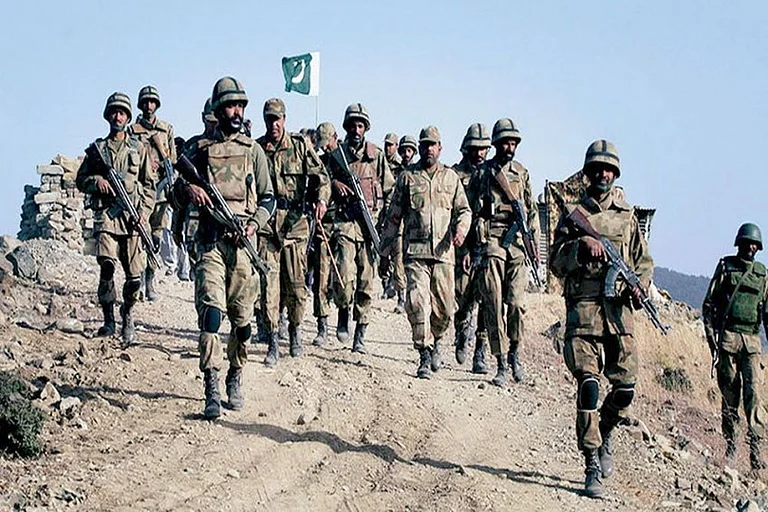
Militancy has emerged as an escalating challenge for Pakistan, with the number of attacks increasing each year since 2022, according to data from Armed Conflict Location & Event Data (ACLED), a global conflict monitoring organisation.
ACLED data shows that total attacks in Pakistan rose nearly fourfold, from 658 incidents in 2022 to 2,425 in 2025. Over the same period, attacks attributed to the Tehreek-e-Taliban Pakistan (TTP) surged more than sevenfold, increasing from 118 to 838.
Political instability has shaped much of Pakistan’s history, with weak civilian governments often undermined by corruption, infighting and the military’s enduring influence. Since the first military coup in 1958, Pakistan has experienced multiple periods of military rule, and no prime minister since independence has completed a full five-year term.
Advertisement
Security challenges have further complicated governance, particularly the rise of militant and separatist movements. The Tehreek-i-Taliban Pakistan (TTP), formed in 2007 with links to the Afghan Taliban, emerged in response to military operations in the former Federally Administered Tribal Areas (FATA). Despite repeated military campaigns, the group has remained active, aided by cross-border movement and militant networks.
Militant violence has intensified in recent years. In 2025, the TTP was involved in around 700 attacks or clashes with security forces in the first 11 months of the year, while allied groups strengthened their presence in Khyber Pakhtunkhwa. Separately, Baloch separatists escalated operations, carrying out increasingly sophisticated attacks, including the hijacking of the Jaffar Express train in March.
Published At: