Ukraine has sought closer ties with NATO for years, but its bid for membership gained urgency after Russia’s 2022 invasion as Kyiv pushed for stronger Western security guarantees.
Russia argues that NATO expansion threatens its security and opposes Ukraine joining the alliance.
Ukraine and NATO maintain that alliance membership decisions cannot be dictated by Moscow.
Ukraine’s NATO Push Explained: Why Russia Opposes It And How Membership Works
NATO and the European Union have different roles and entry requirements — NATO is a military alliance based on collective defence, while the EU is a political and economic union with stricter accession criteria.

Summary
Tens of thousands of Ukrainian soldiers and hundreds of thousands of Russian troops have been killed since Russia’s invasion of Ukraine in 2022.
The United Nation has verified that conflict-related violence in Ukraine in May killed at least 274 civilians and injured 1,763. While the civilian death toll rises, Ukraine’s push to join NATO has become one of the defining issues in its conflict with Russia.
Kyiv had sought closer ties with the alliance for years before Russia’s invasion, and since then has repeatedly renewed calls for membership and greater military support from Western allies. The war has become Europe’s deadliest conflict since the end of World War II.
The fighting has shown little sign of easing. Recent Russian strikes and continued long-range attacks have coincided with renewed diplomatic efforts led by U.S. President Donald Trump, who has publicly pushed for a negotiated settlement and temporary ceasefire measures. While peace discussions remain active, with British, French and German ambassadors to Russia urging direct talks between Moscow and Kyiv in a rare meeting at Russia’s foreign ministry last week, no breakthrough agreement has yet been reached.
One of the core issues that has surfaced in the duration of the war is Ukraine wanting to become a member of North Atlantic Treaty Organization (NATO), a military and political alliance that has members from North America and Europe.
What is the difference between NATO and the European Union?
Although NATO and the European Union (EU) share many member countries, they have different purposes and membership requirements.
NATO is a military alliance focused on collective defence and security. Membership is open to European countries that support the alliance’s principles and can contribute to security in the North Atlantic region. NATO currently has 32 member states.
The EU, in contrast, is a political and economic union with stricter entry conditions. Under Article 49 of the Treaty on European Union, countries seeking membership must meet the Copenhagen criteria, introduced in 1993 and later strengthened in 1995. These include:
stable democratic institutions that uphold the rule of law, human rights and protect minorities;
a functioning market economy that can compete within the EU;
the ability to adopt and implement EU laws, policies and obligations.
These different requirements explain why membership does not fully overlap. For example, the United Kingdom remains a NATO member despite leaving the EU. Similarly, Montenegro and Albania are members of NATO but are not part of the EU.
Today, NATO and the EU continue to work closely together. Their partnership was formalised in the early 2000s and focuses on supporting international peace and security, managing crises, responding to hybrid threats and strengthening partner countries. They also share 23 member states, reflecting their close but distinct roles.
Advertisement
Who can join NATO? Membership rules explained
NATO follows an “open door” policy, meaning any European country can apply to join the alliance.
Under Article 10 of the 1949 North Atlantic Treaty (also known as the Washington Treaty), membership is open to any European state that can uphold the treaty’s principles and contribute to the security of the North Atlantic area. New members can only be admitted through unanimous agreement among existing NATO allies.
In addition to this principle, aspiring members are expected to meet political, military and economic standards outlined in NATO’s 1995 Study on Enlargement. These include maintaining a functioning democratic system, ensuring fair treatment of minority populations, establishing civilian and democratic control over the military, and demonstrating a willingness to contribute to NATO-led operations.
The 1995 study argued that, after the Cold War, NATO enlargement would strengthen stability and security across the Euro-Atlantic region. It stated that expansion could support democratic reforms, encourage cooperation and consultation among member states, and promote good-neighbourly relations.
Advertisement
NATO had 12 founding members in 1949. Since then, the alliance has expanded through 10 rounds of enlargement and today includes 32 member states. Sweden became NATO’s newest member on 7 March 2024.
At present, three partner countries have formally declared aspirations to join NATO: Bosnia and Herzegovina, Georgia and Ukraine. Bosnia and Herzegovina was invited to join the Membership Action Plan (MAP) in 2010, while NATO allies agreed at the 2008 Bucharest Summit that Georgia and Ukraine would eventually become members in the future.
Why Russia opposes Ukraine joining NATO
Russia has long opposed Ukraine joining NATO, arguing that the alliance’s expansion towards its borders threatens its security interests.
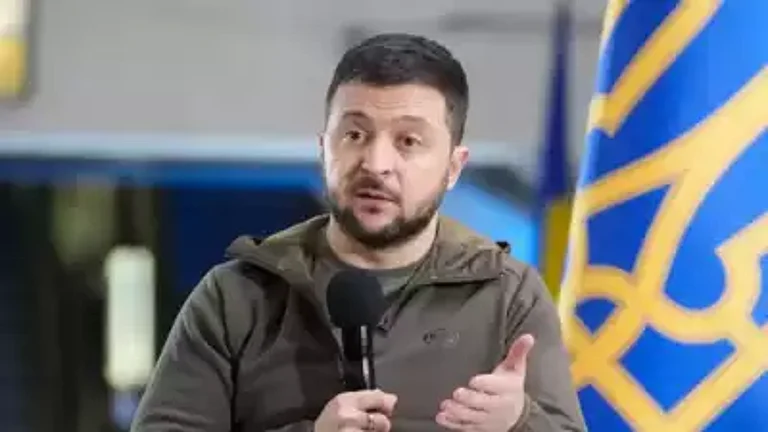
The issue became more prominent in 2008, when NATO stated that Ukraine could eventually become a member. Following Russia’s full-scale invasion of Ukraine in 2022, Ukrainian President Volodymyr Zelensky called for Ukraine’s accession process to be accelerated. However, then-NATO Secretary General Jens Stoltenberg said Ukraine could join "in the long term", but not until after the war ended.
Advertisement
At the centre of the debate is Article 5, one of NATO’s core principles. Article 5 establishes collective defence, under which an attack on one member is treated as an attack on all members. Collective defence is NATO’s most fundamental principle. It states that an armed attack against one NATO member shall be considered an attack against them all.
Article 5 triggers an obligation for each member to come to its assistance of one member being attacked. This assistance may or may not involve the use of armed force, and can include any action that Allies deem necessary to restore and maintain the security of the North Atlantic area.
However, this guarantee does not extend to bases located outside NATO territory or conflicts beyond the alliance’s designated area, which is why it did not apply in cases such as the Vietnam War or the Falkland Islands conflict, The Indian Express reported.
Advertisement
From the Kremlin’s perspective, maintaining a buffer zone between Russia and NATO along its western and southern borders remains central to national security. Russian strategic concerns include the possibility of a NATO-protected Ukraine placing military infrastructure closer to Moscow and limiting Russia’s access to the Black Sea. Russia cited similar security arguments when it annexed Crimea in 2014.
Russia has repeatedly distinguished between Ukraine’s relationship with the EU and with NATO. "As for Ukraine's membership of the EU, we have never objected to this," Russian President Vladimir Putin told Slovak Prime Minister Robert Fico at talks in China, according to Reuters. "As for NATO, this is another issue... Our position here is well known: we consider this unacceptable for ourselves."
Ukraine rejects Russia’s position, arguing that decisions on membership in international organisations belong solely to Kyiv. NATO has similarly maintained that Russia has no veto over alliance enlargement.
NATO was established in 1949 amid concerns over Soviet influence in Europe. In response, the Soviet Union created the Warsaw Pact in 1955 alongside several Eastern European states. The alliance collapsed with the end of the Cold War and was formally dissolved in 1991. Several former Warsaw Pact members later joined NATO.
Since the collapse of the Soviet Union, Russia under Putin has remained wary of Western expansion. Today, the three Baltic states are NATO members and share borders with Russia, while Belarus remains outside the alliance and Ukraine has continued to pursue closer ties with Western institutions.
NATO continues to strongly support Ukraine and condemns "Russia's war of aggression against Ukraine in the strongest possible terms." The alliance states that this aggression undermines Euro-Atlantic and global security and violates international law. NATO Allies have called on Russia to end the war immediately, stop the use of force against Ukraine and fully withdraw its forces. The alliance also maintains that "The Allies do not and will never recognise Russia's illegal and illegitimate annexations, including of Crimea."
Published At: