Pakistan Defence Minister Khawaja Asif warned that the Mecca Defence Alliance could become operative if Houthi attacks on Saudi Arabia amount to aggression against a member state.
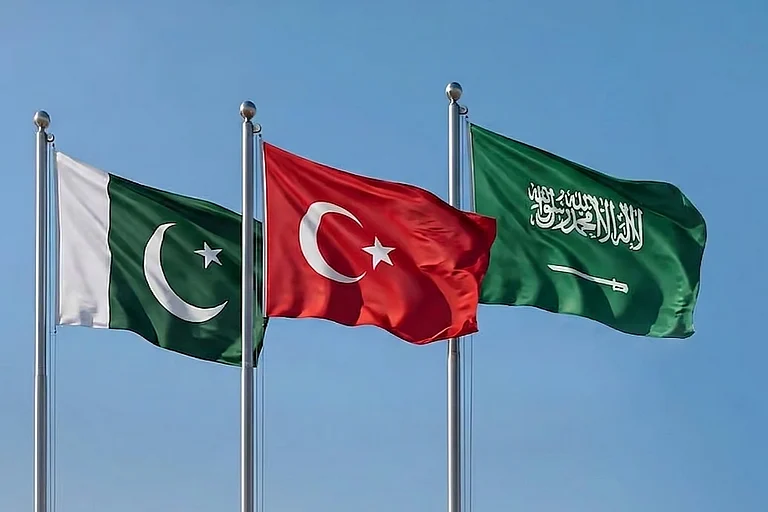
The three-member pact between Pakistan, Saudi Arabia and Turkiye states that an attack on one member would be treated as an attack on all.
The warning comes amid renewed tensions in Yemen, where Iran-aligned Houthi forces are fighting a Saudi-backed coalition that has intervened in the conflict since 2015.
Pakistan Awaits ‘Next Attack’ To Trigger Mecca Defence Pact If Yemen War Spills Into Saudi Arabia
Pakistan's Defence Minister Khawaja Asif warned that the Mecca defence pact with Saudi Arabia and Turkiye could be activated if the Yemen conflict spills into Saudi Arabia

Summary
Pakistan said there should be “no ambiguity” that an attack on any one of the three members of the newly formed Mecca Defence Alliance would be treated as an attack on all, as he warned that the pact could become operative following Houthi strikes on Saudi Arabia.
Defence Minister Khawaja Asif's remarks on Tuesday come hours after Yemen's Iran-aligned Houthi forces launched a wave of missile and drone attacks on Saudi Arabia, targeting cities and economic and energy infrastructure and injuring at least 73 civilians.
What Did Pakistan Say About The Mecca Defence Pact?
The minister said any unprovoked aggression against a member state, or a spillover of the Yemen conflict into Saudi Arabia, would activate the collective-defence provisions of the agreement signed by Pakistan, Saudi Arabia and Turkiye in Mecca last month.
“There should be no ambiguity; there is no need for any clarity that this is a joint defence agreement,” Asif said in an interview with Geo TV channel. Pakistan would honour its commitments to Saudi Arabia under the pact, he said.
“There should be no doubt about this. We are bound by the terms and conditions of this pact and, God willing, we will honour them in case there is a need,” Asif asserted.
Asif, however, said he was not aware of any contact between Pakistan and Saudi Arabia following the Houthi attacks.
He stressed that the agreement was defensive in nature and did not authorise the three countries to launch attacks against another state on their own initiative.
“This is not an aggressive agreement under which the three countries would, on their own initiative, attack another country. But if there is any aggression against one member state, all three member states will respond,” the minister said.
He expressed hope that tensions would subside, but warned the Houthis against extending the Yemen conflict beyond the country's borders.
“If they try to export them, the clauses of this agreement to counter aggression will become operative,” Asif reiterated.
Advertisement

What Is The Yemen War And Who Are The Houthis?
Asif described the Houthis as "non-state actors" and said there was sympathy for Iran across the Muslim world, including Yemen, over its ongoing conflict with the United States.
He, however, cautioned against allowing such sentiments to be used to widen an existing bilateral dispute.
The minister said the Mecca alliance could serve as a deterrent and did not necessarily mean that the three countries would respond to aggression with military force.
“We don't need to respond to a brick with a stone,” he said, arguing that the combined military capabilities of Pakistan, Saudi Arabia and Turkiye should themselves act as a deterrent.
He said Saudi Arabia should not be dragged into what he described as an internal conflict in Yemen and expressed hope that diplomatic efforts could help prevent further escalation.
Advertisement
A Saudi-led coalition of Arab states has backed Yemen's internationally recognised government in its war against the Houthis for more than a decade.
The Houthis said Tuesday's attacks were retaliation for dozens of recent Saudi airstrikes on areas of northwestern Yemen under their control. On Monday, the group accused Saudi Arabia of bombing a prison in the city of Al Hazm, killing at least 11 people.
Yemen's war began in 2014 when the Iran-backed Houthi movement seized Sanaa, forcing the internationally recognised government to flee. Saudi Arabia intervened in 2015 at the head of a coalition backing the Yemeni government.
Years of fighting created a major humanitarian crisis before a UN-brokered truce in 2022 largely halted large-scale hostilities. The truce has since unravelled, with fighting between the Houthis and Saudi-backed Yemeni forces intensifying again in recent months. The Houthis have also attacked Saudi territory and Red Sea shipping, linking Yemen's civil war to wider regional tensions.
Advertisement
Published At: