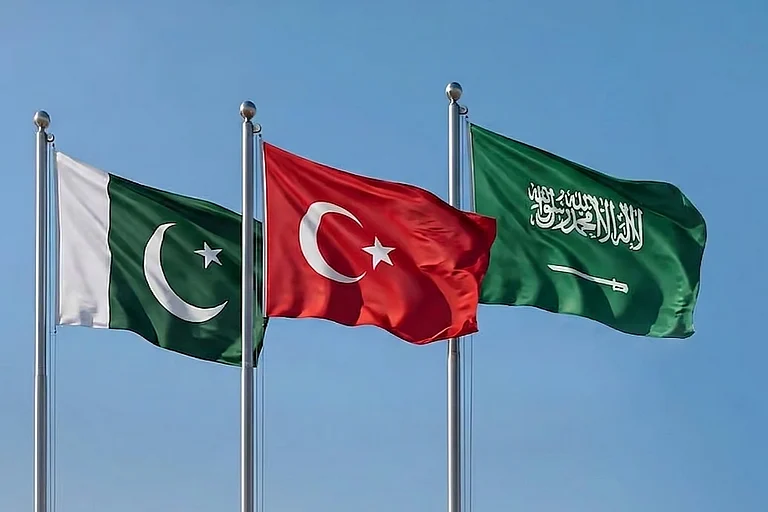
Türkiye, Saudi Arabia and Pakistan have signed a collective-defence agreement
The pact treats an armed attack on one member as an attack on all three
The agreement could reshape regional deterrence but does not explicitly target Israel
Outlook Explains | Türkiye, Saudi Arabia And Pakistan Join Forces: What It Means For Israel
The trilateral agreement introduces a collective-defence commitment between three major Muslim-majority powers, potentially reshaping regional deterrence while stopping short of explicitly naming Israel as a threat.

Summary
Türkiye, Saudi Arabia and Pakistan have signed a joint defence agreement under which an armed attack against any one of the three countries will be regarded as an attack against all three. The pact establishes a new framework for collective deterrence involving three states with significant military capabilities and growing diplomatic coordination over regional security.
The agreement was signed in Makkah during a meeting involving Saudi Crown Prince Mohammed bin Salman, Turkish President Recep Tayyip Erdoğan and Pakistani Prime Minister Shehbaz Sharif. Pakistan's Foreign Ministry described the agreement as strengthening defence cooperation and collective deterrence, while the Turkish Presidency presented it as part of closer strategic and security cooperation.
The agreement comes amid heightened tensions across the Middle East and closer diplomatic coordination between the three countries over Gaza, Jerusalem and wider regional security. But while the pact could affect Israel's strategic calculations, its official announcements do not identify Israel as an adversary.
What Does The Agreement Say?
The central provision is its collective-defence clause: an armed attack against one of the three signatories will be regarded as an attack against all three.
The provision takes the relationship beyond political cooperation by establishing a collective-security commitment. However, the agreement does not create a NATO-style alliance with a permanent military command structure, nor do the official announcements specify an automatic military response to every possible attack.
Its practical significance will depend on how Türkiye, Saudi Arabia and Pakistan implement the agreement. Intelligence-sharing, joint military exercises, defence-industrial cooperation and coordinated planning could give the pact greater operational significance over time.
For now, the agreement establishes a framework for collective deterrence rather than a military bloc directed against a named adversary.
Why Are The Three Countries Coming Together?
Türkiye, Saudi Arabia and Pakistan have maintained defence and political ties for decades, including longstanding security cooperation between Riyadh and Islamabad and growing strategic engagement between Ankara and the Gulf states.
Advertisement
Their interests have also increasingly overlapped over developments in the Middle East.
Türkiye, Pakistan and Saudi Arabia were among eight countries that issued a joint statement in June condemning Israeli actions concerning Al-Aqsa Mosque and reaffirming support for Palestinian statehood.
A further statement issued on July 23 again condemned Israeli actions concerning Jerusalem and backed the establishment of a Palestinian state on the 1967 borders, with East Jerusalem as its capital.
Those statements do not establish that the defence agreement was created to confront Israel. They do, however, demonstrate that the three countries already share important positions on some of the region's most contentious political and security issues.
The defence pact therefore comes at a time when their diplomatic coordination is becoming more significant.
Is This An Anti-Israel Pact?
Neither the Pakistani Foreign Ministry nor the Turkish Presidency identifies Israel as the target of the arrangement. The official language focuses on collective deterrence, defence cooperation and the security of the three signatories.
Advertisement
That distinction matters. All three governments have been critical of Israeli policies towards the Palestinians, but diplomatic opposition to Israel does not automatically amount to a military alliance directed against it.
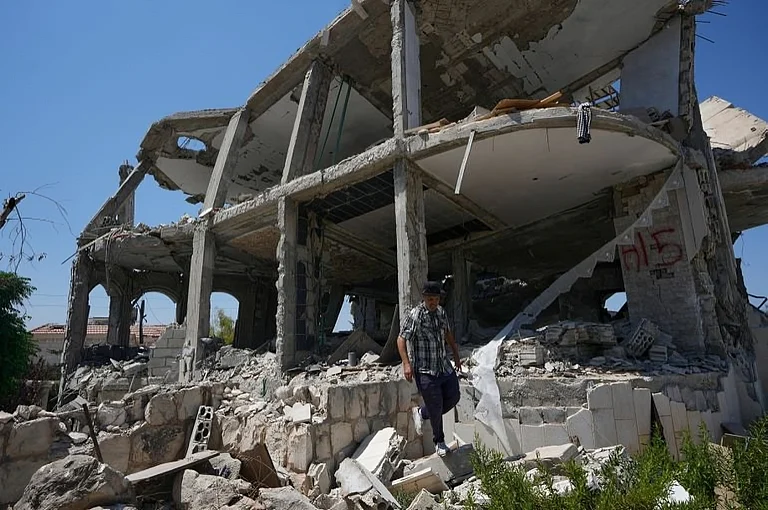
The agreement could nevertheless have implications for Israel. If the collective-defence commitment develops into deeper military coordination, a confrontation involving one of the three countries could potentially carry wider strategic consequences.
But it would be premature to describe the pact as a unified military front against Israel.
What Does It Mean For Israel?
The immediate significance for Israel lies in the potential effect on regional deterrence.
Türkiye is a major military power with a substantial domestic defence industry. Saudi Arabia has considerable economic and strategic weight in the Gulf, while Pakistan has a large and experienced military and longstanding defence ties with Riyadh.
The three countries also occupy strategically important positions across the eastern Mediterranean, Gulf and South Asia.
Advertisement
Their diplomatic coordination over Gaza and Jerusalem adds another dimension. The June and July statements, which condemned Israeli actions and reaffirmed support for Palestinian statehood, demonstrate that the three governments already share positions on issues central to the regional security debate.
Published At: