Iran launches drone and missile attacks on Bahrain and Kuwait.
US strikes followed alleged Iranian attacks on shipping near Hormuz.
Escalating Gulf tensions threaten ceasefire efforts and regional stability.
Ceasefire Unravels: Iran Strikes Bahrain, Kuwait After US Retaliatory Airstrikes
American forces launched airstrikes early Sunday targeting Iranian military infrastructure, U.S. Central Command said
Summary
Iran's paramilitary Revolutionary Guard targeted Bahrain and Kuwait with drone and missile attacks on Sunday, following retaliatory action by U.S. Central Command on Iranian sites, AP reported.
American forces launched airstrikes early Sunday targeting Iranian military infrastructure, U.S. Central Command said.
Tehran quickly escalated the standoff against Gulf Arab states hosting American forces. The Revolutionary Guard threatened a "complete halt" to negotiations to end the war if Washington continues its attacks.
Escalating Maritime Flashpoint
Tensions erupted at sea. A multinational maritime body overseen by the U.S. Navy said on Saturday that it would expand a route near Oman in the Strait of Hormuz to allow for both inbound and outbound traffic.
Iranian forces attacked the Panamanian-flagged tanker Kiku early Saturday, triggering the American military response. The U.S. military said that "Iran had a chance to honour the ceasefire agreement" but "elected not to" when its forces attacked the Kiku.
The Kiku carried crude oil for Qatar's state-run energy company, a key negotiator between Iran and the U.S., and was bound for a United Arab Emirates port. The vessel left a Qatari oil field in the middle of the Persian Gulf earlier in the week, ship tracking websites reported. It appeared to be attempting to use a route established near the coast of Oman, which serves as an alternative to the route sanctioned by Iran.
An interim deal called for transits to resume through the waterway, which once saw one-fifth of the world's oil and natural gas pass through it. However, Iran has twice attacked vessels on the Oman route, backed by a United Nations agency, insisting on controlling passage despite opposition from Washington and Gulf nations.
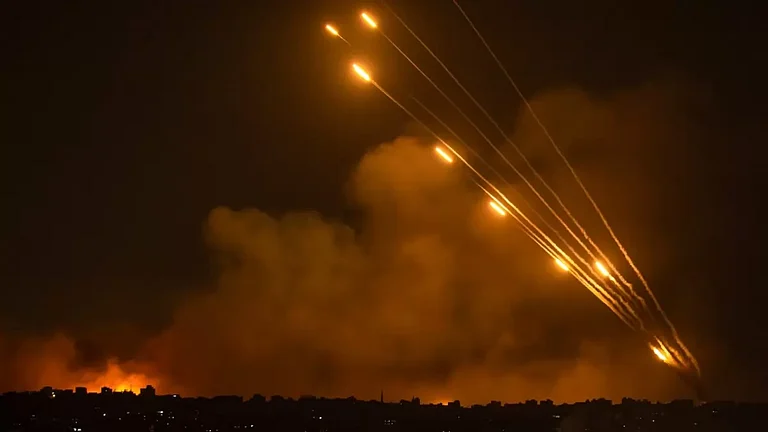
The conflict has steadily intensified over recent days. On Thursday, June 25, 2026, an Iranian drone struck a merchant vessel off Oman, prompting initial U.S. retaliatory strikes.
Advertisement
Donald Trump posted on Truth Social that U.S. forces struck "Iranian missile and drone storage locations, and coastal radar sites, for violating the Cease Fire Agreement, AGAIN!" He warned of a point where the U.S. may no longer be able to be reasonable, "and will be forced to militarily complete the job."
"If that happens, the Islamic Republic of Iran will no longer exist!" Mr. Trump wrote.
U.S. strikes targeted Iranian surveillance infrastructure, communication systems, air defence sites, drone storage facilities and minelayer capabilities. The Revolutionary Guard took responsibility for Sunday's counter-attacks, saying it targeted "Al Asad Air Base in Kuwait". "Let the enemy know that violating the ceasefire... will lead to a complete halt of ongoing processes," the Guard added. The paramilitary organisation, which controls Iran's ballistic missile arsenal, answers directly to Supreme Leader Ayatollah Mojtaba Khamenei and is thought to be wielding even greater influence now in the Islamic Republic.
Advertisement
The targeted nations hold strategic American assets. Kuwait hosts a major U.S. Army base, while Bahrain hosts the U.S. Navy's Fifth Fleet, whose base there came under repeated attack during the war. After the U.S. strikes early Sunday, Kuwait's military said air defences intercepted incoming Iranian drones and missiles, offering no immediate information on any damage.
Bahrain's Foreign Ministry denounced the strikes as a dangerous escalation. The ministry said Tehran's actions represent a systematic pattern of repeated aggression against the kingdom's sovereignty and the security of its citizens.
Published At: