Australia and the Solomon Islands condemned China's ballistic missile test from a nuclear-powered submarine.
Australian Prime Minister Anthony Albanese called it a destabilising act in the Pacific.
The missile test has intensified regional security concerns as Australia seeks to counter China's growing influence in the Pacific.
Australia, Solomon Islands Condemn China's Submarine Missile Test, Pledge Closer Ties
Prime Minister Anthony Albanese and Solomon Islands leader Matthew Wale agreed to deepen bilateral ties and speed up negotiations on a new comprehensive treaty.

Summary
Australia and the Solomon Islands on Tuesday condemned China's test of a ballistic missile launched from a nuclear-powered submarine in the Pacific, as the two countries pledged to strengthen bilateral ties amid growing strategic competition in the region.
Australian Prime Minister Anthony Albanese made the remarks after meeting Solomon Islands Prime Minister Matthew Wale in Honiara, where the leaders also agreed to accelerate negotiations on a new comprehensive bilateral treaty.
"There is no doubt that this is a provocative act by China, which does destabilise the region," Albanese said during a joint news conference.
Albanese said China had failed to provide the standard 48 hours' advance notice before the missile launch, adding that the "real concern" was that the missile had been fired from a nuclear-powered submarine.
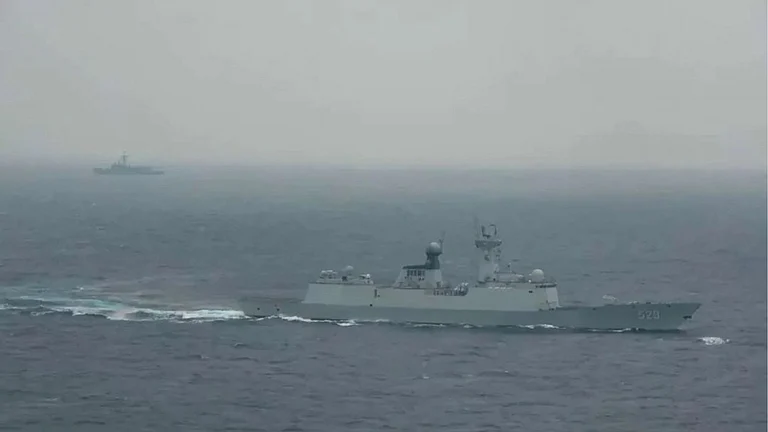
According to China's state-run Xinhua News Agency, a nuclear-powered submarine of the People's Liberation Army Navy launched a ballistic missile carrying a dummy warhead into international waters in the Pacific at 12:01 p.m. (0401 GMT) on Monday. The missile landed in "designated waters", although no location was disclosed.
Although China is Australia's largest trading partner, Canberra has become increasingly concerned about Beijing's growing influence in the Pacific and has pursued security partnerships with island nations to counter any permanent Chinese military presence in the South Pacific.
Wale, whose government took office in May, said China remained "a good friend of Solomon Islands but this is not something a friend does".
"We don't want to see any more countries - China, America, anybody - we don't want anybody testing the ICBMs (intercontinental ballistic missiles) in the Pacific Islands region. That's the bottom line. Be our friend, but don't threaten us," he said.
The Solomon Islands is widely regarded by analysts as China's closest Pacific partner after signing a security pact with Beijing in 2022, a move that alarmed the United States and prompted Australia to step up its diplomatic engagement in the region.
Advertisement
Taiwan's National Security Council Secretary-General Joseph Wu posted an image on social media that he said showed the missile flying over the Philippines before landing between Tonga and Nauru, around 1,000 km (620 miles) from the Solomon Islands.
"The #PRC tested a JL2 #SLBM flying over the #Philippines moments ago. It’s a provocation that destabilizes the #IndoPacific. #China just proved itself again to be a bully on the block.," Wu wrote.
Long-range Chinese missile tests into the Pacific are rare. China last conducted an intercontinental ballistic missile test in 2024, Reuters reported.
Published At: