The war began after the Hamas-led October 7, 2023, attack that killed about 1,200 people and saw 251 hostages taken.
Israel's military campaign in Gaza has since killed 73,066 Palestinians, according to Gaza's Health Ministry.
Netanyahu faces an ICC arrest warrant and declining domestic support ahead of Israeli elections, while the conflict has expanded beyond Gaza to include confrontations involving Iran and Hezbollah.
1,000 Days Of War In Gaza: Palestinians Still Isolated From Humanitarian Aid
A US-brokered ceasefire announced in October 2025 secured the release of all surviving hostages and about 2,000 Palestinian prisoners, but key disputes over Gaza's future remain unresolved.

Summary
"Carrying my sick child on my back through the streets of Gaza, where bystanders are both snipers as well as a queue of thousands waiting for their turn to ‘cross the line’—I walked, I ran, I stumbled and I stood up again. I didn’t know where to look, where to get help from, whom to tell that she was vomiting and she needed immediate treatment. No help was in sight. Hundreds of eyes from behind the military helmets were looking at us.
We were confined. Trapped in our own land,” Zak told Outlook in 2023. He used to work in a mall close to Al Shati refugee camp before he and his family fled to escape Israeli attacks.
Today, the war in Gaza reaches its 1,000th day. On October 7, 2023, Hamas fighters crossed into southern Israel, killing about 1,200 people and taking 251 hostages. Since then, all of the hostages or their remains have been freed or returned through a combination of military operations and negotiated exchanges.
In response, Israel launched a military campaign in the Gaza Strip. According to Gaza's Health Ministry, 73,066 Palestinians had been killed as of Tuesday. The war has also displaced much of Gaza's population and caused extensive damage to homes, hospitals and other civilian infrastructure.
Earlier, Palestinian Ambassador to India Abdullah Ali Shawesh told Outlook India that the suffering of Palestinians before October 7 did not justify the Hamas-led attack on Israel, but argued that the attack also did not justify Israel's military campaign in Gaza. He said the offensive had resulted in the deaths of tens of thousands of Palestinians, the widespread destruction of Gaza and severe hunger, describing it as an "ongoing, televised, textbook, American-Israeli genocide."

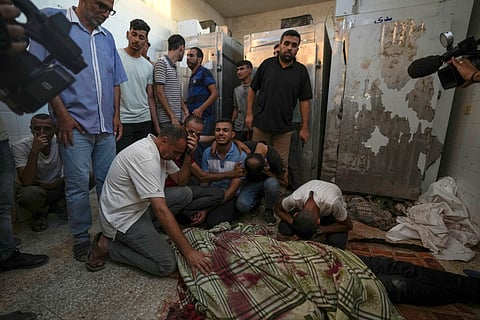
Photo for representation - AP
Endless Exile: Life Inside Displacement Shelters
In October 2024, Israel expanded its offensive into northern Gaza, targeting the Jabalia refugee camp and Beit Lahiya while imposing a siege aimed at creating a deeper security buffer along the border. Operations later extended to Beit Hanoun in November 2024.
Advertisement
“There were so many of us in the house – it was very crowded and there was no privacy. We barely had food or water to drink and wash. I was in my dirty clothes as there was no water to wash dirty clothes. It was very cold and, since we were displaced, I didn’t have any warm clothes," a a 13-year-old boy told the Commission.
Notably the UN Commission learned that girls and women had been forced to wear their veil or their prayer cover constantly as the living spaces were shared with men outside the immediate family. The report also revealed that they remained covered 24 hours a day for fear that, if they were killed, they would at least die covered.
By August 2025, about 1.9 million people, roughly 90% of Gaza's population, had been displaced, with much of the enclave facing acute or catastrophic levels of food insecurity. “This is irrefutable testimony… It is a famine, the Gaza famine,” UN relief chief Tom Fletcher told reporters in Geneva.
Advertisement
In October 2025, US President Donald Trump announced that Israel and Hamas had agreed to a ceasefire as part of a broader 20-point framework intended to end the conflict, disarm Hamas and oversee Gaza's reconstruction under a new civilian administration.
As part of the ceasefire agreement, Hamas released all surviving Israeli and foreign hostages held in Gaza. Following the release of the final living captives on October 13, Hamas began returning the remains of deceased hostages, completing its obligations under the agreement. Israel has freed about 2,000 Palestinian prisoners.
On March 22, 2025, a 17-year-old boy from Ramallah died in Megiddo Prison, according to the UN report. The boy had been held in prison since September 30, 2024, prior to which, according to his father, he was fit, athletic and healthy. After his arrest, he was examined twice at the prison medical clinic in December 2024 and February 2025 for scabies.
Advertisement
In December 2024, he reported to the prison clinician and was diagnosed with head trauma and inadequate food. This diagnosis was included in his prison medical record viewed by the Commission. On 22 March 2025 at 07:48 he suffered from sudden loss of consciousness and died at 09:10.
As for humanitarian aid, COGAT, the Israeli military agency responsible for coordinating civilian affairs and aid access to Gaza, said in October last year that no fuel or cooking gas would be allowed into the enclave except for specific humanitarian infrastructure needs, Reuters reported.
“At one point, we had to eat cat food and grind donkey feed to make bread. It tasted disgusting, but we had to eat to survive, to stay alive,” said a 13-and-a-half-year-old boy who was severely injured after an Israeli airstrike hit his home in December 2023, according to a June 2026 report by a UN Commission of Inquiry.
Advertisement
Notably, the United Nations said in mid-February that it continued to face significant obstacles in delivering lifesaving assistance across Gaza. In a February report, Human Rights Watch said Israeli restrictions on aid continued to drive shortages of medicines, reconstruction materials, food and water throughout the territory.
In a separate statement announcing the closure of Gaza's border crossings, COGAT said enough food had entered the enclave since the ceasefire began to meet four times the population's needs, though it did not provide evidence to support the claim. The agency added that "the existing stock is expected to suffice for an extended period."
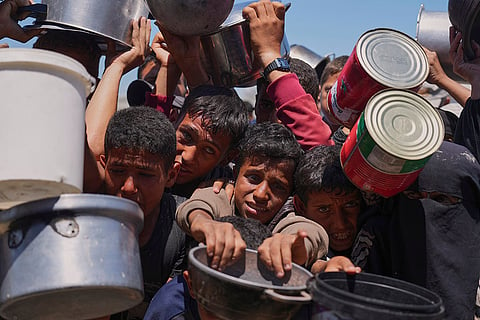
Israel Palestinians conflict | Photo: AP/Abdel Kareem Hana
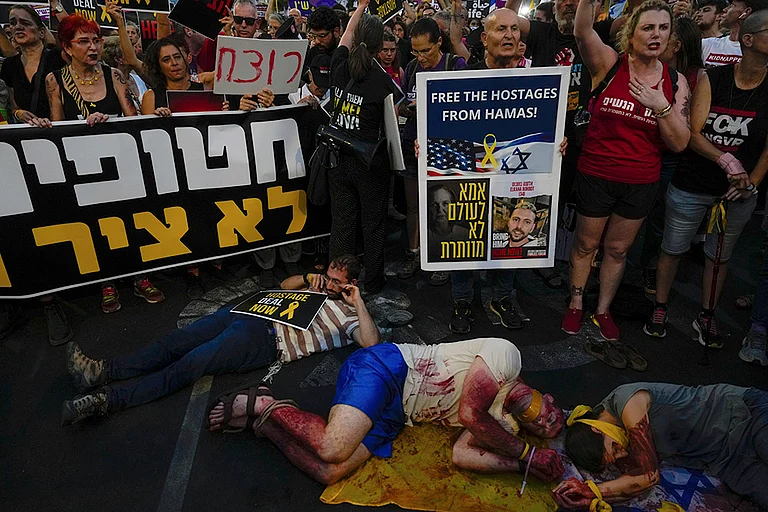
Changing Borders: Israel's Expanding Control
Since the truce took effect, at least 1,053 Palestinians have been killed and 3,406 others wounded, according to Gaza's Government Media Office, which says it has documented 3,465 Israeli violations of the ceasefire agreement.
Despite the truce, the Israeli military has continued expanding the territory under its control in Gaza while issuing new displacement orders, Al Jazeera reported. It has barred Palestinians from entering areas beyond the so-called "Yellow Line", effectively placing about 53% of the enclave off limits to residents.
“The destruction of the enemy also means the complete obliteration of their symbols of power and national sites. And indeed, maybe for the first time, we are hearing that the IDF is destroying targets that are not just military objectives. The destruction of the Supreme Court in Gaza, the destruction of the Islamic University," an Israeli officer posted on 19 December 2023, mentioned in the UN report.
Additionally, the restricted area by March had expanded to 64% of Gaza, with Israeli forces displacing residents and demolishing many of the remaining buildings within those zones. On May 28 this year, Netanyahu said he had instructed the military to extend its control to more than 70 percent of the Gaza Strip.
Key issues in the agreement remain unresolved, including the disarmament of Hamas and the future governance of Gaza. Hamas’s political leader abroad Khaled Meshaal told Al Jazeera in February that disarmament will make Gazans an easy target.
“In the context that our people are still under occupation, talking about disarmament is an attempt to make our people an easy victim to be eliminated and easily exterminated by Israel, which is armed with all international weaponry,” he said.

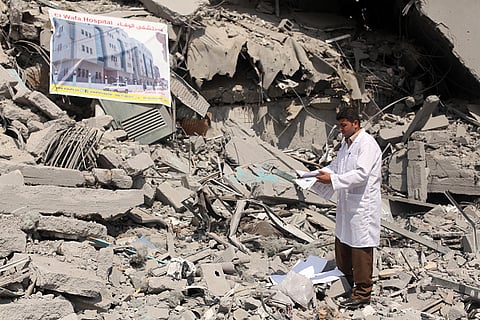
Palestinian doctor inspects devastation the headquarters of El-Wafa rehabilitation hospital Getty Images
Regional Tensions: No End In Sight
With no end to the conflict in sight, the newly constituted Board of Peace has made little progress. In November, the UN Security Council adopted a US-drafted resolution recognising the governing board, describing it as a transitional and temporary administration that "will set the framework, and coordinate funding for the redevelopment of Gaza" under Trump's peace plan until the Palestinian Authority completes agreed reforms.
Notably, Palestine is not a member, but Israel and Netanyahu are part of the board. The Guardian recently reported that the Board of Peace is seeking a sweeping grant of legal immunity. The draft would also allow the body to acquire public property in Gaza free of charge.
The International Criminal Court has issued an arrest warrant against Netanyahu. On November 21, 2024, the body alleged responsibility for the war crimes of starvation as a method of warfare and intentionally directing attacks against the civilian population, as well as the crimes against humanity of murder, persecution and other inhumane acts, allegedly committed between at least October 8, 2023, and May 20, 2024.
Netanyahu has rejected the allegations, and Israel is not a party to the Rome Statute, the treaty that established the ICC.
The war has also come at a significant cost to Israel, both in military casualties and in public support for Netanyahu. Israel is due to hold elections by the end of October, and more than 60% of Israelis believe Netanyahu should not seek another term, according to a poll published last month by the Israel Democracy Institute.
The conflict has also widened beyond Gaza, with Israel and US carrying out military operations against Iran, and Israel also attacking the Iran-backed Hezbollah in Lebanon.
Although a fragile ceasefire between US and Iran, continued Israeli strikes in Lebanon have fuelled concerns about renewed escalation.
Commenting on the regional tensions while defending Trump's newly signed memorandum with Iran, US Vice President JD Vance said: "If I was in the cabinet of the Israeli government, I might not be attacking the only powerful ally that I have anywhere left in the entire world."
Published At: