Few production designers working in independent American cinema today bring the combination of formal architectural training, cross-genre fluency, and cultural specificity that Rajarajeshwari 'RJ' Ragampudi carries into every project. Originally trained as an architect in Hyderabad, she pursued an MFA in Production Design at the American Film Institute — one of the most selective film schools in the world, admitting less than 2% of its applicants annually — before building a body of work that has traveled across international festival circuits from Berlin to SXSW. Her projects span historical dramas, surreal comedies, body horrors, and action romances, earning competitive awards and nominations across multiple festivals not just for the films but also for her production design.
Designing Worlds Beyond Architecture: Rajarajeshwari ‘RJ’ Ragampudi On Building Stories Through Production Design
Production designer Rajarajeshwari ‘RJ’ Ragampudi on her journey from architecture to AFI, designing for indie film, horror, and historical drama across global festivals.

Q: Your journey began in architecture before leading you to production design. What sparked that transition?
RJ: Architecture taught me how people experience space, but I realised I was more interested in how spaces communicate emotion and narrative. While studying architecture, I researched the intersection of film and architecture through Satyajit Ray’s films. That completely changed my perspective. I saw how environments could reveal character, social context, and emotional tension without a single line of dialogue. Production design felt like the perfect intersection of architecture, psychology, art, culture, and storytelling.
Q: Your work has appeared at festivals across multiple continents. Which projects have been especially meaningful?
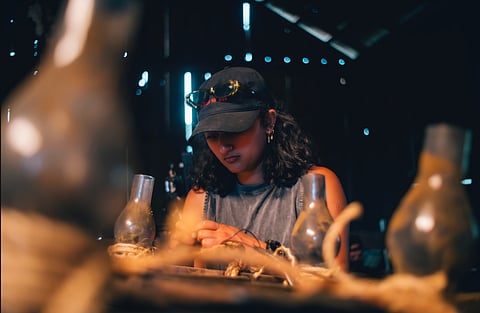
RJ: One project that has been particularly significant is Egg-secution, a surreal short film where I worked as Production Designer. It has screened at internationally recognised festivals including the Portland Horror Film Festival, Toronto Short Film Festival, Canada Shorts Film Festival, and Final Girls Berlin Film Festival — one of Europe's most recognised platforms for genre filmmaking by and about women. The film won Best Surreal Film at Night of Shorts and Best Visual Design at the Experimental, Dance and Music Film Festival, and received a Best Production Design nomination at Days of the Dead Film Festival. For a production designer, those are among the most direct forms of peer recognition the festival circuit offers. But the most exciting is definitely seeing the audiences respond to its usual visual world!
Q: Another project that stands out is “Killer of Men,” a period film set in the early 1800s. What made that experience significant?
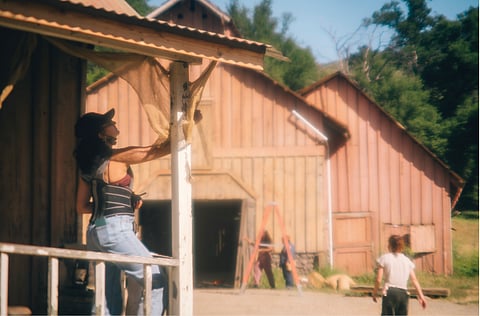
RJ: Killer of Men challenged me in a completely different way. It follows an enslaved fighter in search of freedom, so authenticity was essential — but so was emotional truth. I spent a great deal of time researching architecture, materials, objects, and social history from the period, visiting Whitney Plantation in Louisiana and consulting with local historians to ground the visual world in documented reality. The goal was not only historical accuracy but spaces that reflected themes of ancestry, resilience, and hope without reducing characters to symbols of suffering.
The film was selected for the American Black Film Festival and the Martha's Vineyard African American Film Festival, which reflects a recognition of the care the entire team — and the design specifically — brought to its subject matter.
Q: Your portfolio spans horror, historical drama, comedy, and series work. Does your approach change across genres?
RJ: The visual language changes, but the starting point is always the same: understanding the characters. Horror uses atmosphere and tension, historical drama relies on research and texture, while surreal comedy allows more symbolic experimentation. But in every genre, production design should support the emotional journey of the story rather than exist as decoration.
Q: Your portfolio extends well beyond traditional narrative films. How do you approach design when the format changes entirely?
RJ: That's something I find genuinely energising. Each format asks a fundamentally different question of a production designer, and being forced to answer those questions across very different contexts has sharpened how I think about space and visual communication.
Branded and commercial content is one area where that shift is particularly pronounced. I designed visual content for Sleep or Die, a fashion and lifestyle brand released across Instagram. Commercial design operates under a completely different set of pressures than narrative film — there is no story arc to guide the audience through a space, no character whose psychology the environment needs to reflect. Instead, the design has to communicate a brand's entire visual identity and emotional register almost instantaneously. That kind of compressed visual storytelling demands an economy of decision-making that has genuinely influenced how I approach every other format I work in.
I also designed the interview set for Made New Foundation, a nonprofit that uses immersive content and virtual reality to support incarcerated individuals and marginalised youth. That project was meaningful in a different way — it reminded me that production design shapes not only entertainment but also how people experience conversations about dignity, identity, and social transformation. The environment I created had to feel simultaneously safe, credible, and purposeful, which are not qualities I would typically be balancing on a film set.
What connects all of these formats is the same question I bring to every project: what does this space need to communicate that words alone cannot? The answer changes completely depending on whether you're designing a period drama, a branded content campaign, or an interview set for a social impact organisation — but the discipline of asking it remains constant.
Q: You trained at the American Film Institute, which has produced some of the most significant filmmakers working today. What did that foundation give you that you couldn't have found elsewhere?
RJ: AFI's MFA in Production Design is one of the most selective programmes of its kind in the world — fewer than a dozen students are admitted each year, chosen specifically for the distinctiveness of their creative vision and their potential to contribute something new to the art form. What that environment gives you is not technical training in isolation, but an immersion in a culture of intentionality. Every design decision is interrogated. You are constantly asked not just what a space looks like but what it means, what it reveals about character, what it would be impossible to communicate any other way.
What I took from AFI was a design philosophy I now apply across every project regardless of format or scale: that a production designer's job is not to decorate a story but to deepen it. Environments should carry information that the screenplay cannot. They should make the audience feel something before a single line of dialogue is spoken.
That conviction was formed at AFI, but it has been tested and refined on every project since. What Killer of Men demanded of me as a designer — the historical research, the cultural sensitivity, the need to hold realism and spiritual symbolism in the same frame — I don't think I could have approached with the same rigour without that foundational training. AFI taught me how to ask the right questions. The work since then has been about learning to trust the answers.
Q: Beyond filmmaking, you’re also a visual artist. How does that practice influence your work?
RJ: My personal work combines photography, collage, and digital painting into what I call "scrapbook art." It's inspired by cinema and everyday life, and it gives me a space to experiment freely with colour, texture, and composition. Many of the visual ideas I develop there eventually find their way into my production design work — it functions almost like a private research practice that feeds the professional one.
Q: As an Indian woman working behind the camera in Hollywood, what kind of change would you like to see?
RJ: I’d love to see more South Asians enter departments like production design, art direction, cinematography, and editing—areas that are essential to filmmaking but often receive less visibility. Representation isn’t only about who appears on screen; it’s also about who is shaping the worlds we see on screen. I strongly believe that the more diverse the creative teams, the richer and more authentic the stories become.
Q: Looking back at the body of work you've built — what defines it?
RJ: I think what connects everything is a commitment to environments that carry meaning beyond their visual surface. Whether it's an antebellum fight barn, a surreal dreamscape, or a contemporary drama, I want every space to tell the audience something about the characters who inhabit it — something they couldn't learn any other way. That conviction came from architecture, it was refined at AFI, and it shows up in every project I've designed. The work I'm most proud of is the work where the design is so integrated into the storytelling that you couldn't imagine the film looking any other way.