From Kerala, to Mussoorie and the rain-drenched forests of Goa, Stephen Alter follows the weather system that has steered traders across oceans, fuelled entire ecosystems and unsettled many an empire.
Readers get to meet perfumers in Kannauj who bottle the scent of rain, grazing Nilgiri tahr, herpetologists tracking fungi and caecilians, fishermen watching the sky for warnings.
Artists, musicians and writers who have given the monsoon its enduring metaphors come to life on the pages of this book.
Monsoon Raga: Excerpt From Stephen Alter’s ‘The Fragrance Of Rain’
In this memorable book Stephen Alter paints a vivid portrait of India's most distinct season—the monsoon

Summary
The Rains in Goa
Traditionally, the monsoon has always been a time when travellers returned home after completing their journeys. The seas grew too rough for safe passage and roads were mired in mud. Rivers swelled with the rain and became impassable. Bridges and embankments washed away while ferries could not contend with the swift currents. Towns and villages were marooned like islands amidst the floodwaters that covered fields and lowlands. In the mountains, landslides blocked treacherous routes across ridges.
Along the coast, fishermen beached their vessels to spend time with their families, mending nets and exchanging stories. Traders returned from abroad and adjourned to their factories or counting houses to tally up the year’s earnings. Caravans dispersed after unloading their cargo. Camels, bullocks, and horses were stabled, growing fat on green fodder and enjoying a respite as the rain poured down. Shepherds had no need to roam with their flocks in search of new pastures. Hunters unstrung their bows and set aside their spears. Game trails through the jungle were overgrown with creepers and nettles, the wet grass infested with leeches and venomous snakes. Itinerant minstrels and raconteurs paused their wanderings. Pilgrims returned from pious ramblings to regale their neighbours with tales of sacred sites and miraculous shrines. Mendicants retired to their caves. Soldiers remained in their barracks while muskets and cannons rusted, and gunpowder mouldered in damp magazines.
X
Though my instincts urged me to travel in pursuit of the monsoon, as Alexander Frater had done, I quickly realized that it might be wiser to stay at home and let the monsoon come to me. After my visit to Kerala, I retreated to Goa where my wife, Ameeta, and I have owned a small flat for the past twelve years. While Mussoorie remains my primary home, Goa provides us with a welcome escape from cold Himalayan winters. In that sense, I suppose we are climate migrants, enjoying the warmer temperatures and tropical greenery of Siolim, a small town where we now live for part of the year.
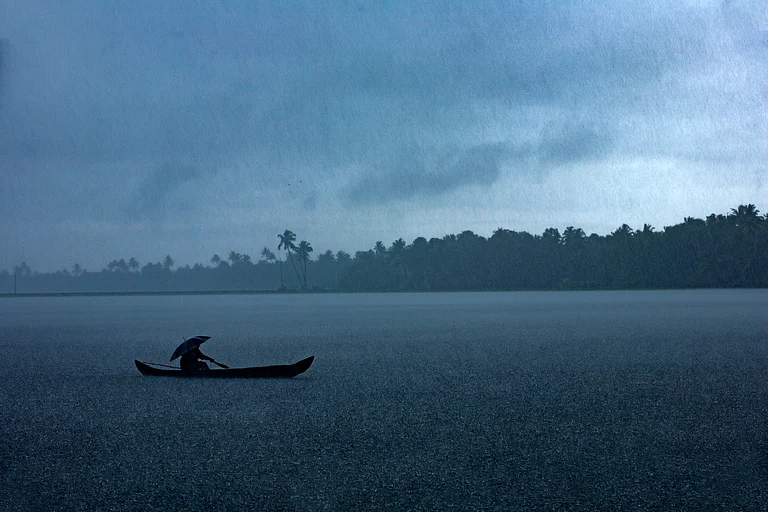
Arriving from Kerala, I found that it had been raining in Goa for almost a week and there was no doubt that the monsoon was here. While this season brings torrential storms it also fosters a quieter pace of life in Goa compared to the busy tourist season in December and January. The greenery becomes even more intense and sitting on the balcony of our flat, I looked out over a lush garden of flowering shrubs that attracts well over a hundred species of birds, from kingfishers and pittas to bulbuls and sunbirds. In the sky, white egrets were stencilled upon dark indigo clouds.
Advertisement
Every morning and evening, as if following a strict flight schedule, a flock of great hornbills winged their way over the treetops. When it rained, the areca nut palms swayed in the wind and shed the deluge like giant parasols, while the humid air felt almost cold.
One of the pleasures that precedes the monsoon in Goa and continues after the rains commence, are mangoes, which ripen at this time of year. As Vivek Menezes, an authority on all things Goan, explains:
Right from the eighteenth century, travellers and writers have agreed that there’s no match for Goa’s mangoes... the Fernandin and Xavier and Monserrate, and most especially, the indescribably sublime Hilario and Mankurad... The whole of Goa, from the Ghats to the Arabian Sea, comprises a mere sliver of the vast Subcontinent, but has developed more than 100 varieties of mangoes ever since the Jesuits introduced modern grafting techniques in the 16th century. Within just a couple of decades of that influx of European ideas, the results of the experiments had become acclaimed, treasured and celebrated wherever they reached across the known world.
Advertisement

Siolim is famous for its Hilario mangoes, commonly known as Manga Hilario or Mangilar. These originated from a single tree grafted by Hilario Fernandez, a wealthy nineteenth century landowner in the town. One morning, soon after returning to Siolim, I went in search of the mother tree. Eventually, I found it growing next to an elegant blue and white bungalow dating back to 1852. The property is now run as a guest house called Hilario’s and the manager, Munawar, guided me through the house to the backyard where the enormous tree, at least 20 metres tall, loomed over a swimming pool. Unfortunately, I was too late to taste the mangoes, most of which Munawar told me had been eaten by langur monkeys and birds. However, at the fruit market in Mapusa, near our home, I found plenty of Alphonso mangoes, which are celebrated as one of the finest varieties in India. With firm, buttery flesh of a saffron hue, they are named after Afonso de Albuquerque, the Portuguese admiral who conquered Goa in 1510.
Advertisement
Though we avoid Goa’s beaches in winter because of the crowds, during the monsoon they are almost empty of tourists. A few days after I returned from Kochi, Ameeta and I went to Morjim, our closest beach, for an evening walk. Other than a makeshift stall selling coconuts, no other vendors were in sight and the shacks that usually line the shore had been dismantled. The sea was rough, with waves more than 2 metres high, the water steel grey in the overcast light. At the northern end of the beach, a few reckless tourists waded into the surf while lifeguards patrolled the sand and stray dogs chased each other in circles. A gusty wind was blowing off the water. Unlike in Kochi, the sky was a mass of billowing clouds.
(Excerpted with permission from Aleph Book Company)
(Stephen Alter is the author of more than 25 books of fiction and non-fiction)
Advertisement
Published At: