Over the last couple of years, three of India’s OTT franchises—Paatal Lok (2020-), Delhi Crime (2019-) and The Family Man (2019-)—have turned their gaze eastward.
These series, though nuanced, teach viewers to associate the Northeast’s appearances with an emergency.
Crime, insurgency, and conspiracy become the default entry points to the Northeast, while everyday life drifts out of the frame.
Under Watch: How OTT Found The Northeast And Filed A Case
In the latest thrillers emerging from Bollywood on OTT platforms, the Northeast region is not invisible anymore, but it is visible on terms that keep it under watch.

Summary
The Northeast has finally arrived in India’s biggest web shows, but it walks into the frame like a suspect. In one series, a Naga leader’s severed head turns up in a government guest house in Delhi. A high-profile business summit collapses into panic, and the camera follows the blood trail all the way to Nagaland’s hills. In another, a trafficking network snakes out from the “eastern pockets” towards the capital, feeding it women who will be bought and sold as brides or labour. Elsewhere, explosions tear through the Northeast, and intelligence officers scramble across Nagaland and Arunachal Pradesh to stop what looks like a Chinese-backed plot.
The locations change from Dimapur to Kohima to an unnamed border town, but the mood holds steady. The region enters the story at the moment something has gone very wrong. Over the last couple of years, three of India’s most influential OTT franchises—Paatal Lok (2020-), Delhi Crime (2019-) and The Family Man (2019-)—have turned their gaze eastward. On the surface, this appears to be long-overdue recognition. For decades, Hindi cinema either portrayed the region as scenery or treated it as a security concern. Even when a figure like Mary Kom finally got a biopic, her own body was replaced, and her voice was rebuilt in the studio.

Family Man 3 Still Youtube
Streaming appears, at first, to be correcting that inertia. Paatal Lok 2 has characters speaking Nagamese and Assamese; it casts actors from the region and spends entire episodes moving between Delhi and rural Nagaland. Delhi Crime 3 acknowledges an interstate trafficking chain that runs through the Northeast and into Haryana. The Family Man 3 situates Nagaland and its rebel factions at the centre of a geopolitical crisis. In the publicity rounds, actors talk about wanting to “do justice” to a part of India that mainstream cinema has mishandled for years. Tillotama Shome, who plays an Assamese cop in Paatal Lok 2, has spoken about the weight of getting the language and body right.
For viewers in the mainland, this feels like progress. For many in the Northeast, it feels more ambivalent—recognition that arrives in uniform. Once the thrill of hearing a familiar language fades, a pattern comes into focus. The Northeast does not appear as a landscape with its own everyday rhythms of work, boredom, romance, small-town bickering, or joy. It appears as a threat profile. It is the source of insurgent plots, trafficking routes, smuggling corridors, and espionage schemes. The region is not invisible anymore, but it is visible on terms that keep it under watch.
Advertisement

Family Man 3 Still Youtube
From Postcard to Risk Map
Hindi cinema’s relationship with the Northeast has long oscillated between distance and unease. For years, the region lived at the edge of the frame, a scenic establishing shot, an undefined “border area”, or a checkpoint on the way to someone else’s story. When the camera lingered longer, it was usually because a counter-insurgency operation needed a backdrop, or because the hills offered a convenient exoticism that could be consumed without complication.
OTT arrived in an industry hungry for new landscapes, languages and textures. Writers wanted to escape the worn-out lanes of Mumbai and Delhi and find unfamiliar ground for crime and political thrillers. The Northeast, with its long and difficult history with the Indian state, offered exactly that: complicated politics, layered identities, and the possibility of moral ambiguity. It was only a matter of time before the streaming camera crossed the chicken’s neck.

Delhi Crime 3 Still Youtube
Paatal Lok 2 was the first major show to commit fully to that terrain. The season opens with the brutal beheading of Jonathan Thom (Kaguirong Gonmei), a Naga politician visiting Delhi for a business summit. The killing becomes an instant national crisis: Delhi police fears unrest, the Home Ministry fears the region slipping out of control and the investigation drags the narrative into Nagaland’s villages, ceasefire camps, and corporate boardrooms. On its own terms, the writing is smart. One body links Delhi’s complacent centre with a periphery it rarely attempts to understand.
Advertisement
The effort to avoid past missteps is also visible. Characters speak Nagamese and local languages rather than a generic “Northeast accent.” Some casting comes from the region. The scenes between Delhi officers and local police carry the friction that anyone from the region recognises immediately. Someone has done their homework. And yet, this is also where the story’s deeper shape reveals itself.

Delhi Crime 3 Still Youtube
Paatal Lok 2: Breakthrough and Blueprint
If Paatal Lok 2 stood alone, it might have remained a messy but earnest attempt to engage with Nagaland’s political reality. Its real influence lies elsewhere in the template it offers the rest of the industry.
The season gives writers an easily reusable frame. Nagaland appears as a landscape of old wounds and armed factions, but the story is told through devices the Mumbai–Delhi audience already knows: the police file, the interrogation room, the corporate memo, the development pitch. The underlying conflict is not whether Nagaland should define its own future, but whether its discontent will be guided into business summits and peace accords or erupt into “senseless” violence that disrupts national stability.
Advertisement
This is not evidence of a sinister design. It is the outcome of narrative convenience. The familiar scaffolding of a crime thriller, body, investigation and conspiracy stays intact as the map shifts eastward. To the viewer, the settings feel new. To the industry, the logic feels safe. The state remains the ultimate interpreter of reason and excess. Nagaland becomes a fresh location that does not require a fresh grammar. That is how Paatal Lok 2 becomes a blueprint. It signals to other creators: you can go to the Northeast, as long as you carry a case file.

Paatal Lok 2 Still Youtube
When a Frame becomes a Habit
The pattern didn’t stop there; Delhi Crime 3 and The Family Man 3 do not replicate Paatal Lok 2 scene for scene, but they operate comfortably within the same architecture.
In Delhi Crime 3, Vartika Chaturvedi’s (Shefali Shah) team unravels a human trafficking chain stretching from the Northeast through Delhi into Haryana. The show treats its victims with care and indicts the social apathy that enables the trade. Yet structurally, the region becomes the starting point of a conveyor belt of suffering—the place the story looks toward when something must be intercepted.
Advertisement
The Family Man 3 goes further. Explosions across the Northeast threaten the prime minister’s peace agenda. Srikant Tiwari (Manoj Bajpayee) heads to Nagaland to persuade a veteran rebel leader to preserve a fragile accord while a younger commander prepares for sabotage. Chinese money flows in through covert channels. The show is attentive to the internal fractures within rebel groups and does not pretend Delhi has clean hands. Still, the framing persists: the Northeast is the arena where the Republic’s nerves stretch thin, where foreign hands can meddle, where national security and local politics blur.

Paatal Lok 2 Still Youtube
Viewed separately, these series are nuanced, sometimes deeply empathetic. Viewed together, they perform a quieter work. They teach viewers to associate the Northeast’s appearances with an emergency—crime, insurgency, and conspiracy become the default entry points. Everyday life drifts out of the frame.
Once that habit settles in, it narrows the imagination. A love story in Kohima not orbiting around the army or an underground faction; a family drama in Aizawl shaped by migration or faith rather than surveillance; a workplace show in Guwahati, where the biggest stakes are career, friendships, or local politics—these become harder to pitch because they lack a threat index. They look ordinary. And “ordinary” is the one thing the region has rarely been allowed to be on screen.

Watching Yourself under Suspicion
When you speak to people in the region about these shows, two currents run side by side. There is relief. And there is a tightening in the chest that never quite goes away.
For an older generation that grew up on Doordarshan and mainstream Bollywood, the relief is real. Seeing a Naga or Mizo actor in a major series, hearing a familiar language spoken without mockery, or recognising a village that does not look like a stitched-together postcard can feel disorienting in a good way. Muana, a retired teacher in Aizawl, put it simply: “At least now they know we exist. For years, we were just a hill in the background.” Younger viewers are blunter. Soboienla, a college student in Shillong from Nagaland, joked that for the first time, Northeastern characters are “doing something other than being the roommate with the funny accent in a Bombay hostel.”
Then the unease arrives. It slips in during pauses, in side comments, in a shrug that lasts too long. A research scholar from Kohima, who did not want to be named, described it as a kind of exhaustion: “Why do we only enter the story when there is a gun on the table?” Others worry about what happens, when classmates or colleagues who have never set foot in the region treat these shows as a shortcut to understanding. If your first visual education about Nagaland is a beheading, a bomb blast, and a secret meeting between rebels and foreign handlers, it is hard to imagine you later picturing it as a place of libraries, football tournaments, weddings, and old-age homes. Soboienla now finds herself adding footnotes in conversation, “It’s not all like Paatal Lok, okay?” just to push back against the sense that a thriller has become a reference manual.

Even people involved in the making of these stories seem aware of how sharp the edge is. Shome, who plays Meghna Barua in Paatal Lok 2, worried that a wrong choice in language or gesture could reinforce the very misrepresentation she wanted to resist. That kind of anxiety is a mark of care. It is also an admission that the structure within which these stories are told is already slanted, and that individual effort can only go so far against the grain.
For now, the work of nuance falls on scattered shoulders: an actor trying to get the cadence right, a writer fighting for a line of context, a viewer patiently explaining to friends that there is more to home than what they have streamed. The machinery around them remains comfortable with the bargain it has struck. It can claim diversity and “regional representation” while keeping its favourite obsessions—crime, national security, the nervous edge of the Republic—exactly where they have always been.
Imagining Otherwise
Imagine if the camera turned up without a case file. It would not need a ban on thrillers or a quota of feel-good tales. What it would need is harder: a willingness to see the Northeast as a place with its own centre of gravity, rather than as a stage on which Delhi’s nerves are tested.
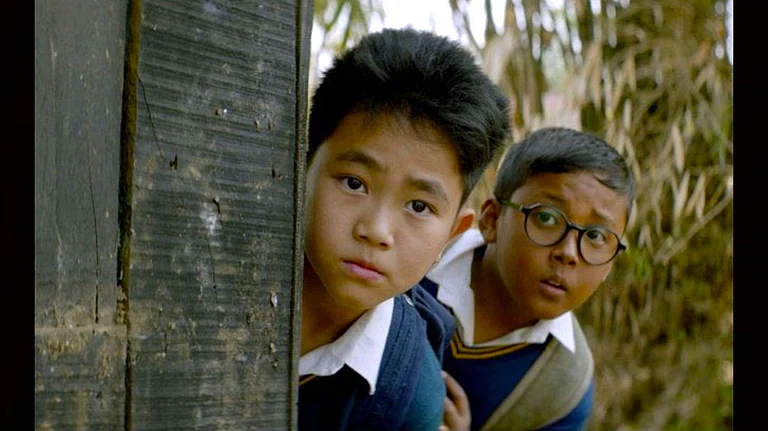
The beginnings are there, scattered in smaller films and modest series that try to linger on friendship, migration, food, music, and memory. They rarely travel far beyond niche audiences, but they sketch a different horizon—one where a character from Kohima or Imphal is allowed to be ordinary, to sulk, to fall in love, to fail at work, without carrying the burden of representing an entire conflict each time she walks into a scene.

For mainstream OTT, the real test is less about bravery than about imagination. Can it picture Nagaland, Manipur, Mizoram or Meghalaya in ways that are not immediately legible as threat or tragedy? Can it hold insurgency and daily life in the same frame, without turning one into a backdrop and the other into spectacle? Can it let people from the region appear not only as sources, suspects or guides, but as narrators whose fears and desires are not already folded into someone else’s security briefing?
Those questions extend beyond any single title. Paatal Lok 2, Delhi Crime 3 and The Family Man 3 matter not because they stand out as villains, but because they mark the moment when the Northeast could no longer be kept off the streaming map. They pushed open a door that had been shut for decades. The risk now is that the door opens only into an interrogation room. For the moment, the region is firmly inside the frame, yet still under watch. The more interesting work lies ahead: to tell stories in which the Northeast is not only seen, but allowed to see back.
Published At: