The trio of Asha Bhosle, RD Burman and Gulzar has given Hindi cinema some of its most memorable songs.
The entire album of Ijaazat (1987) is widely considered to be the best work of the trio.
The RD-Gulzar partnership with Bhosle did not limit her versatility to only one mood or genre. Songs from Khushboo (1975) explore the innate playfulness and force in her voice.
The Trio That Conquered Every Emotion: Asha Bhosle, R.D. Burman And Gulzar
In her partnership with R.D. Burman and Gulzar, Asha Bhosle explored not just her reflective, pensive side, but also shades of rebellion, playfulness and sheer classical prowess.
Summary
The trio of Asha Bhosle, RD Burman and Gulzar has given Hindi cinema some of its most memorable songs that express emotions we often don’t have words for. It is impossible to not have one’s mind burst into a combination of tunes when reading these names together. Generations have relied on these songs to express the most complex sentiments and layered feelings.
Bhosle left the world quieter on April 12, 2026. Her voice liberated the Hindi film protagonists from only being the demure patriarchal devoted love interests to having many more shades to themselves—shades of desire, liberation, seduction, pleasure, joy, intoxication and much more. But what two partnerships gave her was the chance to explore her own inordinate depth. One was her partnership with Khayyam for Umrao Jaan (1981). The other was the consistent partnership with RD Burman and Gulzar. This is where she explored not just her reflective, pensive side—with immense thehraav and layers in renditions of very human emotions, that are seldom linear and singular—but also shades of rebellion, playfulness and sheer classical prowess.

Asha Bhosle, RD Burman and Gulzar X
The entire album of Ijaazat (1987) is widely considered to be the best work of the trio. In the sublimely painful “Mera Kuch Samaan”, Bhosle taps into the deep pathos of her voice, unlocking the piercing memories that heartbreak converts happy moments into. The intimacy of the moments is brought to life in the softness of her voice. “Katra Katra”, picturised on Sudha (Rekha) is a composition seeped in romance and togetherness. Her voice holds the lightness of hope at the beginning of a happy relationship. “Chhoti si kahani se” holds the same joy. But the song that goes into depths of immense sadness, loneliness and emptiness is “Khaali haath shaam aayi hai”. The use of the bansuri accentuates the sorrow laden in the track and words. Bhosle’s voice laces the words and expresses the deep heaviness that exists when tears refuse to flow to vent the grief.
Another lilting track is from Namkeen (1982), “Phir se aaiyo badra bidesi”, with bare minimum orchestration that allows for Bhosle’s voice to carry the melody over the mountains. The song and voice has the quality of an echo and is inherently hummable, tying together the picturisation, singing and tune impeccably.
Advertisement
Asha Bhosle, RD Burman and Gulzar Facebook
The RD-Gulzar partnership with Bhosle did not limit her versatility to only one mood of songs or genre. Khushboo (1975) with “Bechara dil kya kare” and “Ghar jaayegi tar jaayegi” explore the innate playfulness and force in her voice. The timbre that allows her to expand her range and infuse her voice with energy is explored in both these songs completely. The same applies for “Botal Se Ek Baat Chali Hai” from Ghar (1978). While the rest of the songs were sung by Lata Mangeshkar, the irreverence in this particular track was brought to life by the inimitable Bhosle.
Liberation and defiance were a large part of Bhosle’s singing. She legitimised female desire in her songs, even if mainstream cinema made that the vamp’s voice, given that female desire could never be acceptable within a deeply patriarchal framework without villainising/demonising the woman. However, the music was heard even when it wasn’t watched—it was sung in buses and public spaces and female desire existed. This defiance has a completely different colour in this partnership, seen in Khoobsurat (1980). With “Saare niyam tod do”, through the clash of discipline and freedom, tradition and modernity, submission and expression, it was Bhosle’s voice that became the voice of rebellion. It was heartening that the familial defiance had a single female voice as the protagonist and the unapologetic voice of Bhosle became its amplifier.
Advertisement

The same film brings alive yet another shade of playfulness with “Sun sun sun didi tere liye ek rishta aaya hai”. It is interesting to note in Gulzar’s filmography that the lyrics are not restricted to just a singular kind of relationship. This song has exemplified the nok-jhok relationship that exists between sisters. The rendition of the song is extremely playful, with Bhosle breaking into stammers when needed, immensely enjoying pulling the proverbial older sister’s leg. Many years later, the same sentiment can be heard in “Balma” from Vishal Bharadwaj’s Pataakha (2018), rendered by Rekha Bharadwaj and Sunidhi Chauhan.
Singing is as much performance as acting. And singers too embody characters they sing for—the sentiment, situation, story and expression. Bhosle’s singing is a masterclass in emoting through voice. In her career that spans over seventy years, there is not a single emotion that she has not expressed in her voice. Technique is as much for expression as for pure classical renditions, which heighten expressions with finesse that only the greatest can bring to life. “Roz roz daali daali” from Angoor (1982), holds different kinds of emotions in each line. And Bhosle renders each line with impeccable expression.
Advertisement
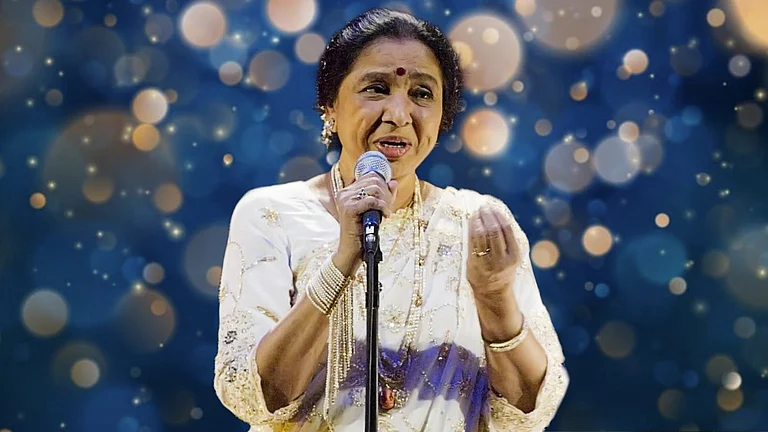
Bhosle’s repertoire is arguably the richest in Hindi film music. From qawwalis to ghazals, bhajans to cabarets, classical ragas to hummable romantic tunes, defiant rebellious tracks to seductive beauties legitimising female desire—there was not a shade she didn’t bring alive. She pushed the boundaries of Hindi film music, exhibited her inordinate range. She is often associated with joy and fun times. But it is Bhosle’s pathos and reflective renditions that pierce many a heart. And in that journey, RD Burman and Gulzar are unforgettable. All we can say is thank you for the music, now and forever.
Published At: