Directed by Nitesh Tiwari, Ramayana is out on November 5.
A slew of big-budget mythological revivals has recently swept Indian cinema.
There have been raging misfires like Adipurush and monster hits like Hanu-Man.
Sacred Epics, Mega Budgets : The High-Stakes Gamble For Indian Mythological Cinema
Out on November 5, Ranbir Kapoor-starrer Ramayana arrives on the back on a mythological resurgence in Indian cinema

Summary
Over the last century, Indian mythological cinema has transmuted from a sacred, stage-bound medium into visual exhibitionism and innovative genre experimentation. In its foundational decades, films like Raja Harishchandra (1913) and Mayabazar (1957) leaned into reverent, devotional retellings that functioned as cinematic extensions of temple culture, awash in awe. Although mythological narratives briefly retreated in the late twentieth century, S.S. Rajamouli’s Baahubali saga (2015–2017) spawned a massive resurgence by blending traditional epic themes with blockbuster production values.
Today, the genre has branched off into distinct creative paths: high-budget spectacles like Brahmāstra: Part One – Shiva (2022) and Kalki 2898 AD (2024) combine Vedic lore with modern superhero and dystopian science-fiction frameworks, while grounded hits like Kantara (2022) and Hanu-Man (2024) tap more rooted registers of storytelling. Folkore is emerging as a primary component.
However, Ramanand Sagar’s Ramayan (1987–1988) remains the pinnacle. The Doordarshan Sunday morning broadcasts were not mere television, they were a collective act of worship. Families bathed, dressed in headcovers, and adorned their TV sets with flowers and incense before tuning in. They were not watching a show; they were conducting darshan, as if encountering the divine. For decades, actor Arun Govil was met in public not as a performer, but with feet-touching reverence as Rama himself. That ultimate identification never faded. it hardened into a benchmark.

Such works in India also get conflated with the deliberate mounting of a superhero canvas. Increasingly, this is the case.
Nitesh Tiwari’s upcoming two-part Ramayana starring Ranbir Kapoor represents the ultimate high-stakes gamble in this ongoing evolution. It's a mega-budget effort to bridge Hollywood-grade spectacle with the strict devotional reverence demanded by Indian audiences. Functioning as a direct course-correction to the disastrous backlash of Adipurush (2023), the production aims for world-class visual effects anchored by international VFX houses (mutliple Oscar-winner DNEG) and a score by Hans Zimmer and A.R. Rahman. With a reported budget exceeding ₹800 crore, it pushes the grand-scale epic model of Baahubali and Kalki 2898 AD to its absolute tether, also testing whether modern technology can rise to the standard set by Ramanand Sagar's classic television series without sacrificing narrative solemnity. It also preens itself as the introduction of India's epic to the world.
Advertisement
Ahead of Ramayana's release on November 5, one can think back to several recent mythological movies orchestrated on scales from ginormous to modest, that met with varying degrees of success and opposition.
Mahavatar Narsimha (2025)
Perhaps the most striking success of the recent mythological wave has come from animation. Directed by Ashwin Kumar, Mahavatar Narsimha retells the story of Prahlad, whose devotion to Vishnu brings him into conflict with his powerful father, Hiranyakashipu. The story culminates in Vishnu's manifestation as Narasimha, the half-man, half-lion avatar.
Released in July 2025, the film reportedly cost around ₹40 crore and raked in approximately ₹327 crore worldwide, according to Sacnilk. Its Hindi-dubbed version attracted a particularly large audience, challenging the assumption that Indian animated films are primarily intended for children or have limited theatrical appeal. Its commercial success received considerable attention, particularly because it came without the conventional advantage of a major star cast. Mahavatar Narsimha ranks among the five blockbusters of 2025 in Hindi, with it making eight times its investment. Despite no mainstream star power or promotional juggernaut, it held its own against Son of Sardaar 2 and Saiyaara.
Advertisement
Presented by Hombale Films, the film is the first instalment in the planned seven-part animated Mahavatar Cinematic Universe, based on the various avatars (Incarnations) of Lord Vishnu.

Ramanand's Ramayan IMDB
Adipurush (2023)
The biggest blunder has been Om Raut’s Adipurush, an ambitious retelling of the Ramayana. Pulling off a staggering budget estimated between ₹500 crore to ₹700 crore, the film was primed to be a massive spectacle, starring Prabhas as Raghav, Kriti Sanon as Janaki, and Saif Ali Khan as Lankesh. Upon its release in June 2023, the production was met with immense backlash. Critics and audiences alike trolled the film's amateurish visual effects, pointing out that the heavily digitized environments looked more like low-tier video games than an epic cinematic universe. The dialogues were slammed, which many viewers felt was overly colloquial, crude, and disrespectful to the solemnity of the source material.
Despite an explosive opening weekend driven by pre-release hype and star power, Adipurush slumped into an unprecedented box-office crash due to virulently negative word-of-mouth. It wrapped its theatrical run with an estimated worldwide gross of around ₹390 crore to ₹400 crore, failing to recover its massive production costs and emerging a pure debacle. Ostensibly made to please Hindu nationalist fervour, an unexpected blow came when its target audience turned on it. The Hindu Mahasabha, a right-wing group, filed a police complaint over the film's "wrong" costumes, illustrations and choice of words. The controversy underlined that Indian epics cannot be meddled in too much otherwise backlash is instantly guaranteed.
Advertisement
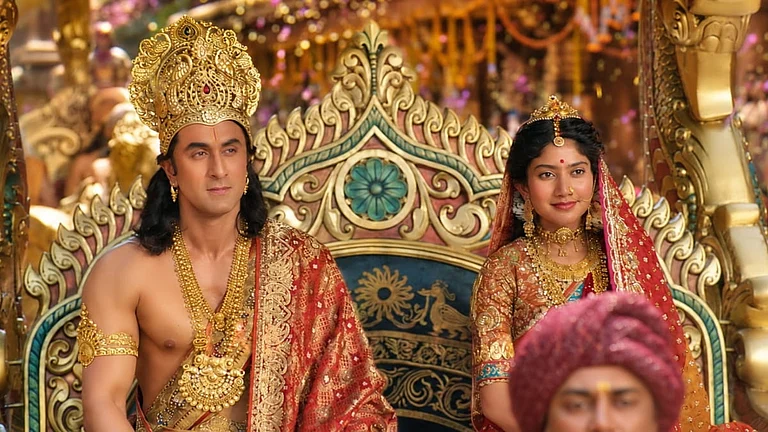
Hanu-Man (2024)
Directed by Prasanth Varma and starring Teja Sajja, the film follows an ordinary young man who acquires extraordinary abilities connected to Lord Hanuman. Its approach is less about recreating an ancient epic than about imagining how divine power might enter a contemporary superhero story. Released on 12 January 2024 during the Sankranti festival period, it hinges on our rooting for the underdog, Hanumanthu.
Made on a reported budget of around ₹40 crore, the film grossed approximately ₹295 crore worldwide, according to Sacnilk figures cited by Mint. Its success was especially significant because it demonstrated that a film without a superstar-led cast or a gigantic budget could compete in a market increasingly attracted to cinematic spectacle. Allusions to the Ramayana are capitalised for applause, like Hanumanthu sitting on a pile of beaten up thugs is equated to Hanuman sitting on his large tail.
Advertisement
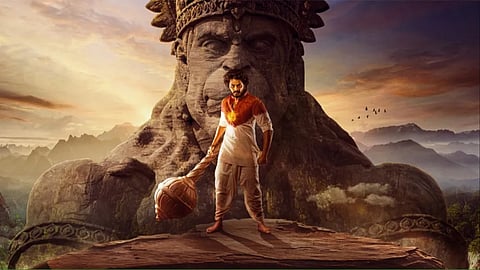
Hanu-Man Illustration
The future of the genre is predicated on a simple reality. While modern audiences look for world-class scale, technology is merely the hook. Sacred reverence, character integrity, and fidelity remain the non-negotiable price of admission.
Published At: