May 7 marks the 165th birth anniversary of Indian polymath Rabindranath Tagore.
Tagore’s poetry, music, novels, plays and philosophy became a psychological and sociological map of an emerging Indian identity during the Bengal Renaissance period.
Tagore’s work remains a mirror. The filmmakers who have succeeded in adapting him have not been afraid to look into that mirror and see their own flaws, desires and the restrictions of their contemporary zeitgeist.
Rabindranath Tagore Birth Anniversary | The Master’s Legacy In Indian Cinema
Tagore was a disruptor. On his 165th birth anniversary, as his sonar bangla awaits its final moments of consummate saffronisation, it is absolutely imperative that we remember Tagore for all he was—a man deeply troubled by the narrowness of nationalism as well as the parochial boundaries of caste, creed and country.

Summary
Rabindranath Tagore’s works constituted a vast, restless sea. A polymath, Tagore’s poetry, music, novels, plays and philosophy became a psychological and sociological map of an emerging Indian identity during the Bengal Renaissance period.
For over a century, filmmakers have attempted to navigate this sea—some finding pearls of profound humanism and others getting lost in the tide of sentimentality. To adapt Tagore is to engage with a philosophy that prioritises the internal over the external, making the transition from page to screen a precarious endeavour.
Charulata still IMDB
Ray’s Tagore
In his 1964 masterpiece Charulata, Satyajit Ray took Tagore’s 1901 novella Nastanirh (The Broken Nest) and transformed it into a visual symphony of loneliness. This was not the first time Tagore’s work had been adapted for the screen, but it definitely became the most significant one to come out of both Tagore and Ray’s oeuvre. The fact that the story was inspired by Tagore’s own relationship with his sister-in-law, Kadambari Devi, only made it that much more important in understanding the politics of both auteurs’ works.
Kadambari Devi (born Matangini Gangopadhyay) was merely nine-years-old when she arrived at the Tagore household after marrying Jyotirindranath Tagore, a decade older than her. She soon became a close confidant and companion of Rabindranath, who was two years younger than her. A chasm grew between them when he got married—he was 22 and his bride, Mrinalini Devi (Bhabatarini Roy Choudhury, so re-named after the nickname Tagore had given to his first love, Nalini, aka Annapurna Turkhad, according to some stories) was nine. Kadambari Devi took her own life soon after. But in Charulata, the ending was left on a less sour note, with an iconic freeze frame that indicated a reconciliation and the possibility of a happier future.
Teen Kanya Still IMDB
Ray captured the delicate, forbidden tension between Charulata (Madhabi Mukherjee), her brother-in-law Amal (Soumitra Chatterjee) and her husband Bhupati (Shailen Mukherjee) with terrific restraint. But above all, Charulata’s strength lied in its understanding of female interiority. Madhabi Mukherjee’s Charu was an intellectual trapped in a gilded cage and Ray’s camera captured the stagnancy of her world with a complex kind of simplicity. Ray further explored these gender dynamics—in the backdrop of the Swadeshi movement and incendiary Hindu-Muslim clashes—in Ghare Baire, the 1984 adaptation of Tagore’s 1916 novel of the same name. The ideas were just as radical for the early twentieth century as it was for the 1980s.
Advertisement
Similarly, in Teen Kanya (1961), Ray explored three distinct phases of womanhood—the child-woman in The Postmaster, the obsessed spirit in Monihara and the tomboyish bride in Samapti. These adaptations succeeded because Ray understood that Tagore’s politics was intersectional, woven into the domestic fabric, where the personal was always political.
Do Bigha Zameen Still IMDB
The Politics of the "Other"
While Ray focused on the drawing room, other directors took Tagore into the streets and the shadows. Bimal Roy’s Do Bigha Zameen (1953) is a seminal work of Indian neo-realism inspired by Tagore’s poem Dui Bigha Jomi. Roy took the core tragedy of the poem, the displacement of the farmer from his land and expanded it into an epic of urban migration. It remains a scathing critique of religious and class hierarchies that force the rural poor into the soul-crushing machinery of the city.
Tapan Sinha, another titan of the Golden Age, approached Tagore with a different lens. His Kabuliwala (1957) is perhaps one of the most empathetic cinematic treatments of the economic migrant’s experience. By humanising the Afghan moneylender, Sinha tapped into Tagore’s universalism, showing how the bond of fatherhood transcends borders and religion. Sinha also delved into the "Tagorean Gothic" with Kshudita Pashan (1960). The film captured the haunting, claustrophobic atmosphere of an ancient mansion filled with the ghosts of the past. This same story inspired Gulzar’s Lekin (1990), which, while beautiful, leaned more into the musicality of the myth than the psychological decay Sinha had highlighted.
Advertisement
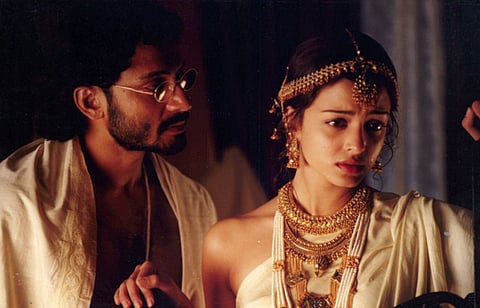
Chokher Bali Still IMDB
Ghosh, Tagore and Dismantling Gender
In the early 2000s, Rituparno Ghosh revitalised the Tagorean adaptation by focusing on the feminine gaze. In Chokher Bali (2003), Ghosh stripped away the Victorian modesty often associated with period dramas to reveal the raw, pulsating desire of the widow Binodini. Unlike earlier adaptations that might have softened Binodini’s edges, Ghosh embraced her manipulation and her eroticism, making her a modern protagonist in a 19th-century setting.
Ghosh continued this exploration with Noukadubi (2011), a story of mistaken identities and the fragility of marriage, and Chitrangada: The Crowning Wish (2012). The latter is a radical reimagining of Tagore’s dance drama. Ghosh used the myth of the warrior princess to explore gender identity and queer desire, proving that Tagore’s work was always elastic enough to accommodate contemporary discourse on the body and self-image. Ghosh’s adaptations were lush, tactile, emphasising that for Tagore’s women, the interior world was also a site of rebellion.
Advertisement
Ghosh, much like Ray, understood that Tagore’s women were never meant to be mere martyrs and muses. They were complicated, often selfish, fully realised, intelligent human beings in their own rights.
Tasher Desh Still IMDB
The Burden of the Bard
Tagore’s work remains a mirror. The filmmakers who have succeeded in adapting him are those who have not been afraid to look into that mirror and see their own flaws, their own desires and the restrictions of their contemporary zeitgeist.
In recent years, the approach to Tagore has bifurcated. On one hand, we have Anurag Basu’s series Stories by Rabindranath Tagore (2015). Basu brought a cinematic gloss and a breezy accessibility to the short stories, but some of it sacrificed complex subtext for a more palatable narrative style. On the other end of the spectrum is "Q" (Qaushiq Mukherjee). His Tasher Desh (2013) was a punk-rock, psychedelic trip in cinematic form. It was a polarising film, but it turned Tagore’s play into a critique of fascism and mindless conformity. In that regard, Q honoured the revolutionary spirit of Tagore.
Advertisement
Many more lesser adaptations of Tagore’s work have emerged over the last decade as lazy exercises in nostalgia. They have treated Tagore as a museum piece, focusing on the heavy costume jewellery, ornate Bengali diction and the predictable tropes of the bhadralok (gentleman) culture, while entirely missing the fact that Tagore was a disruptor. On his 165th birth anniversary, as his sonar bangla awaits its final moments of consummate saffronisation, it is absolutely imperative that we remember Tagore for all he was—a man deeply troubled by the narrowness of nationalism as well as the parochial boundaries of caste, creed and country.
Published At: