The Odyssey is Christopher Nolan's new film.
Matt Damon, Anne Hathaway, Tom Holland, Robert Pattinson star in this electrifying ensemble.
Nolan takes on Homer's ancient text with spirit, daring and powerfully mournful resonance.
The Odyssey Review: Christopher Nolan’s Tortured Epic Sings A Warning To Our Battered Times
After taking his time in foraging through the ashes, the Oscar winner builds up to a climax for the ages, perfectly stringing together every whisper, allusion and callback.

Summary
Christopher Nolan is one of the most ambitious filmmakers working today. His latest, The Odyssey, proves there’s little or nothing that may daunt him into buckling under pressure. Tackling a 3000-year-old text replete with fractured narratives and contested interpretations may have a more natural pull than you'd initially ascribe to a storyteller trying new terrain to explore and probe. Homer’s The Odyssey is a mighty ask. It's stretching the limits of adaptation. But Nolan takes it on invigoratingly. There’s no greater joy than witnessing a filmmaker snatching a bittersweet victory from the most bracing challenge. This film is one of the most exciting, sobering visions of recent times wherein an artist has leapt impossibly high. Just to watch him go at it with such vigour, beauty, solemn ache and tenacity is breathtaking.
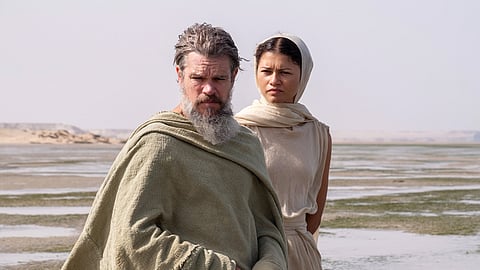
Still IMDB
The Odyssey opens with the anxious wait for the return of war hero Odysseus (Matt Damon) to his kingdom, Ithaca, his wife, Penelope (a towering Anne Hathaway), and son, Telemachus (Tom Holland). The bards sing of the Trojan War, culled from stories of men from the sea and distant lands. Many proclaim Odysseus dead, some like Penelope, Telemachus and Odysseus’ blind friend and loyal advisor, Eumaeus (John Leguizamo), desperately cling onto hopeful tidings. But it’s been years since the war ended. Menelaus (Jon Bernthal) , the king of Sparta, has returned. Time is running out in Ithaca. The kingdom can’t remain much longer without someone ascending the throne. The palace is swarming every night with dozens of suitors feasting like they are entitled to the space, none of whom attract even Penelope’s passing curiosity, who remains hidden behind a lattice screen where she weaves away, torn between bereavement and anticipation. A chronicle of Odysseus’ decade-long homecoming, the film loops back and forth in Nolan’s go-to editor Jennifer Lame’s astute cleaving. Lame keeps digging through the story’s intricate layers, a trace of a backstory here, a hint of a forgotten memory there.

In the most poignantly effective callback, Lame keeps returning to the site of the Troy’s sacking. It’s chilling and potent as a legendary warrior is forced to take stock of the horrors committed in the name of glory. As a touted hero is thrust with a moral reckoning, Telemachus’ coming-of-age has to deal with staking patriarchal honour in a noisy, restless kingdom. Holland, though, is a tad too bland despite the demands of a certain naivete. There’s little emotional variation he plumbs. Chief among the opponents is the sly, leering Antinous (Robert Pattinson, relishing every snide putdown), vying for Penelope’s hand.
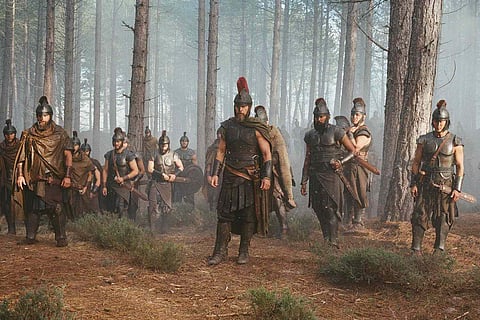
Still Universal
Not everything in the film lands, which is forgivable given the sheer scale at hand. The first half of The Odyssey may be a bit lumbering to wade through. There's a lot Nolan has to get through. Every supersized obstacle or trick comes with its own unique expectation. He trawls through the myriad, deadly monsters, the one-eyed Cyclops whose cave home Odysseus’ men encroach, Scylla, Charybdis, the Sirens, the Laestrygonian giants. The largesse of the ground to cover appears at times to weigh against a purer, unbridled storytelling impulse. Samantha Morton’s Circe is the most unsettlingly memorable rendition of all, practically seizing the film in a delicious chokehold while buttressing the real fears that drive her to extremes.
Advertisement
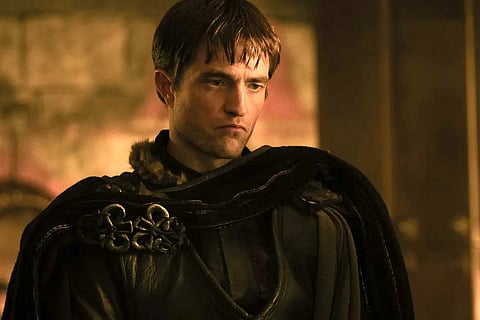
Still Universal
Once the ropes get looser, with many of the hurdles out of the way, the film springs into formidable form, almost justifying every elemental decision, a little detail tucked into its pockets. In the latter hour, The Odyssey pulls itself together, drawing it's strings towards a hugely satisfying payoff. Every cue and callback folds perfectly into a climax that's for the ages. Ludwig Göransson’s score, that otherwise segues experientially into the film’s fabric, scores a heart-thumping high in this passage that touches as much of an apogee as possible. Nolan sharpens the subtexts into precise revelation, diminishing the gulf between the ancient and the contemporary.
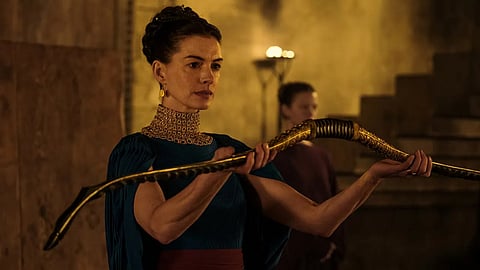
Still X
Damon inhabits the sombre, introspective heart of the saga with as much reckless daring as a deeply hollowed out sense. This is a man who must find his way to acknowledge his hubris, accept and regard the tide of death and loss he's wrought. The Odyssey charts a tussle between free will and fate. Odysseus is audacious, wildly intemperate and throwing caution to the winds, cutting a hypocritical pose. He may swear by Zeus’ law (which every other character rakes up) but is also just as prone to casting his own men overboard. Neither does he bother to honour the dead. The physical wearing down, the inner haunting are carried adroitly by Damon. Trauma and guilt inevitably well up more irrepressibly than Odysseus would have initially allowed himself to concede. He’s so blinded by defending every injustice to himself he shuts out everyone else, until the voices in his head become impossible to drown out. Does he even wish to return home?
Advertisement
DP Hoyte van Hoytema captures the landscapes, rugged physical canvas upon which this drama of mythic proportions plays out with astonishing, all-consuming force. The sea-lashing, the taking of Troy, the final clash-there’s no lack of jaw-dropping sequences.
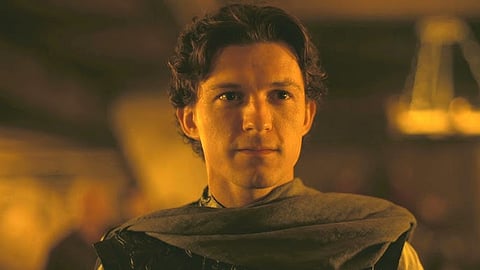
Still X
Nolan orchestrates the way to a mournful, thunderous, pulse-pounding final act, where the war is finally assessed for what it exposed in naked, ugly display. It’s one of the most powerful, contemplative, hair-raising things the filmmaker has ever done, bridging the gap between bravado and raw humanity. The Odyssey wraps up with an appeal that’s equally wary of historical cycles of tragedy repeating ad nauseam. As generations roll on, no one really learns from the ghastliest mistakes of the past. The present, the future will be consigned to eternal doom as long as the long-droning wake-up call isn’t heeded. In darting from the mistakenly rousing to the melancholic resignation of one’s most fatal misjudgement and arrogance, The Odyssey strikes a plangent warning to every civilisation staring at its fate.
Advertisement

Published At: