Raakh transforms a familiar true-crime story into a deeply emotional drama by focusing on the victims, their families and the lasting impact of the crime.
Ali Fazal delivers a restrained and compelling performance in a series that balances investigation, social commentary and human grief with remarkable confidence.
Disturbing, gripping and difficult to watch at times, Raakh never loses sight of the real tragedy at the heart of its story.
Raakh Review | Ali Fazal-Led Crime Thriller Is A Disturbing Look At Evil That Refuses To Let Its Victims Be Forgotten
More than a true-crime thriller, Raakh is a devastating portrait of loss, institutional failure and a city forever changed by one horrific night.

Summary
Some crimes become larger than the people who committed them. Nearly five decades after the Billa-Ranga murders shook the country, the details remain difficult to revisit. Two children leave home for a radio programme. They never make it there. People notice something is wrong. There are moments when intervention seems possible. Yet life around them keeps moving, unaware of the tragedy unfolding in real time.
That lingering sense of helplessness hangs over Raakh from its very first episode.
Now streaming on Prime Video, the eight- episode series revisits one of India's most horrifying criminal cases, following siblings Suman and Sahil Arora after they disappear on their way to a radio programme in Delhi. What follows is a massive manhunt, but Raakh is less interested in the mechanics of solving a crime than in the devastation left behind by it. The destination is never a mystery. Most viewers will already know how this story ends. The challenge for the makers is finding a way to make a familiar tragedy feel immediate again. Somehow, they manage exactly that.
What makes Raakh work is that it refuses to treat the case as mere true-crime entertainment. It is not interested in sensational twists or in turning its criminals into fascinating anti-heroes. Instead, the series spends its time with the people forced to live through the consequences. The victims. Their parents. The investigators. Even the perpetrators.
That decision gives the series its emotional weight. The heart of the show belongs to Mona and Ashok Arora, played by Sonali Bendre and Aamir Bashir. Bendre, in particular, is remarkable. There is an early scene where denial slowly gives way to fear, and she captures it with extraordinary restraint. The performance never reaches for melodrama. It simply sits with the unbearable possibility that something terrible may have happened.
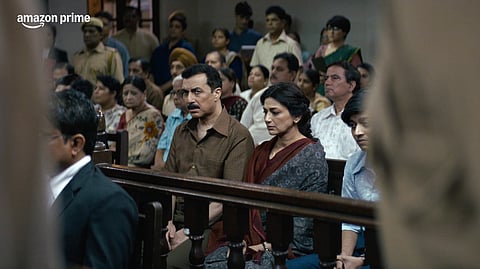
A Still of Mona and Ashok Arora YouTube

The series understands something many crime dramas overlook: grief does not arrive all at once. It arrives in phases. One moment brings hope. The next brings panic. Then comes silence. Then anger. Then hope again. Bendre navigates those emotional shifts beautifully.
Advertisement
The young actors playing Suman and Sahil are equally impressive. Because the audience already knows their fate, every moment spent with them carries an underlying sadness. Yet the series never reduces them to symbols. They feel like children. Curious, playful and full of life.
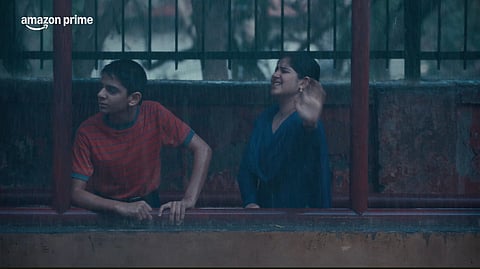
A Still Of Sahil And Suman YouTube
Raakh also deserves credit for its portrayal of journalism. The subplot involving a female journalist investigating the case provides another perspective on institutional failure. Her attempts to pursue leads are consistently met with resistance, reflecting both the profession's limitations and the gendered barriers in newsrooms and public life.
One of the most difficult parts of Raakh is watching these children fight for survival. The series repeatedly reminds viewers that they resisted. They pushed back. They did not simply surrender to their circumstances. Knowing how their story ends only makes those moments harder to watch.
Ali Fazal delivers one of his strongest performances in recent years as Inspector Jayprakash Jatav. What works about Fazal's performance is its restraint. Jayprakash is not written as a larger-than-life supercop. He is ambitious, frustrated and deeply invested in the investigation. From the beginning, there is a sense that this case means more to him than another file on his desk.
Advertisement
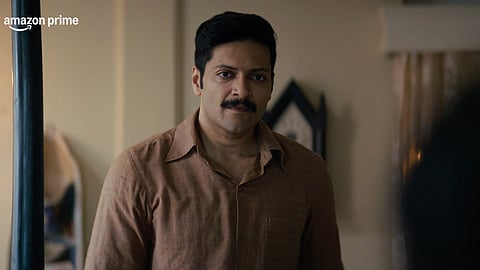
A Still Of Inspector Jayprakash Jatav YouTube
Part of that urgency comes from where he stands within the system itself.
The series subtly explores questions of caste, hierarchy and institutional power through his character. His relationship with his father, played by Rakesh Bedi, becomes one of the show's most rewarding threads. Their scenes together are warm, occasionally funny and often revealing. Beneath them sits a larger conversation about dignity, ambition and what it means to keep fighting within a system that often works against you.
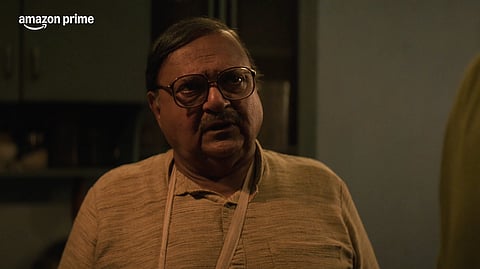
A Still of Rakesh Bedi YouTube
Raakh also deserves credit for acknowledging an uncomfortable reality. The case receives immediate attention because the missing children belong to an Army officer's family. The series never overstates its point, but it quietly raises questions about whose tragedies are given urgency and whose are allowed to disappear unnoticed.
Then there are Babu and Rajjo.
If Ali Fazal grounds the series emotionally, these two characters provide its most unsettling dimension. Their relationship is fascinating because the show never fully defines it. There is loyalty between them, but there is also fear. Dependence. Jealousy. Control. A constant struggle for dominance. Some scenes suggest affection while others suggest something far darker.
Advertisement
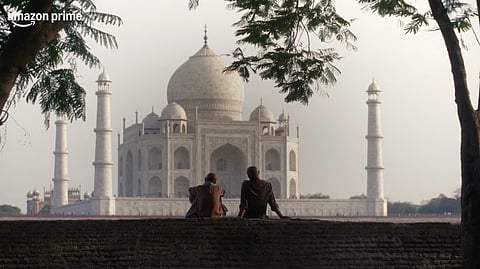
A Still of Babu and Rajjo YouTube
The ambiguity is precisely what makes them so compelling.
One of the series's most memorable sequences takes place around the Taj Mahal. On the surface, it almost feels romantic. Look a little closer, and it becomes something else entirely. What emerges is a portrait of two men desperate to escape the limitations of their own lives. Coming from poverty and social marginalisation, they crave status, respect and recognition. The tragedy is that every attempt to achieve those things becomes filtered through violence.
Raakh never asks viewers to sympathise with them. But it does try to understand how such people are created. The recreation of 1970s Delhi is another major strength. The city feels dusty, chaotic and lived-in. Police stations feel crowded. Newsrooms feel frantic. Streets feel unpredictable. There is a constant sense that danger could emerge from anywhere.
The pacing helps enormously. Across eight episodes, there is very little wasted movement. The narrative remains focused without feeling rushed.
Advertisement
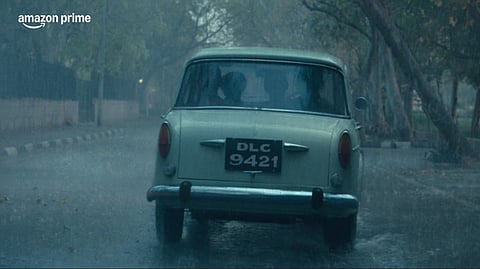
A Still From Raakh YouTube
That said, Raakh is not an easy watch.
The final episode is genuinely disturbing. Not because it relies on shock value, but because it forces viewers to confront the reality of what happened. Some scenes are graphic. Others are emotionally overwhelming. This is not the sort of crime drama that can be casually consumed in the background. And perhaps that is exactly how it should be.
The series understands that certain stories should leave viewers uncomfortable. Raakh may take dramatic liberties here and there, but it never loses sight of the tragedy at its centre. It remains gripping from beginning to end, anchored by strong performances and a clear sense of purpose.
Most importantly, it remembers the people behind the headlines. Long after the investigation ends and the criminals are caught, what remains are two children whose lives were cut short far too soon. That is the part of the story that stays with you.
Published At:
Tags