Raghubir Yadav anchors this 2026 father-son drama with a lived-in performance.
The Bhopal-set story takes an estranged family towards Varanasi.
Asha Bhosle’s final playback contribution adds rare emotional weight.
Om Ka Hari Review | A Familiar Father-Son Drama That Keeps Forgetting Its Women
Raghubir Yadav brings conviction to a familiar father-son drama that leaves its women behind.

Summary
Om Ka Hari wants to be a film about reconciliation, mortality and the things families leave unsaid. Instead, it becomes an exhausting exercise in watching an older man’s resentment occupy almost every inch of the screen. Harish Vyas sets his story in Bhopal and takes his characters to Varanasi, hoping the journey will unlock something profound between a father and his estranged son. There are emotions here. A decent film is even buried somewhere inside them. The problem is that Om Ka Hari keeps mistaking familiarity for depth.
Hari Prasad Sharma (Raghubir Yadav) believes he has only six days left to live after what he thinks is a heart attack. He decides to spend those final days in Varanasi and takes his estranged son Om (Anshuman Jha) with him. What follows is less a dramatic discovery than an extended excavation of an old family wound. Hari is resentful, stubborn, and deeply invested in the social expectations that shaped his generation. Om has his own frustrations, and the trip forces both men to confront a relationship left unattended for far too long.

A Still Of Hari YouTube
There is a familiar middle-class texture to the film, especially in its Bhopal portions. The house, the family dynamics and the everyday anxieties can occasionally recall TVF's Gullak. But where Gullak finds humour, warmth and specificity in these details, Om Ka Hari often turns them into evidence for a thesis it has already decided upon. Hari is deeply frustrating, a patriarch whose resentment and rigid worldview weigh on everyone around him.
The character is built around the familiar figure of the ageing patriarch who has spent decades confusing authority with affection. His resentment becomes everyone else’s problem. The women around him have learnt to absorb his behaviour, accommodate him and work around his emotional limitations. The film seems aware that this is a problem, but awareness is not the same as examination. Hari's behaviour is presented as something the family must navigate rather than something the film needs to seriously interrogate.
Advertisement

A Still From Om Ka Hari YouTube

That becomes particularly frustrating because the women have stories of their own.
The relationship between Om and Priya (Ayesha Kapur) could have opened up an entirely different emotional register. The film has the opportunity to explore a lesbian relationship within this middle-class family ecosystem, where reputation, social pressure and the dreaded 'log kya kahenge' mentality already play such a large role. Instead, that possibility is reduced to almost nothing. A potentially rich conflict is dispatched in a line while the emotional lives of two men continue to dominate the film.

A Still Of Om And Priya YouTube
The film’s insistence on making everything revolve around the men of the house becomes increasingly difficult to ignore.
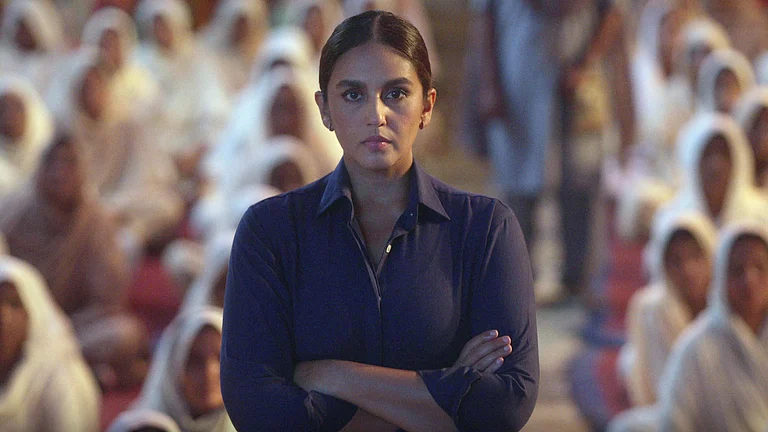
That imbalance hangs over Om Ka Hari long after the individual scenes have passed. The film adopts such a distinctly male-centric gaze that even when women are positioned close to the central conflict, their interiority feels secondary. Soni Razdan, playing Hari’s wife and Om’s mother, is given a role that carries considerable emotional expectation, yet the character and her journey never quite live up to it. The result is especially frustrating because the story already contains the ingredients for a much more interesting family drama. It could have examined how different members of the same family inherit, resist, or reproduce patriarchal expectations. Instead, the camera keeps returning to the father and son.
Advertisement

A Still From Om Ka Hari YouTube
The Varanasi portion does not help. The city is treated almost entirely as a ready-made symbol for spiritual awakening, death and redemption. The Ganga, the ghats, the pandits and the religious imagery are all familiar cinematic shorthand. There is nothing inherently wrong with using Varanasi this way, but Om Ka Hari rarely finds a fresh visual or dramatic relationship with the city.
The pandit, played as Hari's foil, is another example. The character could have challenged Hari's worldview or offered an alternative understanding of mortality and forgiveness. Instead, he often feels like the screenplay's designated wise man, arriving with precisely the sort of insight the story requires at precisely the right moment. The idea is sound. The execution is predictable.

A Still From Om Ka Hari YouTube
Yet, the performances are not what holds the film back. Raghubir Yadav knows exactly how to play Hari. He can make the character irritating without making him lifeless. There is craft in how he inhabits Hari's stubbornness, especially in the small shifts between anger, vulnerability, and self-pity. Yadav also sings a bhajan in the film, a moment that suits the actor's ability to make performance feel lived rather than merely performed. He carries the weight of scenes that the writing often leaves standing on its own.
Advertisement
Anshuman Jha has the difficult task of playing the son opposite him, but the screenplay gives Om considerably less emotional complexity than it should. The actor has the necessary presence, yet the emotional scenes do not always reach the intensity the film expects. Soni Razdan, Ayesha Kapur and the rest of the supporting cast bring experience and ability, but their characters are not given enough space to become fully realised people.

A Still Of Anshuman Jha YouTube
The film also offers a lovely piece of musical history. Asha Bhosle's contribution as the film’s final playback song gives Om Ka Hari a moment of genuine resonance. It is one of the few elements that carries an emotional history larger than the film itself.
Vijay Raaz's narration provides another interesting touch, though even that cannot disguise how often the film strains to sound profound. There is a difference between a film having something to say and a film repeatedly signalling that it does. Om Ka Hari falls into the latter trap.
Advertisement
The most irritating thing about the film is the hidden drama inside it. The ageing patriarch, the son carrying old resentment, women negotiating the consequences of that behaviour, social conformity, sexuality and the fear of judgement could have formed a sharp portrait of a family caught between two generations. Instead, the film keeps dragging everything back towards the father-son relationship.
Men have changed. Women have changed. Families have changed. The film seems stuck somewhere in between, still asking us to treat the emotional limitations of its patriarch as the central tragedy.

A Still From Om Ka Hari YouTube
There is a good film hidden somewhere within Om Ka Hari. But it struggles to come through beneath the predictable conflicts, heavy-handed symbolism and male-centred writing.
Published At: