Taapsee Pannu leads a thriller centred on a mother’s desperate search.
The film tackles child trafficking but struggles with its treatment.
Strong supporting performances cannot rescue the film’s increasingly messy storytelling.
Gandhari Review | Taapsee Pannu’s Thriller Squanders A Serious Story On Convenient Twists
A mother's search for her kidnapped daughter becomes an exhausting thriller that treats a devastating subject with far too much melodrama.

Summary
Child trafficking is not a subject that needs manufactured stakes. The horror is already there. The disappearance of a child, the systems that allow such crimes to continue and the lives permanently altered by them offer enough material for a disturbing and powerful film. Gandhari, however, takes a story with enormous potential and buries it under convenient plot turns, melodrama and increasingly unbelievable revelations.
Directed by Devashish Makhija and written by Kanika Dhillon, the Netflix thriller follows Bani (Taapsee Pannu), whose daughter Mishti disappears from a railway station while travelling to spend her summer holidays in West Bengal. Bani's desperate search soon brings her to Joypurra, a fictional town where almost everyone appears to know more than they are willing to reveal.
The premise immediately creates a sense of dread. A missing child is enough to hold an audience's attention, particularly when the story is set against the frightening reality of child trafficking in India. But Gandhari struggles with the sensitivity required to tell such a story. The film does not allow the horror of the situation to emerge through its characters and circumstances and repeatedly raises the stakes through increasingly convenient developments.

A Still Of Bani YouTube
Bani is attacked during her search and temporarily loses her eyesight. The film then introduces another layer to her journey as she begins living in Joypurra, trying to understand the town and the circumstances surrounding Mishti's disappearance. Her vision slowly begins to return, but Bani continues pretending to be blind because it gives her access to information and spaces that would otherwise remain closed to her.

A Still From Gandhari YouTube
On paper, this is an interesting idea. In execution, it becomes another example of the film bending its logic to keep its central character moving through the story. Pannu's character Bani is repeatedly placed in situations where the screenplay allows her to do almost anything necessary to advance the plot. Instead of feeling like a woman intelligently navigating danger, her progress often feels dictated by convenience.
The deeper Bani gets into Joypurra, the more the town resembles a giant puzzle in which everyone is hiding something. There are missing girls, stories of exploitation and an organised criminal network operating beneath the surface. Junnu Amba's (Mita Vashisht) own connection to the larger story introduces another tragedy involving a missing child, but the character and her history arrive so abruptly that the emotional weight never fully settles.
Advertisement
A Still Of Swastika Mukherjee YouTube

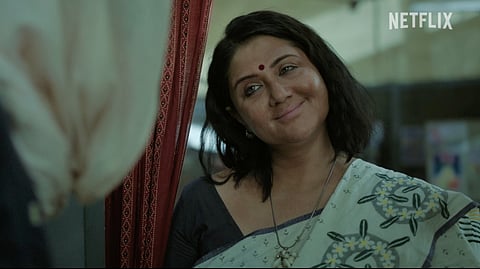
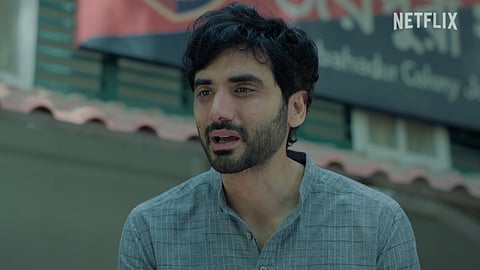
Vashisht brings presence to Junnu Amba, even when the screenplay does not give her enough room to develop. Swastika Mukherjee also adds energy to the film as an NGO worker, while Ishwak Singh is convincing as Gopal, Bani's husband. Their performances occasionally provide the film with the emotional grounding it desperately needs.
Pannu, however, is given the enormous task of carrying almost every major emotional turn. Bani's grief, rage, fear and determination are pushed to such extremes that the performance begins to feel tiring. The problem is not that the character expresses too much emotion. A mother searching for her kidnapped daughter should be allowed to fall apart. The problem is that Gandhari repeatedly confuses emotional intensity with volume.
Bani's relationship with her husband, Gopal, is also frustratingly handled. Gopal is not portrayed as a stereotypical neglectful husband, and that should have allowed the film to build a more complicated marriage. Yet the story repeatedly creates conflict around Bani's decisions without developing the emotional logic behind them strongly enough. The film seems eager to distribute blame and suspicion, but it does not always elicit the reactions it expects from its characters.
Advertisement
A Still Of Gopal YouTube
Joypurra itself becomes one of the film's strangest problems. Bengal and Bengali culture are used to create atmosphere, but the treatment often feels superficial and occasionally uncomfortable. The Bengali pronunciation is noticeably inconsistent and the region is presented through an overwhelmingly grim lens. Darkness, criminality and corruption begin to define the place so completely that Joypurra becomes a convenient setting for misery.

A Still From Gandhari YouTube
This is particularly disappointing because the film is clearly interested in issues of class and poverty. It shows how financial desperation can make vulnerable people easier to exploit and how criminal networks thrive in spaces where institutions fail. But these observations are repeatedly reduced to melodramatic circumstances. Poverty becomes a convenient tool for raising the emotional temperature rather than being explored with the complexity it deserves.
The trafficking storyline also suffers because the film keeps escalating instead of investigating. Each new revelation is meant to make the audience gasp, yet after a point, the twists become so bizarre that the story loses credibility. None of this is to deny the realities of trafficking or the unimaginable crimes that occur against children. The problem is the creative freedom Gandhari takes in representing the darkness and grim realities.
Advertisement

A Still From Gandhari YouTube
A serious issue can be fictionalised without becoming implausible. Here, the screenplay often chooses the most dramatic possibility. The result is a thriller that keeps asking the audience to accept another revelation, another hidden connection and another improbable development until the story begins to feel less like an investigation and more like an exercise in keeping the plot alive.
Makhija's direction occasionally creates tension, particularly in Bani's search through the unfamiliar spaces of Joypurra. There are moments where the town feels genuinely threatening and the film's atmosphere suggests the possibility of a more restrained thriller. But those moments are repeatedly interrupted by writing that refuses to trust its own subject.
The cast is not the problem here. Vashisht, Mukherjee, and Singh all seek to imbue their characters with conviction, while Pannu remains fully committed to Bani's desperation. Yet even committed performances cannot repair a screenplay that becomes increasingly messy as it goes along.
Advertisement
A Still From Gandhari YouTube
Gandhari had the scope to tell a difficult story about child trafficking, poverty and institutional failure. Instead, it turns a devastating reality into a melodramatic thriller filled with convenient plotting and unbelievable twists. The intention behind the film may be serious, but the treatment rarely feels equal to the subject.
Published At:
Tags