A Chronicle of the Lost premiered at Visions du Reel 2026.
It follows the memories of a worker at an abandoned jute mill.
The short film formally bends to articulate a voice that's both public and intimate.
A Chronicle Of The Lost Review | Hybrid Short Film Streams Through Unresolved Memories
Visions du Réel 2026 | Soumya Mukhopadhyay’s non-fiction stretches form and rhythm in trailing an imagined worker of a forsaken jute mill.

Summary
Soumya Mukhopadhyay’s arresting short film, A Chronicle of the Lost, stitches together celluloid and digital images to mark time that seems both sedate and shifting. Gesturing to a collapse, the creative non-fiction isn’t bottling a bygone moment so much as it seeks to accumulate all its runoff. The opening intertitle lays all the exposition, historically tethering the protagonist’s (Sraman Chatterjee) meandering journey. On the banks of the Hooghly river, jute mills were once a massive industrial player. But as profit wended away, the mills closed abruptly. Thousands of workers were stranded. Premiering in International Medium Length & Short Film Competition at Visions du Réel Film Festival 2026, the film opens on the river banks themselves, as dawn steals in. People bath and wash while a larger sense of decay slowly spreads. The river is where the film ultimately closes on a sighing, plaintive note.

Still Cherrpix
Threaded by a voiceover (Vijay Patidar), the film builds on a fictional jute mill worker’s imagined letters to his wife. It was few bare weeks into their marriage when the factory shut down. The screenplay isn’t cuffed to exact temporal details. Despite a seemingly subjective narration, the film simulates a wider outline. Mukhopadhyay pursues the ether of a people struck off by capitalism. There’s a bone-deep sadness scenting the unceremoniously evolving scenes. The mourned stalks each step of the character’s rambling.

There has been a long distance. She stayed back in the village while he worked in the city. As unfamiliarity seems to creep in, he asserts memories to keep alive the petering out connection. He regrets the taste of her cooking vanishing from his memory. It leads to the rude shock of wondering if he might forget how to operate the machines. Cobweb mottles the factory fallen to ruin. A Chronicle of the Lost is haunted by such erosions. Time unleashes cruel vagaries, arbitrarily snipping one of sustenance and their foundational sense of being. Cast unmoored, one grapples to find footing but remains doomed to choppy waters. The character is locked in the bygone, unable to reshape and realign themselves amidst brutal, erratic change. He recounts the 15 years he spent at the mill—noise that fell into an eternal silence. How can he move on when stifled by the past’s hold? Habit is insistent. Even now, he slips into a shirt and trousers. The futility of what was once a daily ritual is secondary to his dogged attachment.
Advertisement
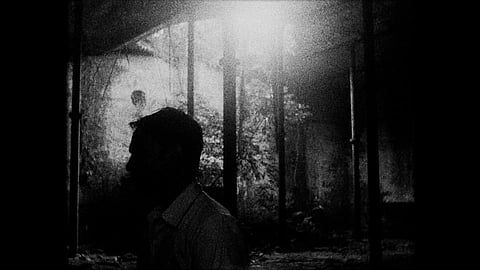
Still Cherrypix
Manas Bhattacharyya’s camerawork forms the film’s spine. The images appear like dispatches from another time, whilst simultaneously being in an odd suspension. Monochrome spills into colour. The serrations occur more loosely than tightly cleaved. We feel as if the image is giving way in these soft switches. These aren’t so much exertions as languid floating in between. Mukhopadhyay conjoins working-class despair and desolation with the big screen in an empty hall. Suddenly, the beloved’s voice finds representation, subsumed on a screen that’s the ultimate site of projection.

The past casts an imposing spectre. The worker isn’t necessarily drawn in super-specific shades. There’s a public-ness his voice represents. A single voice carries a collective anguish. He’s one of the many workers facing a crisis of identity and livelihood. He confesses trying out other work options but not being able to muster interest. Years after the factory’s closure, he still cycles past its gates, hoping against hope. He keeps circling it even as any return is impossible. A Chronicle of the Lost is a sieve of these fragile, trembling hopes. It sees the direness, the helplessness, the bid to make sense of an arbitrary fate, the teeming vulnerability. Somehow, Mukhopadhyay achieves this without being invasive. He honours the dignity of their lives. In the film, man and city fuse, fragment and coalesce again. At a delicate crossroads, we realise its spiritual enquiries settling.
Advertisement
As tangible and textured the film appears, it’s also purposefully prone to dislodging itself, making itself adrift. It’s like the film can’t contain its bearings amidst such strikes the working-class has to contend with. The ground beneath their feet keeps dissolving. They are reminded, again and again, of a systemic opposition to their upliftment. A Chronicle of the Lost takes these ideas and impressions as vapour blowing through its images. This formally adventurous film keeps mining something fresh and stirring in every aural shake-up.
Published At: